Post University's MSN PMHNP: credits, clinical hours and preceptors
Post University's online MSN in the Psychiatric Mental Health Nurse Practitioner specialization runs 51-54 credits and 630 precepted clinical hours, spread over five preceptorships at mental and behavioral health sites. Post advertises 34 months and allows 42. You choose each preceptor and site, and the Clinical Coordinator approves them.
Get your placement plan
Tell us your Post program and where you live. A placement advisor replies with the preceptor and site options that fit your course.
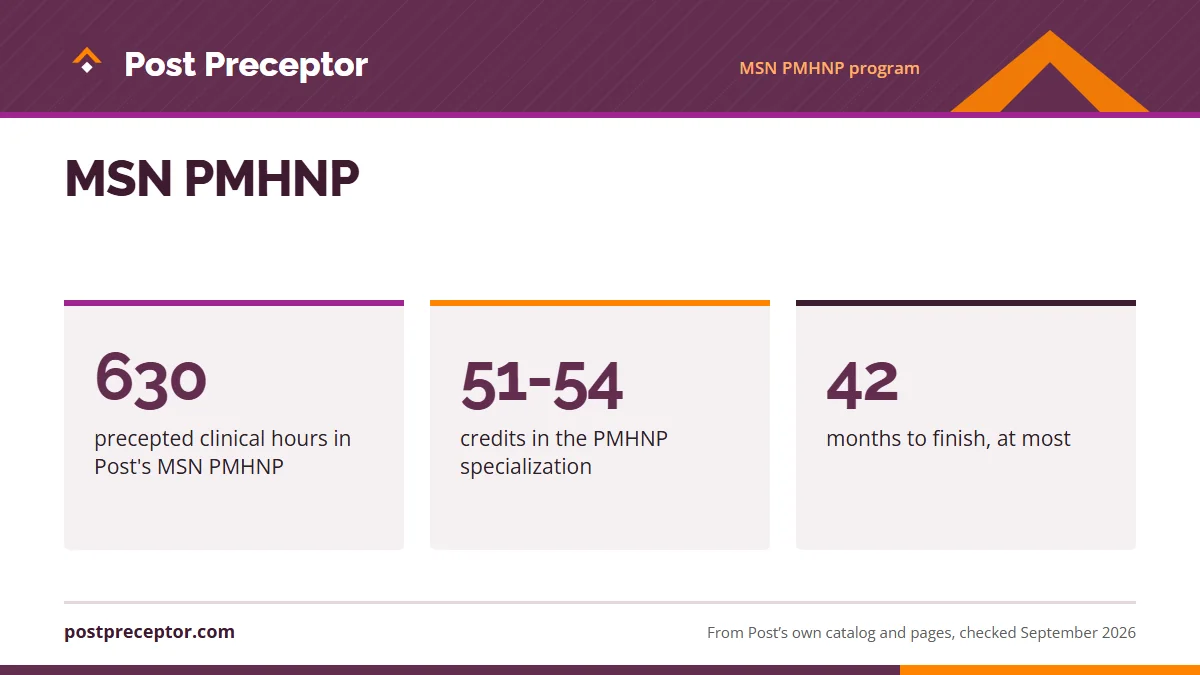
The PMHNP in numbers
The PMHNP is the longest of Post's three nurse practitioner tracks and the only one with five preceptorships rather than four. Post University's American Sentinel College of Nursing & Health Sciences runs it entirely online.
| Item | Post's figure | Where Post says it |
|---|---|---|
| Credits | 51-54 | post.edu PMHNP page |
| Precepted clinical hours | 630 | 2025-26 catalog |
| Preceptorship courses | 5: N 561, N 563, N 565, N 567, N 569 | Catalog preceptor table |
| Advertised length | 34 months | post.edu PMHNP page |
| Completion limit | 42 months | 2025-26 catalog |
| Format | Online, 8-week terms, one course at a time | post.edu MSN page; catalog |
| Accreditation | MSN accredited by CCNE | post.edu |
Those credits come straight from the course list: six core and 3P courses and eleven specialty courses at three credits each make 51, and a student who needs N 523 Diagnostic Reasoning after a first 3P exam failure picks up three more. Post publishes only the range; the breakdown is our arithmetic.
Every catalog from 2021-22 through 2025-26 keeps the precepted requirement at 630. The 2025-26 table also puts the NP tracks' total practice hours at 585-675, while its footnote says 630-720; both ranges fold in practice-experience hours from core courses, and they differ because the practice-experience hours once attached to N 522PE ended in August 2024. For preceptor planning, 630 is the figure that matters.
Getting in: admission and the 3P gate
Post's nursing admissions page looks for a prior nursing degree (BSN or MSN) earned with at least a 3.0 GPA, a current RN license, and twelve months or more of full-time clinical nursing as an RN inside the past three years. Where you live counts as well: your home and your unencumbered RN license both have to be in a state Post has approved for its NP specializations, and the driver's license or state ID you submit must show that home state.
The door to the specialization is the 3P sequence. You finish N 522PE Advanced Physical Assessment, N 512 and N 521 with a 3.0 GPA, then sit the APEA 3P exam in Week 7 of the last of those courses and need 67% or higher. Fail once and you take N 523 before retesting; a second failed score, or a failed N 523, closes the NP tracks to you, though switching to a non-NP MSN is possible. N 560, the opening PMHNP course, lists the passed exam as a prerequisite.
The PMHNP courses and their preceptorships
Past the core, the specialization has eleven courses, N 559 through N 569. N 559 Psychotropic Pharmacology stands on its own, and its 2021-22 description puts it after N 560. The remaining ten work as five pairs, each a didactic course followed a term later by its preceptorship.
| Didactic course | Preceptorship | Hours | Patients or setting in Post's sources |
|---|---|---|---|
| N 560 Advanced Practice Psych Nursing I | N 561 | 135, implied | Lifespan mental health (the PMHNP site rule) |
| N 562 Advanced Practice Psych Nursing II | N 563 | 135, implied | Child and adolescent (2024 schedule title) |
| N 564 Advanced Practice Psych Nursing III | N 565 | 135 (2021-22) | Adults and older adults; primary care and acute mental health |
| N 566 Psych Specialty for Advanced Practice | N 567 | 90 (2021-22) | Adolescents experiencing substance misuse |
| N 568 Advanced Practice Psych Nursing IV | N 569 | 135, implied | Integration |
"Implied" here means the 630 total less the 90 printed for N 567, divided evenly among the other four; Post has printed no course-level figure for N 561, N 563 or N 569. Every preceptorship has a guide of its own: N 561 for the first term, N 563 for young patients, N 565 for adults and older adults, N 567 for adolescent substance misuse and N 569 for the finish.
Where PMHNP clinicals happen, and who precepts
For clinical hours, Post's catalog points PMHNP students to settings for mental and behavioral health care, with patients drawn from every age group. Each course then favors a particular group, which is why one site seldom carries you through the program. The PMHNP clinical sites page pairs settings with courses.
Nurse practitioner preceptors must hold an unencumbered license in good standing, carry national certification matching the population they serve, have a graduate degree (master's or doctorate), and bring a year or more of practice. Physicians are welcome too, MD or DO. Post's advice is to have NPs precept two or more of your clinical courses, and ideally every one. Post also rules out anyone you report to at work, family members, and classmates in your own program.
Geography has limits as well. Clinical work can only happen in NP-approved states where your license is active, and crossing into another state for a site takes approval from the specialization first.
Who finds the preceptor
Post's 2025-26 catalog is direct about it: "Each Master of Science in Nursing student in a nurse practitioner specialization is responsible for selecting an appropriate clinical site and preceptor for each clinical experience." For a PMHNP student that adds up to five separate searches, one per preceptorship.
Post's online tuition page says the same for NP students and adds that they may contract with an outside company whose business is locating nearby clinical preceptors. That describes what we do for Post PMHNP students.
All five searches end at one checkpoint. When Week 1 of a preceptorship closes, Post expects a signed preceptor agreement letter, an executed affiliation agreement, current CastleBranch compliance, the NP Clinical Schedule, your RN license report, the preceptor's license report, certification and CV, and the student contact form; a missing piece means removal from that course term. Some state boards add a request for your clinical plan as much as 60 days before it begins.
Who can enroll: the state question
Seven states get a No for NP licensure in Post's current NP disclosure: Kansas, Louisiana and Tennessee; Arizona, Oregon and Washington; and New York. A footnote explains that Post recruits and enrolls NP students only where its coursework meets the educational requirements for licensure. The other states read Yes across all three NP tracks, apart from one PMHNP gap.
For California, the program cell names the FNP and AGPCNP and leaves the PMHNP off. Maryland and Utah went the other way: the 2023 version limited them to the FNP and AGPCNP, and the current one adds the PMHNP. Post's Distance Learning State Approvals page reads more broadly, saying online programs are open to students in every state, so where the two differ, lean on the NP disclosure and check with admissions. The state table is on Post's NP disclosure by state.
Pace, starts and staying on track
NP students move through one course at a time, each lasting eight weeks, and the competency-based SIMPath format is closed to them. Post's NP pages promise monthly starts, yet the 2024 ASC schedule offered NP specialty and clinical courses in six terms a year, those beginning in odd-numbered months. Your Student Success Advisor can tell you which pattern your plan follows, and that decides when each preceptorship begins.
Anything under a B (83%) in a nursing course, B- included, is a failing grade. Any one NP course may be retaken a single time; once the 3P exam is behind you, the retake allowance shrinks to one NP-specific course for the rest of the program, and N 523 has none. Retaking a preceptorship means logging its clinical hours again.
No campus visit is part of the program. What NP courses do require is attendance at scheduled live online sessions, from exams and presentations to the final graduation meeting, and Post warns that skipping them may cost you the course or your place in the program. The 34 advertised months assume steady progress; 42 months is the ceiling.
Why PMHNP students plan all five preceptorships with us
Five preceptorships, each leaning toward different patients, is a heavy load to manage while working as an RN and taking one course at a time. We map all five at the outset: wide-ranging psychiatric practices for N 561 and N 569, youth programs for N 563, adult and older-adult settings for N 565, and adolescent substance use care for N 567, each close to home and inside a state where your license is valid.
Every candidate is checked against Post's credential rules before you meet them. We gather the license report, certification and CV, have the agreement letter signed, and file the affiliation agreement request with weeks to spare, so each Week 1 file is complete before the term opens. During every preceptorship we remain reachable, and if a preceptor's plans change we move quickly to a replacement. Tell us where you are in the program through the contact form.
Questions Post students ask
How many clinical hours does Post's PMHNP require?
630 precepted clinical hours, per the 2025-26 catalog. You may also meet 585-675 or 630-720 as "total practice hours" for Post's NP tracks; those ranges fold in practice-experience hours from core courses and are not extra preceptor time. Both ranges sit in the same catalog table and footnote. Plan preceptor time around 630 unless your current catalog says otherwise.
How long does Post's online PMHNP take?
Post advertises 34 months, and the catalog sets 42 months as the PMHNP deadline. Since NP students carry a single course per term, a retaken course, an unresolved extension or an empty term between preceptorships all push graduation later, which is why a late preceptor lands directly on your finish date.
Can California residents enroll in Post's PMHNP?
Not as the PMHNP, going by Post's current NP disclosure: its California row lists the FNP and AGPCNP only. That disclosure is undated, and the State Approvals page words enrollment more broadly, so a California resident interested in psychiatric NP study should ask Post's admissions team before planning around it.
Is Post's PMHNP accredited?
Yes. CCNE accredits Post's MSN, which includes the PMHNP specialization. The university's institutional accreditor is NECHE, the New England Commission of Higher Education, and Connecticut's Office of Higher Education licenses Post. The DNP carries a separate ACEN accreditation, and the BSN, like the MSN, is CCNE-accredited.
Does Post place PMHNP students with preceptors?
Post's model is student-led: you locate and propose each site and preceptor, and the Clinical Coordinator reviews and approves them. The catalog suggests the student tracking system directory as a first place to look, and Post's tuition page acknowledges that some students hire a preceptor-finding company to do the search.
Related pages
Last checked 2026-09-27
We check these pages against Post University's own catalog, program pages and published nursing documents. Your course faculty and the Clinical Coordinator have the final word.
- Post University: MSN Psychiatric Mental Health Nurse Practitioner
- Post University 2025-26 catalog: Additional Nursing Information
- Post University 2025-26 catalog: Academic Policies and Procedures
- Post University: Online nursing admissions requirements
- Post University: Nurse Practitioner Disclosure by State
Post asks you to select your own preceptor. We make the search the easy part.
Tell us your Post track, your city and your next preceptorship course. We line up preceptors who fit the course, collect the license report, certification and CV the Clinical Coordinator reviews, and start the affiliation agreement early so your Week 1 packet is complete before the term opens.
- Preceptors matched to the course: primary care for FNP and AGPCNP, mental and behavioral health for PMHNP, doctoral nurse leaders for DNP hours
- Preceptor agreement letter, license report, certification and CV ready for Post's approval
- Every preceptorship planned together, close to home in a state where you hold your license and Post's disclosure says yes
Start your placement plan
Track, city and next preceptorship course is all we need to begin.