What shapes the cost of your placement
Every Post Preceptor quote is written for one student's plan, so the cost follows the work your placement takes: your Post University track and how many preceptorship courses you want covered, how narrow each course's patient population is, where you live and train, and how much time is left before Week 1. Send those details and your placement advisor replies with a quote built around them.
Get your placement plan
Tell us your Post program and where you live. A placement advisor replies with the preceptor and site options that fit your course.
Five things your quote is built from
- Your track. FNP, AGPCNP, PMHNP, DNP or a non-NP MSN specialization, each with its own preceptor rules and settings.
- How many courses. One upcoming preceptorship, or every one left in your track.
- The patients each course needs. A general primary care course is a wider search than one centered on children or on adolescent substance misuse.
- Where you live. Your approved state, your license and the number of suitable practices within reach of home.
- Lead time. The weeks between your request and Week 1 of the clinical term.
The sections below show how each one changes the work, and so the quote. When you are ready, send the details through the contact page and ask for a quote.
Your track and the courses you want covered
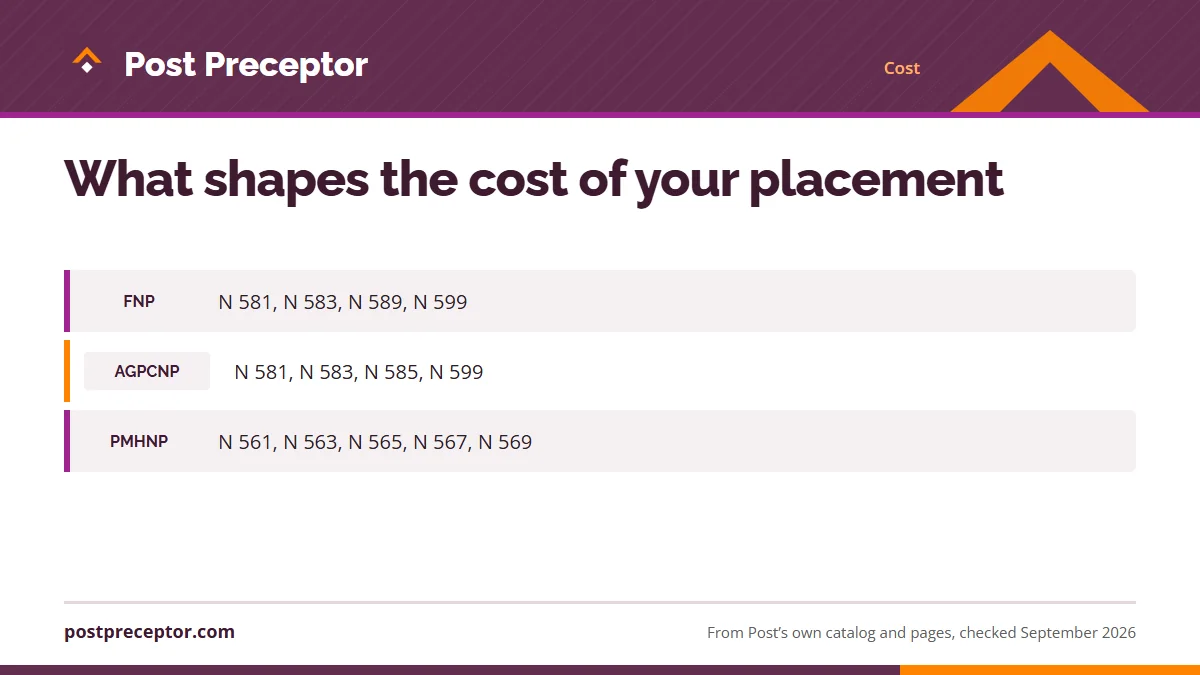
In Post's 2025-26 catalog, the FNP and AGPCNP each require 540 precepted clinical hours across four preceptorship courses, and the PMHNP requires 630 across five. You can ask us to plan a single course or the full set.
| Track | Preceptorship courses | Setting |
|---|---|---|
| FNP | N 581, N 583, N 589, N 599 | Primary care, with obstetric, gynecological and pediatric patients in N 589 |
| AGPCNP | N 581, N 583, N 585, N 599 | Primary care from adolescence to older adulthood, with aging in N 585 |
| PMHNP | N 561, N 563, N 565, N 567, N 569 | Mental and behavioral health across the lifespan |
DNP practice experiences call for a nurse preceptor with a doctoral degree, and every precepted DNP experience needs an affiliation agreement; see DNP practice hours. Non-NP MSN practice experiences use a preceptor employed at the site with a master's degree or higher. Each shapes the search in its own way.
How narrow each course's patients are
The narrower the patient group, the smaller the pool of qualified preceptors and the more searching a placement takes. Among the FNP courses, N 589 stands out: its patients are obstetric, gynecological and pediatric, from birth through adolescence, all in primary care. For the AGPCNP, N 585 centers on the care of older adults.
PMHNP courses vary the most. N 563 carries a child and adolescent focus in Post's 2024 schedule, N 565 covers adults and older adults in primary care and acute mental health settings, and N 567 works with adolescents experiencing substance misuse over 90 hours rather than 135 (per Post's 2021-22 course descriptions). A preference for an NP over a physician, which Post recommends for at least half of your clinical courses, can narrow the pool further.
Where you live and train
Post keeps NP clinicals in approved states where you hold an active RN license, and a clinical outside your home state needs prior approval. Within those limits, the number of suitable practices within a reasonable drive differs a great deal between a metro area and a rural county, and that difference shapes the search.
A few situations add steps: a California address, where Post's disclosure lists only the FNP and AGPCNP and an extra NP preceptor form applies; a plan to train across a state line; or a site inside a health system with its own student onboarding. Post's current NP disclosure marks seven states, among them New York and Tennessee, as places where it does not enroll NP students, so a move can matter too. The state guides show Post's disclosure row for where you live.
How close Week 1 is
Lead time is the factor you control most. With several months before a clinical term, the search can move practice by practice, and the agreement letter, the preceptor's documents and the affiliation agreement request all settle well ahead of Week 1. With a few weeks, the same work has to run in parallel, and fixed waits take up a larger share of the time: a state board's notice period of up to 60 days in some states, or up to seven business days for Academic Affairs to contact a new site.
If your term starts soon, say so in your request and read need a preceptor fast. The earlier you ask, the more choice you keep over where you train.
What every placement includes
Whatever the quote, the work behind it covers the whole path to a complete file for the Clinical Coordinator.
- A search in the right setting for your course, in your approved state, near home.
- Each candidate checked against Post's license, certification, degree, experience and conflict rules.
- The preceptor's license report, certification and CV collected, and the preceptor agreement letter signed.
- The affiliation agreement request started early, and your NP Clinical Schedule planned with the preceptor.
- On-call support through the term, with a replacement search if a preceptor steps away.
- Planning for your next preceptorship while the current one runs, so each term opens with a settled placement.
How it works walks through each step in order.
Costs that sit outside a placement quote
Post's tuition page states that any cost of obtaining a clinical preceptor or clinical site is the student's own responsibility. Separately, Post lists several course tools, including Typhon, Shadow Health, EHRGo and the APEA 3P exam, as provided by and payable directly to third parties, and your CastleBranch record, with its annual background check and drug screen for NP students, belongs to your program requirements. Post's own pages cover those items.
If a site asks for onboarding items of its own, such as health forms or badging, your placement advisor flags them early so nothing surprises you in Week 1. The Clinical Coordinator's approval, your compliance record and your course registration all stay exactly as Post sets them.
Questions Post students ask
Why is there no price list on this site?
Because no two Post placements take the same work. A PMHNP student who wants all five preceptorships planned in a rural county, starting in six weeks, is a different job from an FNP student who needs one primary care course with months to spare. A quote written for your plan tells you far more than a table of averages would.
Are Typhon and CastleBranch part of a placement quote?
No. Those belong to your Post program: Post names Typhon among the course tools payable directly to a third party, and CastleBranch holds the compliance record every NP student keeps current for the whole program. A placement quote covers the search, vetting, documents and agreement work for your preceptors and sites.
Can I get a quote for just my next course?
Yes. Tell us the course, the term and your location, and your placement advisor will quote that placement. If you would rather plan every remaining preceptorship together, ask for that too; seeing the full sequence at once helps protect your time limit, since Post's NP students move through their courses one at a time.
What details make a quote accurate?
Your Post track, the course number and term of your next clinical course, your home city, state and ZIP code, every state where you hold an RN license, whether you prefer an NP or a physician preceptor, and any lead you already have. The more exact the details, the more exact the quote you receive.
Does Post cover the cost of a placement service?
Post's tuition page places costs connected with obtaining a clinical preceptor or clinical site on the student. Plan for a placement alongside your other program expenses, and if an employer or another sponsor supports your studies, ask them directly whether clinical placement costs fall within that support.
Related pages
Last checked 2026-09-27
We check these pages against Post University's own catalog, program pages and published nursing documents. Your course faculty and the Clinical Coordinator have the final word.
Post asks you to select your own preceptor. We make the search the easy part.
Tell us your Post track, your city and your next preceptorship course. We line up preceptors who fit the course, collect the license report, certification and CV the Clinical Coordinator reviews, and start the affiliation agreement early so your Week 1 packet is complete before the term opens.
- Preceptors matched to the course: primary care for FNP and AGPCNP, mental and behavioral health for PMHNP, doctoral nurse leaders for DNP hours
- Preceptor agreement letter, license report, certification and CV ready for Post's approval
- Every preceptorship planned together, close to home in a state where you hold your license and Post's disclosure says yes
Start your placement plan
Track, city and next preceptorship course is all we need to begin.