Post University's MSN Family Nurse Practitioner, course by course
Post University's online MSN Family Nurse Practitioner track asks for 540 precepted clinical hours, every one of them in primary care, carried by four preceptorship courses that each take up a full 8-week term. You choose each preceptor and site, and Post's Clinical Coordinator approves them. Below is the track in order, from the 3P gate to N 599, with the point where each search should start.
Plan your FNP preceptorships
Tell us your state and your next clinical term.
The FNP track in numbers
The Family Nurse Practitioner (FNP) specialization belongs to the American Sentinel College of Nursing & Health Sciences at Post University and runs fully online. The program page advertises 28 months and 42-45 credits, and the 2025-26 catalog sets 36 months as the outer limit. The hour count lives only in the catalog: the web page promises "Individualized Precepted Clinicals" and stops there.
| Item | What Post publishes |
|---|---|
| Credits | 42-45 |
| Advertised length | 28 months |
| Time limit | 36 months |
| Precepted clinical hours | 540, all in a primary care setting |
| Preceptorship courses | N 581, N 583, N 589, N 599 |
| Format | 8-week terms, one course per term, online with required live sessions |
Counting courses explains the credit range. Six core and 3P courses plus eight FNP courses make fourteen 3-credit courses, or 42 credits, and N 523 Diagnostic Reasoning adds three more for anyone who needs it after a first 3P miss. That breakdown is our arithmetic; the catalog prints only the range.
Getting to the first preceptorship
Admission to the FNP calls for a BSN or MSN with a 3.0 GPA, an RN license, and at least one year of full-time clinical RN work within the last three years. Your home and your RN license must both be in a state that Post's NP disclosure marks Yes for the FNP, and the license must be active and unencumbered. Post's NP disclosure by state shows which states those are.
The practical entry point is the 3P gate. You complete N 512, N 521 and N 522PE, holding a 3.0 GPA across them, then score at least 67% on the APEA 3P exam during Week 7 of the last one. The 3P exam guide covers the retest path through N 523.
CastleBranch starts to matter at the same point. Past the 3P courses, NP students cannot register for NP courses or log clinical hours without a compliant account, and the account stays current for the whole program, with a fresh background check and drug screen each year.
The four FNP preceptorships
Each preceptorship follows a didactic course with the same focus, and each one fills an 8-week term by itself, because Post lets NP students take only one course per term.
| Course | Follows | Hours | Patients and setting |
|---|---|---|---|
N 581 Advanced Practice Nursing I Preceptorship Experience | N 580 | 135 | Adolescents, adults and older adults with stable, chronic and acute disease, in primary care |
N 583 Advanced Practice Nursing II Preceptorship Experience | N 582 | Not published per course; the track total implies 135 | More complex acute and chronic problems across the same ages, in primary care |
N 589 Maternal and Child Care Preceptorship Experience | N 588 | 135 | Obstetric, gynecological and pediatric patients from birth through adolescence, in primary care |
N 599 Advanced Practice Nursing Integration Preceptorship Experience | N 598 | Not published per course; the track total implies 135 | Integration; N 598 has you design an evidence-based quality-improvement project in primary care |
Two cautions go with this table. The catalog's preceptor list gives course numbers only, and tying N 583 and N 599 to the FNP rests on prerequisites (N 598 accepts either N 584 with N 585 or N 588 with N 589). The newest course descriptions anyone could read date from 2021-22, so check current wording in the catalog. Post's clinical hours page holds the program totals and the hours planner.
Maternal and child care: the search to begin earliest
Of the four courses, N 589 asks the most of a single practice. Its 135 hours cover obstetric, gynecological and pediatric patients from birth through adolescence, and like every FNP hour they must sit in primary care. A family practice whose panel is mostly adults may see only a few children a week, which can leave a term short.
The natural targets are practices with steady pediatric and well-woman volume: family medicine with a large pediatric panel, pediatric primary care, or a primary care office that handles prenatal and gynecological visits. Before you commit, ask the Clinical Coordinator whether the setting counts as primary care under Post's rule and which national certifications suit the course, since the catalog asks for certification in the population focus.
Post accepts an MD or DO as preceptor and recommends an NP for at least two of your clinical courses (50%), with all four preferred. The physician allowance can do the most good in N 589, where a pediatrician or a family physician with many young patients supplies the mix, provided the Coordinator approves and your NP-led courses still reach the recommended share. The N 589 course guide covers that course on its own.
Primary care for all 540 hours
The 2025-26 catalog leaves no room here: FNP students log every clinical hour in a primary care setting. The 2021-22 catalog only recommended it, and by 2022-23 it had become a requirement, which is why advice from older cohorts about hospital hours no longer fits.
If a site is anything other than a clear primary care practice, such as urgent care, a specialty clinic or a hospital unit, put the question to the Clinical Coordinator before any paperwork starts. A quick answer there saves you from collecting a preceptor's license report, certification and CV for a site that cannot count.
Primary care also shapes what makes a site workable in practice: steady outpatient volume across ages, a preceptor with room in the schedule for roughly two clinic days a week, and an office willing to sign Post's affiliation agreement. The primary care sites guide walks through how to vet a practice.
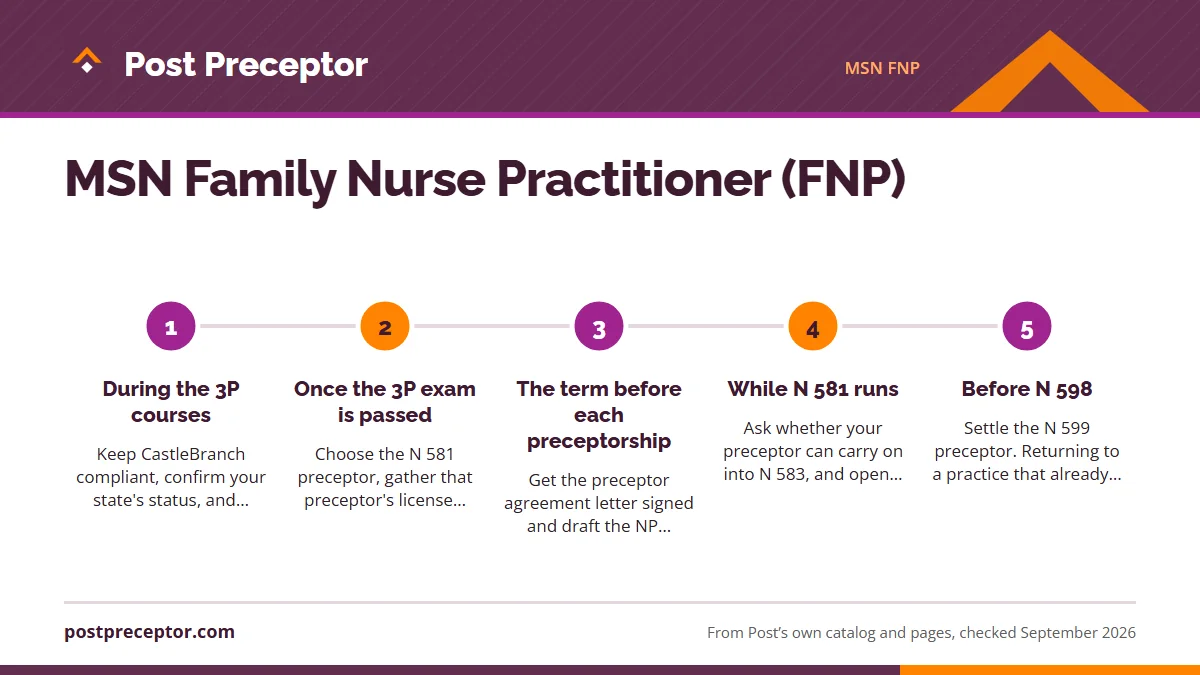
When each FNP search should start
- During the 3P coursesKeep CastleBranch compliant, confirm your state's status, and build a shortlist of primary care practices near home for
N 581. - Once the 3P exam is passedChoose the
N 581preceptor, gather that preceptor's license report, national certification and CV, and file the affiliation agreement request in Post's tracker; Post says its Academic Affairs staff reach the site's contact within seven business days. - The term before each preceptorshipGet the preceptor agreement letter signed and draft the NP Clinical Schedule, so the whole packet is complete by the end of Week 1.
- While
N 581runsAsk whether your preceptor can carry on intoN 583, and open theN 589search, the search most likely to need extra lead time. - Before
N 598Settle theN 599preceptor. Returning to a practice that already has an agreement with Post can save weeks, though Post notes an existing agreement is no promise of approval there.
Timing counts for more at Post than the calendar suggests. Post's 2024 schedule placed every NP specialty course in an odd-month term, which means a preceptorship that misses its start could sit idle for two months rather than one. The Week 1 deadline guide lists every packet item.
Why FNP students choose us for Post's preceptorships
We plan all four FNP preceptorships as one project. We search primary care practices close to home, inside your licensed and approved state, and we screen each preceptor on every point Post checks: license standing, national certification, graduate preparation and years in practice.
The preceptor's license report, certification and CV come to you from us, the preceptor agreement letter comes back signed, and the affiliation agreement request goes in early enough that your Week 1 packet is finished before the term opens. N 589 gets its own search from day one, aimed at practices with real pediatric and women's health volume, and we map the NP and physician preceptors across all four courses so the balance holds.
If a preceptor steps away partway through the track, we stay on call and find the replacement. Tell us your state and your next clinical term with the form below, or reach us through the contact page.
Questions Post students ask
Does Post University find preceptors for FNP students?
Post places the search with you. Its 2025-26 catalog makes each MSN nurse practitioner student responsible for choosing a suitable clinical site and preceptor for every clinical experience, pointing students to the tracking system's directory as a starting place, and the Clinical Coordinator then approves both. Post's online tuition page adds that students may choose to contract with a company that specializes in finding clinical preceptors, which is exactly the work we do for Post students.
Can I do FNP clinicals at the clinic where I work?
Post allows it when the practice is primary care and the preceptor meets Post's rules. The preceptor must not be the person you report to or a family member, and the clinic still needs an affiliation agreement with Post plus the Clinical Coordinator's approval. Clinicals at your workplace explains how to set it up without a conflict.
Can a physician be my preceptor in Post's FNP program?
Yes. Physicians with an MD or DO are on the catalog's list of acceptable preceptors. Post still recommends a nurse practitioner for at least half of your clinical courses (two of the four) and prefers NPs throughout. With four FNP preceptorships, that means deciding early which course, if any, uses a physician.
Is there an on-campus residency in Post's FNP program?
None appears in Post's catalog, program pages or admissions page. The FNP does include mandatory live online sessions set by each syllabus, such as exams, virtual presentations and the final graduation meeting, and missing them can lead to course failure. Your clinical hours take place near home with an approved preceptor.
Can I complete FNP clinical hours in another state?
Only in an approved NP state, and only one where your own license is active and unencumbered. Clinicals in a state other than your primary residence need prior specialization approval from Post. A compact RN license can satisfy the license item in CastleBranch, but check each clinical state with the Clinical Coordinator.
What happens if I fail an FNP preceptorship at Post?
You take the course again in full, clinical hours included. Post's graduate nursing courses need a B (83%) or better, and a B- is a fail. Any NP course gets a single repeat, and once the 3P exam is behind you, only one NP-specific course in the whole track may be retaken, so a second slip can end the program.
Related pages
Last checked 2026-09-27
We check these pages against Post University's own catalog, program pages and published nursing documents. Your course faculty and the Clinical Coordinator have the final word.
Post asks you to select your own preceptor. We make the search the easy part.
Tell us your Post track, your city and your next preceptorship course. We line up preceptors who fit the course, collect the license report, certification and CV the Clinical Coordinator reviews, and start the affiliation agreement early so your Week 1 packet is complete before the term opens.
- Preceptors matched to the course: primary care for FNP and AGPCNP, mental and behavioral health for PMHNP, doctoral nurse leaders for DNP hours
- Preceptor agreement letter, license report, certification and CV ready for Post's approval
- Every preceptorship planned together, close to home in a state where you hold your license and Post's disclosure says yes
Start your placement plan
Track, city and next preceptorship course is all we need to begin.