Three ways to secure a preceptor for Post clinicals
Post University's nurse practitioner model gives the student the choice of clinical site and preceptor, and the Clinical Coordinator approves both. You can meet that responsibility three ways: search on your own, work through your network and employer, or hand the search to a placement company, a route Post's own tuition page describes. The routes can also be mixed across your four or five preceptorships.
Get your placement plan
Tell us your Post program and where you live. A placement advisor replies with the preceptor and site options that fit your course.
Every route ends at the same desk
Whichever route you take, approval is identical. The Clinical Coordinator reviews every preceptor and site, the same credential and conflict rules apply, and the same packet is due before Week 1 of every clinical course closes. The routes differ only in who does the searching, vetting and paperwork before the file reaches the Coordinator.
That makes the decision practical rather than philosophical. The real questions are how much lead time you have, who you already know, and how much of the preparation you want to carry alongside a nursing job and an 8-week course. Because each preceptorship is its own placement, you can also switch routes from one course to the next without changing anything on Post's side.
The three routes side by side
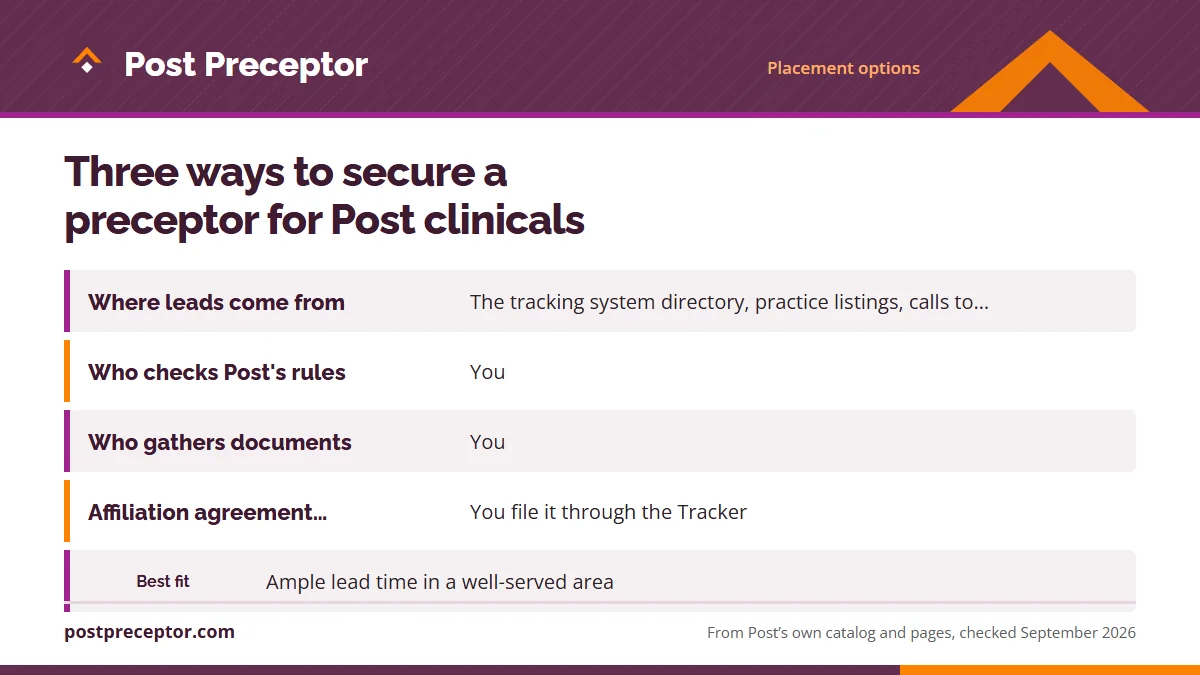
| Your own search | Your network and employer | Post Preceptor | |
|---|---|---|---|
| Where leads come from | The tracking system directory, practice listings, calls to offices | Clinicians you have worked with; your employer's providers | A dedicated search built around your course, state and home area |
| Who checks Post's rules | You | You | Your placement advisor, before any introduction |
| Who gathers documents | You | You, with your contact's help | We collect the CV, license report and certification and get the agreement letter signed |
| Affiliation agreement request | You file it through the Tracker | You file it for the employer's site | Prepared with you and started early |
| Best fit | Ample lead time in a well-served area | Strong clinical contacts outside your reporting line | Tight timelines, narrow patient populations, or a stalled search |
| If a preceptor leaves | A fresh search of your own | Depends on who else you know | We are on call and begin a replacement search at once |
Your own search: the route Post's catalog describes
Under the catalog, choosing the clinical site and the preceptor for each clinical experience is the job of every MSN nurse practitioner student, and the catalog offers the tracking system directory as a place to begin. Running the search yourself keeps full control over where you train and builds working relationships you may carry into practice.
It works best with an early start, ideally right after you pass the APEA 3P exam, and in an area with several primary care or mental health practices to approach. Budget time for the part after a yes: confirming the preceptor's certification and degree, getting the agreement letter signed, collecting documents and requesting the affiliation agreement. Expect some declines along the way: busy practices weigh each student request against their patient load, so a short, specific ask with your course dates and weekly hours helps. The find-your-own-preceptor guide lays out the method.
Your network and your employer
Your own contacts are often the warmest leads: NPs and physicians you have worked beside, colleagues who finished NP programs, and the clinicians at your own organization. Post allows clinicals where you work as long as the preceptor is not your direct supervisor, and relatives and classmates are excluded everywhere. If your employer runs several clinics, ask about primary care or behavioral health locations outside your own department. See clinicals at your workplace.
Two cautions apply. The setting must match the course, so a hospital floor where you work nights will not satisfy the primary care rule for FNP and AGPCNP hours. And a friendly yes still has to become a complete file: the site needs a fully executed affiliation agreement, and the preceptor must meet every item on the preceptor requirements page.
A placement company, in Post's words
Post names this route itself. Its online tuition page says students "struggling to find a clinical preceptor may choose to contract with a company that specializes in finding the nearest available clinical preceptors." The same page is clear that any cost of obtaining a preceptor or site belongs to the student.
Post Preceptor is that kind of company, built entirely around Post's process. We search where your course's patients are, in a state where you hold a license and Post's disclosure reads Yes, as close to home as your area allows. Each candidate is screened against Post's rules before you meet them; we then gather the preceptor's CV, certification and license report, obtain the signature on the preceptor agreement letter, and open the affiliation agreement request weeks ahead, which leaves your Week 1 packet finished before the term starts.
The Clinical Coordinator still approves every placement; our work makes sure what reaches the Coordinator is complete the first time. How it works shows each step, and cost explains what shapes a quote.
Mixing routes across your preceptorships
You face this choice four times in the FNP or AGPCNP and five times in the PMHNP, and the best answer can change by course. A colleague's primary care practice might suit N 581 well, while N 589, with its obstetric, gynecological and pediatric patients, may call for a wider search. For PMHNP students, N 567 and its focus on adolescents experiencing substance misuse deserves early planning because its population is narrow.
Planning all of them at once, whichever routes you use, is what protects the calendar. Because Post lets an NP student carry only one course in each 8-week term, a gap in any single course pushes back every course after it. Start with the course that will be hardest to fill, not simply the one that comes first, and fit the easier placements around it.
Questions that settle the choice
Run through these before you decide. Your answers usually point clearly to one route, or to a mix.
- How many weeks remain before Week 1 of your next clinical course?
- Do you already have a named preceptor who meets every Post requirement and sits outside your reporting line?
- Does the site have, or can it sign, an affiliation agreement in time?
- Are you in an approved state, and would any clinical cross a state line?
- Does the course need a narrow population, such as pediatrics or adolescent substance misuse?
- How much time can you give the search and paperwork while your current course is running?
If most answers point to short lead time or a narrow population, send us your course and term and your placement advisor will lay out the plan.
Questions Post students ask
Does Post allow students to use a preceptor placement company?
Yes. Post's tuition page names the option directly for NP students having trouble finding a preceptor, and it assigns any related cost to the student. The approval does not change: the Clinical Coordinator reviews a preceptor and site found by a company the same way as one you found yourself, against the same rules and the same Week 1 deadline.
Can I use my employer for one course and a service for another?
Yes. Each preceptorship is its own placement with its own approval, agreement letter and Week 1 packet, so the route can differ by course. A workplace preceptor for one course and a placement service for a harder-to-fill course is a sensible split, as long as each preceptor meets Post's rules and the setting fits that course's patients.
Does a placement company speed up Clinical Coordinator approval?
The Coordinator sets the pace of approval. What a thorough placement service changes is the file that arrives: a preceptor already checked against Post's rules, the agreement letter signed, the documents collected and the affiliation agreement request underway. A complete, correct file avoids the back-and-forth that eats into the weeks before a term.
Which route is quickest when Week 1 is close?
The one that reaches a complete file soonest. A named colleague at a site that already holds an affiliation agreement can move quickly; a new site adds up to seven business days before Academic Affairs even makes contact. With neither in hand, a placement service working on your course full time is built for that situation; see need a preceptor fast.
Related pages
Last checked 2026-09-27
We check these pages against Post University's own catalog, program pages and published nursing documents. Your course faculty and the Clinical Coordinator have the final word.
Post asks you to select your own preceptor. We make the search the easy part.
Tell us your Post track, your city and your next preceptorship course. We line up preceptors who fit the course, collect the license report, certification and CV the Clinical Coordinator reviews, and start the affiliation agreement early so your Week 1 packet is complete before the term opens.
- Preceptors matched to the course: primary care for FNP and AGPCNP, mental and behavioral health for PMHNP, doctoral nurse leaders for DNP hours
- Preceptor agreement letter, license report, certification and CV ready for Post's approval
- Every preceptorship planned together, close to home in a state where you hold your license and Post's disclosure says yes
Start your placement plan
Track, city and next preceptorship course is all we need to begin.