Finding your own preceptor at Post University: what the rule means and how to search well
Post University asks each nurse practitioner student to pick both where and with whom every preceptorship happens, with approval of both resting with the Clinical Coordinator. Post's catalog suggests the tracking system directory as the first place to look. A search that works is built around the course's patients, your approved state and Post's preceptor rules before the first call is made.
Get your placement plan
Tell us your Post program and where you live. A placement advisor replies with the preceptor and site options that fit your course.
What Post's rule assigns to you
The 2025-26 catalog makes every MSN student in an NP specialization "responsible for selecting" an appropriate site and preceptor "for each clinical experience." Read closely, the sentence covers three things. You pick both the site and the person. You do it for every preceptorship, which means four separate searches for FNP and AGPCNP students and five for PMHNP students. And the pair must be appropriate, meaning they pass Post's setting, credential, conflict and state rules.
Post's online tuition page says the same thing in plainer words: NP students are required to find their own clinical preceptor, and any cost of obtaining a preceptor or a site is theirs. The catalog also puts the required documents on you, completed and in the Clinical Coordinator's hands in good time, and the Coordinator approves every site and preceptor you put forward.
The model reaches beyond the NP tracks. Non-NP MSN and DNP students who need a preceptor for a practice experience also find their own, and that person must be employed at the site; the practice experiences page covers those courses.
Post's search order: directory, contacts, then wider
Post's catalog is unusually specific about where to look, and it sets an order: "Start with the tracking system directory, then consider personal (family provider) or professional contacts (local nursing organizations), and then expand your search as needed (former NP students)." The directory step is fairly new; the 2021-22 and 2022-23 catalogs told students to begin with personal or professional contacts.
The catalog does not name the tracking system, but Typhon is the clinical tracking platform Post names elsewhere, so the directory is most likely Typhon's. Treat its entries as leads rather than openings; nobody listed has agreed to anything for your term until you ask. A 2022 opening Post advertised for an assistant NP clinical coordinator listed "management of the preceptor bank" and helping students secure preceptors among the duties. No later Post source confirms that bank, so ask the Clinical Coordinator what help exists for your area today.
The next rungs reward care. A "family provider" reads as a clinician who treats you or your family; relatives themselves stay excluded as preceptors. Local nursing organizations and former NP students know which practices take students and how they like to be asked. Alongside the search, Post supplies the approval review, the Affiliation Agreement Tracker and the NP Clinical Guidelines, which Post keeps off its public site; request the current copy from the Coordinator.
Build the target list before you call anyone
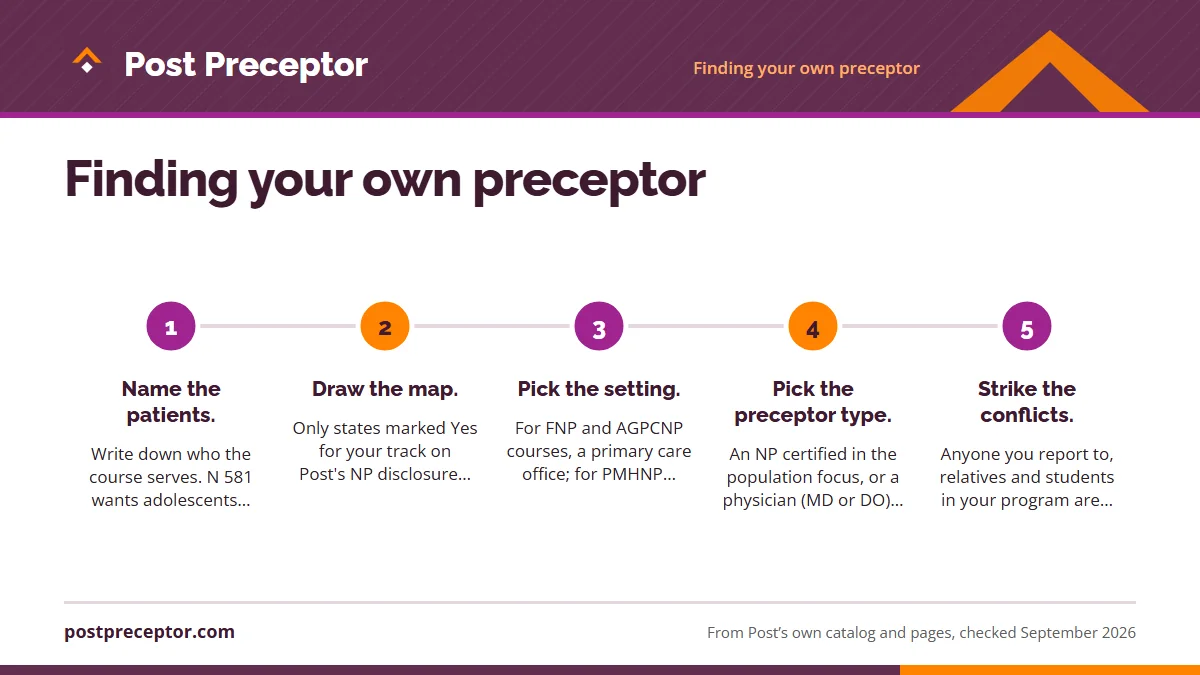
Most wasted weeks come from calling practices that could never be approved. Screen on paper first:
- Name the patients.Write down who the course serves.
N 581wants adolescents through older adults in primary care;N 589needs obstetric and gynecological care plus pediatric patients up to adolescence;N 567wants adolescents experiencing substance misuse. - Draw the map.Only states marked Yes for your track on Post's NP disclosure where your RN license is active and unencumbered. Training outside your home state requires Post's approval in advance (RN license for clinicals).
- Pick the setting.For FNP and AGPCNP courses, a primary care office; for PMHNP courses, a mental or behavioral health program. The primary care sites and PMHNP sites guides list what to ask about.
- Pick the preceptor type.An NP certified in the population focus, or a physician (MD or DO). Post wants at least two of your preceptorships led by an NP.
- Strike the conflicts.Anyone you report to, relatives and students in your program are out; see who cannot precept you.
- Note the owner.A practice owned by a health system may route students through a central office with its own forms and lead time.
Making the ask
Busy clinicians say yes to requests that are specific and easy to judge. Lead with the course code, its patient population and the term dates, then the weekly commitment: a 135-hour preceptorship in an 8-week term is close to 17 hours a week, and N 567 carries 90 hours. Say that you are a licensed RN in an online Post program run by the American Sentinel College, so the preceptor knows you arrive with nursing experience.
Then be plain about what agreeing involves. The preceptor signs Post's preceptor agreement letter and shares a license report, proof of certification and a CV; the practice will be asked for an affiliation agreement unless one already exists with Post; and the preceptor completes evaluations of you in Typhon. A one-page summary with these points, sent before a follow-up call, answers most questions in advance. The agreement letter guide describes each document so you can explain it accurately.
Keep a search log
A simple log turns a scattered search into a measured one. For each contact, record the practice, the preceptor's credentials as you verified them, the state, the date of your ask, the reply and, if it was a no, the reason. Patterns show up quickly: repeated declines over student volume suggest widening your radius, while declines over paperwork suggest a clearer summary.
When a yes arrives, verify before celebrating. Look up the license and certification yourself, confirm the preceptor's degree and years in practice, and ask whether the site already holds an affiliation agreement with Post. Then start both paperwork tracks that day: the agreement letter and documents from the preceptor, and a Tracker request for the site. The placement process overview shows how those tracks meet at the Week 1 deadline.
A verbal yes is a lead, not a placement. Until the letter is signed and the site's agreement is executed, keep your second-best option warm.
When to start, and in what order
Post publishes no search timeline, so the calendar is yours to set. Three facts push it earlier than most students expect: the full packet is due by the end of Week 1, Academic Affairs may take seven business days just to open contact with a new site, and certain boards of nursing ask for word of a student's clinical plan as early as 60 days before it starts. A search that begins during the 3P term, a full term before the first preceptorship, leaves room for all three.
Order the searches by difficulty, not by date. Narrow populations, such as the pediatric and obstetric mix in N 589 or the adolescent substance misuse focus in N 567, deserve the earliest start. Where a preceptor's patients suit more than one of your courses, ask about hosting both; it can spare you a second search.
Why Post students hand the search to us
Post's tuition page acknowledges that a student may hire a firm whose whole business is locating preceptors, and Post Preceptor does that work for Post students alone. We build the target list around your course's patients, your approved state and your home area; screen each preceptor's license, certification, degree, experience and conflicts against Post's standard; make the ask; collect the documents; secure the preceptor's signature on the agreement letter; and file the affiliation request well ahead.
You receive an introduction to a preceptor who has already said yes and a file ready for the Clinical Coordinator. We plan your remaining preceptorships at the same time and stay on call through each term. Tell us which course comes next on the contact page.
Questions Post students ask
Does Post University assign preceptors to NP students?
Post's catalog places the choice of site and preceptor with the student and the approval with the Clinical Coordinator. Post's contribution is the directory in its tracking system, recommended as a first stop, along with the review of whatever you submit and the Affiliation Agreement Tracker for contracting a new site. Ask the Coordinator how best to use the directory for your region.
Can two Post students share one preceptor in the same term?
Post's published rules do not address it; the Clinical Coordinator is the one to ask. Practically, each student in a 135-hour preceptorship must log roughly 17 hours weekly, so a shared preceptor must have the patient volume and the time for both. Post does exclude a preceptor who is a student in your own program.
Is the Typhon directory a list of preceptors who are available now?
Post describes it only as a starting point. An entry is a lead to follow up, not a commitment to take you for a particular term. Contact each lead with your course, dates and weekly hours, and verify the preceptor's credentials yourself before you submit anything.
Post's nursing college says clinicals are arranged locally. Does Post arrange them?
The American Sentinel College's FAQ says clinical rotations are typically arranged in students' local areas for convenience, which describes where clinicals happen. Post's policy on who does the arranging is in the catalog: the student chooses the site and the preceptor, and approval belongs to the Clinical Coordinator. Plan your search on that basis.
How far ahead should I start my preceptor search?
Post sets no search date, but a full term ahead is a sound minimum. The Week 1 packet, the affiliation agreement's opening seven business days and the up-to-60-day notice some boards require all consume time before the term. Courses with narrow patient groups, like N 589 and N 567, deserve an even earlier start.
Related pages
Last checked 2026-09-27
We check these pages against Post University's own catalog, program pages and published nursing documents. Your course faculty and the Clinical Coordinator have the final word.
Post asks you to select your own preceptor. We make the search the easy part.
Tell us your Post track, your city and your next preceptorship course. We line up preceptors who fit the course, collect the license report, certification and CV the Clinical Coordinator reviews, and start the affiliation agreement early so your Week 1 packet is complete before the term opens.
- Preceptors matched to the course: primary care for FNP and AGPCNP, mental and behavioral health for PMHNP, doctoral nurse leaders for DNP hours
- Preceptor agreement letter, license report, certification and CV ready for Post's approval
- Every preceptorship planned together, close to home in a state where you hold your license and Post's disclosure says yes
Start your placement plan
Track, city and next preceptorship course is all we need to begin.