Who cannot precept you at Post University, and the exception route
Post University rules out three relationships: a preceptor you report to directly at work, anyone related to you, and a student in your own program. Beyond those, anyone who misses Post's credential standard cannot be approved. Non-NP MSN and DNP students have one way around a credential gap, the Exception to Preceptor Requirements form.
Get your placement plan
Tell us your Post program and where you live. A placement advisor replies with the preceptor and site options that fit your course.
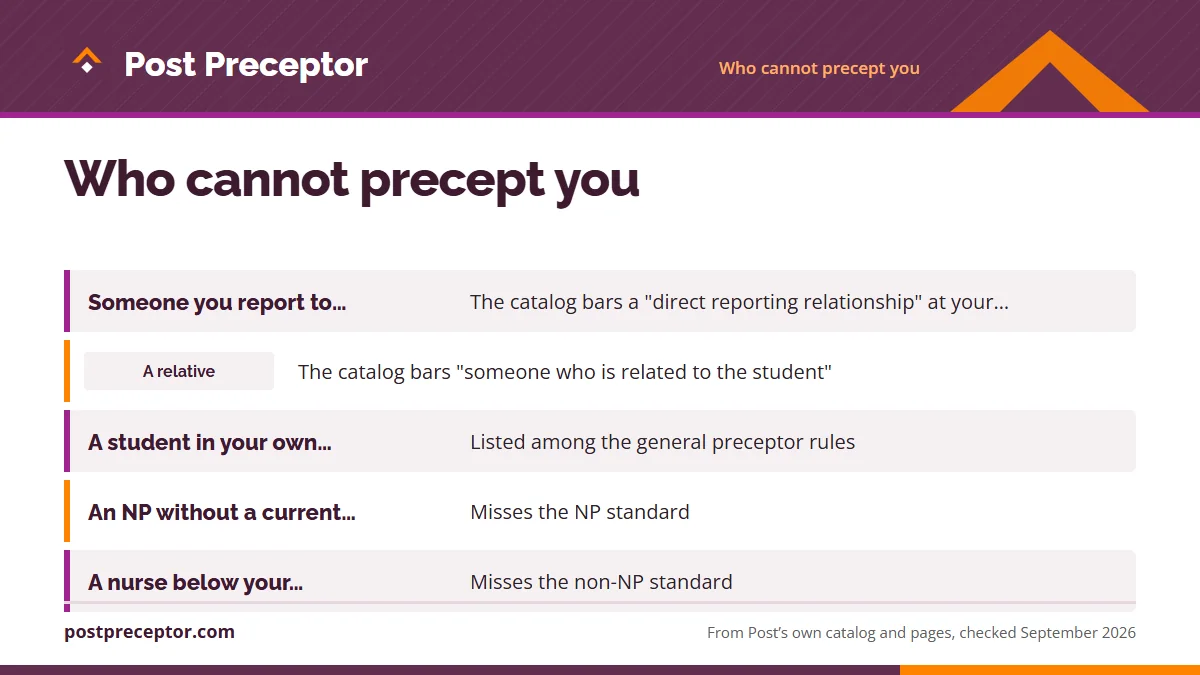
The excluded list at a glance
The Clinical Coordinator rejects a preceptor for one of two reasons: a relationship that compromises an honest evaluation, or a credential that falls short. The first group is short and fixed; the second depends on your program.
| Who | Why | Applies to |
|---|---|---|
| Someone you report to directly at work | The catalog bars a "direct reporting relationship" at your place of employment | Every program |
| A relative | The catalog bars "someone who is related to the student" | Every program |
| A student in your own program | Listed among the general preceptor rules | Every program |
| An NP without a current, unencumbered license, population certification, a graduate degree or a year of experience | Misses the NP standard | FNP, AGPCNP, PMHNP |
| A nurse below your program's degree level, or without a current RN license where they practice | Misses the non-NP standard | Non-NP MSN |
| A nurse without a doctorate, or a doctorate holder who is not a nurse | Misses the DNP standard | DNP |
Your direct supervisor
Post's wording is precise: preceptors "cannot be in a direct reporting relationship with the student at his/her place of employment." The target is the person who writes your schedule, reviews your work and signs your appraisal. That person cannot also grade your clinical performance.
The rule leaves room elsewhere in the same building. A nurse practitioner in another department, a physician whose patients you see but who does not manage you, or a colleague in a sister clinic can all be sound choices, provided the setting suits the course. The workplace clinicals page covers that route in full.
Some cases need a ruling rather than a guess. Your manager's manager is not a direct report line, but the influence is obvious. A supervisor at a second or per diem job still counts, since the rule speaks of your place of employment. A former supervisor you no longer report to is not described at all. In each case, name the relationship to the Clinical Coordinator before the agreement letter is signed.
Relatives, friends and your own clinician
Post excludes anyone "related to the student" and does not define how close the relation must be. Read it broadly: parents, siblings, spouses and partners, in-laws, cousins, aunts and uncles. A relative's practice partner is a different question, since the partner is not related to you; disclose the connection and let the Coordinator decide.
Friends are not named in Post's rules. A close friendship still sits awkwardly with an honest evaluation, so mention it when you submit the preceptor. And note one phrase in Post's own search advice: it suggests "personal (family provider)" contacts. That points to the clinicians who care for you or your household, which differs from being related to you. Being a patient of the practice is not excluded by the published rules, though some clinicians prefer to keep those roles apart.
Disclose every personal connection up front. A conflict the Coordinator discovers later can cost you the placement in the middle of a term.
Classmates, and nurses who are also students
The general rules bar a preceptor who is a student in the same program. The obvious case, a fellow Post NP student, could not qualify anyway. The less obvious case is a licensed, certified nurse practitioner who is enrolled at Post, for example an MSN-prepared NP earning a second MSN in another NP specialization, a route Post advertises. That person is a student in the MSN program even though they already practice as an NP.
Whether "same program" means the same degree or the same specialization is not spelled out. An NP enrolled in Post's DNP is in a different program from your MSN on any reading, but ask. The preceptor requirements page sets out who qualifies once the conflicts are cleared.
Clinicians who miss the credential line
For NP students, a preceptor must be a nationally certified NP or a physician. Four near misses come up often:
- An NP in the first year of practice, which falls under Post's one-year minimum.
- An NP whose certification lapsed, or whose population focus does not match the patients your course requires.
- A clinician with a board order on the license, which fails the unencumbered test even if the license is active.
- A physician assistant. Post's 2021-22 and 2022-23 catalogs said a PA could not precept NP students; the current catalogs no longer mention PAs, so any PA needs the Clinical Coordinator's answer first.
Non-NP MSN and DNP courses have their own lines: a degree at or above your program's level and a current RN license for MSN work, and a nurse with a doctoral degree for DNP work, employed at the site in both cases. A capable leader with the wrong degree is a candidate for the exception form rather than a lost cause.
The Exception to Preceptor Requirements form
Post's catalog gives non-NP MSN and DNP students a route to "petition for an alternate preceptor." You send the proposed preceptor's CV or resume with the Exception to Preceptor Requirements form, which sits under Required Documents in the course, to the practicum coordinator. It fits the case where the best expert for your project, say an informatics director or an infection preventionist, does not hold the degree or license the standard asks for.
A petition is strongest when it shows why this person is the right expert for the course's work and how the gap in the standard is covered. Post does not say whether the form can overcome a relationship conflict, so plan on it only for credential gaps. For NP students, the catalog places the form in the non-NP rules; ask the Clinical Coordinator whether any exception route exists for your course. The practice experiences page covers the courses the form serves.
Why Post students let us screen for conflicts
Post Preceptor screens every candidate for the relationship and credential problems on this page before you ever meet them. We confirm the license and certification against Post's standard, check the degree and the years in practice, and settle any reporting or family connection at the outset, so the preceptor you are introduced to is one the Clinical Coordinator can approve.
When your best lead is a borderline case, we tell you exactly why and present an alternative who clears every line. The agreement letter is then signed, the documents are collected and the affiliation request is started early. Share your track and course through the contact page.
Questions Post students ask
Can the nurse practitioner I work with every day precept me?
Yes, if you do not report to them directly and they meet Post's standard: a current, unencumbered license, national certification for your population, a graduate degree and a year or more of practice. The site still has to suit the course, such as primary care for FNP and AGPCNP hours, and needs an affiliation agreement with Post.
Can a family friend be my preceptor at Post?
Post's rules name relatives, not friends, so a friend who meets the credential standard is not excluded on paper. Tell the Clinical Coordinator about the friendship when you submit the preceptor. A friend who precepts you also completes your evaluations, and the Coordinator weighs whether that evaluation can be objective.
Can my own primary care provider precept me?
Post's published rules do not exclude a clinician who treats you, and the catalog even suggests contacts such as a family provider when you search. The usual tests still apply: credentials, setting, state and no reporting relationship. Some clinicians prefer not to mix the roles, so ask directly and disclose the connection to the Coordinator.
Can NP students use the Exception to Preceptor Requirements form?
Post's catalog describes the form in its rules for non-NP MSN and DNP preceptors, where students send it to the practicum coordinator with the proposed preceptor's CV or resume. The NP rules do not mention it. If an NP course leaves you with no qualifying preceptor, ask the Clinical Coordinator directly what options exist.
What happens if Post finds a conflict after my preceptor is approved?
Post's published rules do not describe that case, and the Clinical Coordinator would decide. The safest course is to disclose every connection before the agreement letter is signed. A preceptor who has to be replaced mid-term puts your hours at risk; see preceptor dropped out for how to recover quickly.
Related pages
Last checked 2026-09-27
We check these pages against Post University's own catalog, program pages and published nursing documents. Your course faculty and the Clinical Coordinator have the final word.
Post asks you to select your own preceptor. We make the search the easy part.
Tell us your Post track, your city and your next preceptorship course. We line up preceptors who fit the course, collect the license report, certification and CV the Clinical Coordinator reviews, and start the affiliation agreement early so your Week 1 packet is complete before the term opens.
- Preceptors matched to the course: primary care for FNP and AGPCNP, mental and behavioral health for PMHNP, doctoral nurse leaders for DNP hours
- Preceptor agreement letter, license report, certification and CV ready for Post's approval
- Every preceptorship planned together, close to home in a state where you hold your license and Post's disclosure says yes
Start your placement plan
Track, city and next preceptorship course is all we need to begin.