Post University preceptor requirements: who can precept an NP student
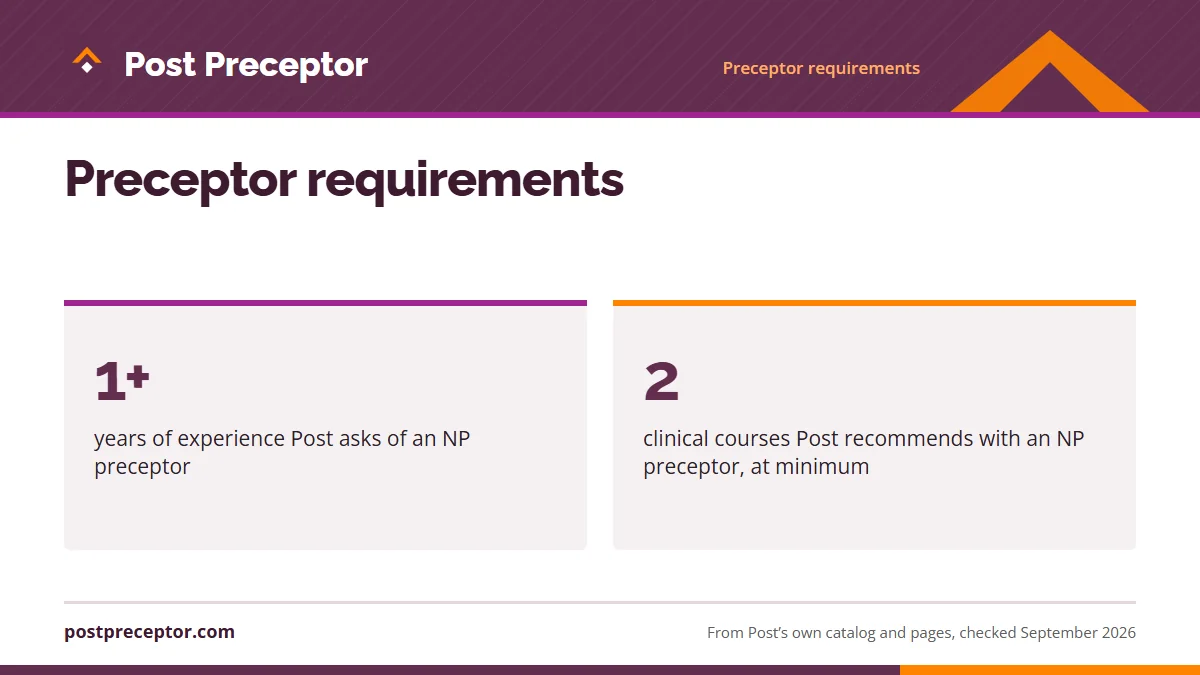
Post University's 2025-26 catalog accepts an NP preceptor who holds a current, unencumbered state license and national certification in the population focus, is prepared at the master's or doctoral level, and has at least one year of experience. A physician (MD or DO) may also precept, though Post recommends an NP for at least two of your clinical courses and prefers one for all of them.
Get your placement plan
Tell us your Post program and where you live. A placement advisor replies with the preceptor and site options that fit your course.
The standard, line by line
Post's rule for NP preceptors is compact, and each line is tested separately when the Clinical Coordinator reviews your file. The wording in the middle column is the catalog's; the right column is how that line is usually shown.
| Requirement | Post's wording | How it is shown |
|---|---|---|
| License | "current unencumbered state license" | A license report from the board's own lookup |
| Certification | National certification in the population focus | Proof from the certifying body |
| Education | APRN preceptors "must be master's or doctorally prepared" | The CV, with degrees and dates |
| Experience | "one or more years of experience" | The CV's work history |
| Preceptor type | NP preferred; at least two clinical courses with an NP recommended; MD or DO allowed | Your plan across the track |
| Relationship | Not your direct supervisor, not a relative, not a student in your program | Your own disclosure |
The documents that prove the first four lines travel with the signed agreement letter; the agreement letter guide covers gathering them. This page is about whether a clinician qualifies in the first place.
Certification: matching the population focus
National certification is where most borderline cases arise, because NP certification is issued by population. The clean matches are simple: family certification for an FNP student, adult-gerontology primary care for the AGPCNP, psychiatric-mental health for the PMHNP.
Other combinations are the Clinical Coordinator's call, and Post's published rules do not settle them. A family NP precepting an AGPCNP student in an adult primary care course covers the patients that course names. A pediatric primary care NP or a women's health NP hosting part of N 589, whose patients run from obstetric and gynecological care to children through adolescence, is less clear-cut. An adult-gerontology NP asked to supervise that same course would see few of its patients.
Whenever the certificate and your track differ, put the question to the Coordinator with the course code and a description of the practice's patients before anyone signs. A two-line answer then saves a rejected file in Week 1.
License, degree and experience
"Current" and "unencumbered" are separate tests: an active license with a board order attached fails the second. The license should be for the state where the precepting happens, which also has to be a state Post approves for your specialization and where your own RN license is active. Post's catalog does not address a preceptor licensed through a multistate arrangement, so confirm any such case with the Coordinator.
An APRN preceptor needs a master's or doctoral degree, and the CV should state it with the year it was earned. The year of experience rules out a clinician in the first months after certification, however capable. Post ties the experience to the relevant area, so what counts is time practicing as an NP in a comparable setting rather than years as an RN; if a CV leaves the dates vague, ask for them.
In Connecticut, new APRNs practice under a written collaboration with a physician for their first three years. That statute says nothing about precepting students, so a collaborating NP who meets Post's standard is not excluded by it; the Connecticut practice page explains the collaboration rules.
NP or physician: planning the balance across your track
Post allows an MD or DO to precept, recommends that at least two of your clinical courses (the catalog adds "50%") be precepted by an NP, and prefers an NP for all of them. The recommendation is easiest to meet when you plan every preceptorship at once rather than course by course.
| Track | Preceptorships | NP-led courses to plan for | Physician specialties that fit the settings |
|---|---|---|---|
| FNP | N 581, N 583, N 589, N 599 | At least two of four | Family medicine, internal medicine, pediatrics and OB-GYN in primary care |
| AGPCNP | N 581, N 583, N 585, N 599 | At least two of four | Internal medicine, family medicine, geriatrics |
| PMHNP | N 561, N 563, N 565, N 567, N 569 | Two by Post's count; ask whether the 50% applies to five courses | Psychiatry, including child and adolescent psychiatry |
The course-to-track mapping is read from Post's prerequisites. A physician often fills the hardest single gap well, such as a pediatric practice for part of N 589 or a child and adolescent psychiatrist for N 563, provided your other courses are NP-led.
Preceptors for non-NP MSN and DNP students
Post applies a different standard to precepted practice experiences outside the NP tracks. The preceptor must hold a degree at or above the level of your program, which means a master's or higher for an MSN student, and a current RN license in the state where the preceptor practices. For DNP work, the preceptor must be a nurse with a doctoral degree. In both cases the preceptor must be employed at the site, and the relationship exclusions still apply.
Where the right expert falls outside that standard, Post's "Exception to Preceptor Requirements" form lets a student petition for an alternate preceptor. The DNP also needs an affiliation agreement for every precepted experience. The DNP practice hours and practice experiences pages go course by course.
Connecticut's preceptor regulations, which ask for a BSN and two years of experience, are written for RN programs; no Connecticut rule for preceptors of NP students was found. Post's catalog is the standard that applies.
How we screen a preceptor before you meet them
Post Preceptor checks every line of Post's standard before an introduction, not after. We pull the license from the board's lookup and look for any encumbrance, confirm national certification and match it to your course's population, read the CV for the graduate degree and the dates of NP practice, and rule out the relationship conflicts. Where a case falls in a gray area, such as a certificate outside your track, we flag it so the question reaches the Clinical Coordinator early.
We also plan the NP-to-physician balance across all your preceptorships, so the recommendation is met by design. The preceptor arrives with the documents collected and the agreement letter signed. Tell us your track and next course through the contact form, or see how it works.
Questions Post students ask
Can a physician assistant precept a Post NP student?
Post's 2021-22 and 2022-23 catalogs said a physician assistant was not eligible to precept NP students. That sentence is gone from the 2024-25 and 2025-26 catalogs, which name NPs and physicians (MD or DO) and simply leave PAs out. Ask the Clinical Coordinator before approaching a PA; an NP or physician keeps your file inside the published standard.
Can a nurse practitioner with less than a year of experience be my preceptor?
Not under Post's published standard, which asks for one or more years of experience. Count from the start of practice as an NP rather than years as an RN. A newer NP in the same practice might host a later course once the year has passed, so it can be worth keeping the contact.
How many of my Post preceptors need to be nurse practitioners?
Post recommends that at least two of your clinical courses be precepted by an NP and prefers an NP for every one; physicians (MD or DO) are allowed for the rest. For the PMHNP's five preceptorships, ask the Clinical Coordinator how the catalog's two-courses-or-50% wording applies to your plan.
Who can precept a Post DNP student?
A nurse with a doctoral degree who holds a current RN license in the state where they practice, is employed at the site and is neither your direct supervisor nor a relative. Every precepted DNP experience also needs an affiliation agreement. If the best mentor for your project does not fit, ask about the Exception to Preceptor Requirements form.
Does my preceptor's certification have to match my NP track exactly?
Post requires national certification in the population focus, and a matching certificate is the safe choice. Mixed cases, such as a family NP hosting an AGPCNP student or a pediatric NP for part of N 589, are decided by the Clinical Coordinator. Ask with the course code and the practice's patient mix before your preceptor signs anything.
Related pages
Last checked 2026-09-27
We check these pages against Post University's own catalog, program pages and published nursing documents. Your course faculty and the Clinical Coordinator have the final word.
Post asks you to select your own preceptor. We make the search the easy part.
Tell us your Post track, your city and your next preceptorship course. We line up preceptors who fit the course, collect the license report, certification and CV the Clinical Coordinator reviews, and start the affiliation agreement early so your Week 1 packet is complete before the term opens.
- Preceptors matched to the course: primary care for FNP and AGPCNP, mental and behavioral health for PMHNP, doctoral nurse leaders for DNP hours
- Preceptor agreement letter, license report, certification and CV ready for Post's approval
- Every preceptorship planned together, close to home in a state where you hold your license and Post's disclosure says yes
Start your placement plan
Track, city and next preceptorship course is all we need to begin.