The Post University clinical placement process, from the 3P exam to your first clinical day
At Post University, each nurse practitioner clinical course moves through one chain of events: you choose a site and preceptor that suit the course, the preceptor and the site each sign their own paperwork, the Clinical Coordinator approves both, and your file is complete before Week 1 of the term closes. This page walks that chain in order and points you to the guide that owns each link.
Get your placement plan
Tell us your Post program and where you live. A placement advisor replies with the preceptor and site options that fit your course.
The route at a glance
Post's 2025-26 catalog spreads the rules for NP clinicals across admissions, compliance and the "Additional Nursing Information" section. Put in sequence, they form eight stages. The first two happen once; the rest repeat with every preceptorship, which means four rounds for FNP and AGPCNP students and five for PMHNP students.
| Stage | What it involves | Who moves it |
|---|---|---|
| 1. Qualify | Complete N 512, N 521 and N 522PE with a 3.0 GPA, then pass the APEA 3P exam at 67% or better | You |
| 2. Stay compliant | A CastleBranch account kept current for the whole program, with a background check and drug screen every year | You |
| 3. Choose | A site and preceptor matched to the course's patients, in an approved state where your license is active | You, or a placement service working for you |
| 4. Paper the preceptor | Signed preceptor agreement letter; the preceptor's license report, certification and CV | You and the preceptor |
| 5. Paper the site | Affiliation agreement requested through the Tracker, then fully executed | You, Academic Affairs, the site |
| 6. Approve | Review of the site and the preceptor | The Clinical Coordinator |
| 7. Close Week 1 | Every required item complete by the end of the first week of the term | You |
| 8. Train and record | Clinical hours and evaluations kept in Typhon | You and the preceptor |
Before the first search: the 3P gate and CastleBranch
No NP specialty course opens until you clear the 3P gate. The 3P set (N 512, N 521, N 522PE) needs a combined 3.0 GPA, and the APEA 3P exam is taken in Week 7 of the last of them with a passing mark of 67%. Missing the mark once means taking N 523 Diagnostic Reasoning before a second attempt. The 3P exam guide covers the rules and why that term is the right moment to begin looking for your first preceptor.
CastleBranch runs underneath everything else. Post expects NP students to keep a compliant account for the entire program, repeats the background check and drug screen annually, and blocks registration for NP courses beyond the 3P set, and the logging of clinical hours, while an account is out of compliance. A lapsed immunization or an expired CPR card can stop a placement that is otherwise finished, so the CastleBranch page is worth reading before stage three.
Choosing a site and a preceptor that Post will approve
The choice belongs to the student under Post's model, and it has to satisfy four tests at once. The setting must match your track: primary care for every FNP and AGPCNP hour, and mental and behavioral health sites with patients across the lifespan for the PMHNP. The patients must match the course, such as the birth-through-adolescence population in N 589 or the teenagers with substance misuse in N 567.
The preceptor must meet Post's credential standard and sit outside the conflicts Post excludes. And the site must be in a state that Post's NP disclosure lists as Yes for your specialization, with your own RN license there active and unencumbered; training outside your home state needs approval in advance.
Each test has its own guide: the method for searching is in finding your own preceptor, the credential list is on preceptor requirements, and the state rule is on RN license for clinicals. Checking all four before you ask anyone to sign saves a great deal of rework.
Two tracks of paperwork, started the same day
Once a preceptor says yes, two sets of documents begin, and they move at different speeds. The preceptor's side is quick when the preceptor is organized: a signature on the preceptor agreement letter, the preceptor's license report, a copy of the certification and an up-to-date CV. The agreement letter guide explains each item.
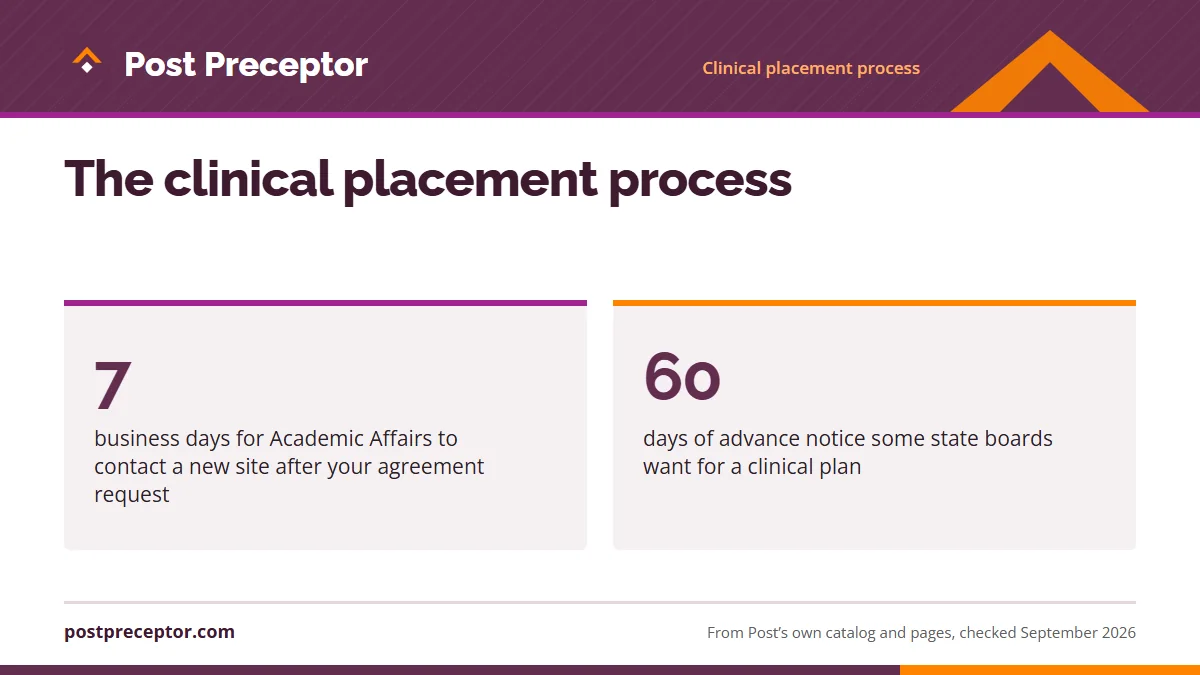
The site's side is slower because it involves three parties. You file the request in Post's Affiliation Agreement Tracker; within seven business days someone from Academic Affairs contacts the person you named at the site, and the site's own reviewers then work through the contract until it is fully executed. Post also cautions that a contract it already holds with a facility is no assurance you will be approved to train there. Hospital-owned practices can add onboarding of their own on top; one Connecticut system asks for learner health forms four weeks before the start date.
File the Tracker request the same day the preceptor agrees. The affiliation agreement page covers what the site will be asked for.
Approval, board notice and the Week 1 close
The Clinical Coordinator reviews both the site and the preceptor, reads the documents and rules on whether you can join the clinical course. You begin that review by uploading the approval forms into the student tracking system, and Post's catalog adds that enrollment in a clinical course waits until the paperwork is done. The Clinical Coordinator page sorts out which Post office handles which question.
Two clocks run beside that review. Post cautions that certain boards of nursing expect to hear about a student's clinical plan up to 60 days in advance, so in those states your site may need to be settled two months before the term. And the full packet, which adds your NP Clinical Schedule, your own RN license report and a student contact form to the agreements and preceptor documents, has to be finished when Week 1 closes, or you are removed from the course for that term. The Week 1 deadline guide walks through each item with a backward plan.
Removal in Week 1 costs more than one course: NP students carry just one course in each eight-week term, so every later course slides back with it.
Once the term is running
A 135-hour preceptorship spread over eight weeks comes to about 17 clinical hours weekly, so the schedule you agree with your preceptor has to hold from the first week. Hours and evaluations are recorded in Typhon, which Post's catalog calls the student tracking system, and Post's clinical staff help preceptors get into it and complete their evaluations. The Typhon guide covers logging.
Falling behind on hours? Post routes any extension involving clinical time to the Clinical Coordinator, and while an extension is open, an NP student is held back from the following course. Remember the course itself too: NP students must post in the online classroom in Week 1 and attend the synchronous sessions their syllabus sets. When the term ends, the chain starts again for the next preceptorship, which is why the most organized students plan all of them together.
Why Post students hand us the route
Post Preceptor is built around exactly this chain. We look for a site and preceptor suited to your course, your track's setting and your approved state, as near home as your area allows. Each candidate clears Post's credential and conflict rules before any introduction, the license report, certification and CV are gathered, and the agreement letter comes back signed. We open the affiliation agreement request early, allow for any board notice and health-system onboarding, and plan every remaining preceptorship with you so each Week 1 file is finished ahead of the term.
The Clinical Coordinator makes every approval; our job is a complete, correct file on the first submission. If a preceptor withdraws mid-program, we stay on call and begin looking for a replacement the same day. Tell us your track and your next clinical course through the contact form.
Questions Post students ask
How long does Post take to approve a clinical site and preceptor?
Post does not publish an approval time. The one clock in its published rules is the Affiliation Agreement Tracker: Academic Affairs staff contact a new site within seven business days of your request, and the site's own contract review follows. Ask the Clinical Coordinator how long reviews are running and plan backward from Week 1 with a margin.
Do I go through the whole process again for each clinical course?
Yes. Each preceptorship needs an approved site and preceptor and its own complete Week 1 file. Staying with the same preceptor and site can shorten the work, because the relationship and the contract may already be in place, but confirm the agreement is still current and that the practice's patients suit the next course.
Is it too early to look for a preceptor during the 3P courses?
No. Post's published rules tie registration for the NP specialty courses to passing the 3P exam, and they set no rule against searching earlier. Many students start during the 3P term so the first preceptorship has a full term of lead time. Keep CastleBranch compliant during that stretch, since you cannot log clinical hours without it.
Who approves a clinical site found by a placement service?
The Clinical Coordinator, exactly as for a site you found yourself. Post's tuition page acknowledges that a student may hire a company devoted to locating preceptors, and the approval standard is unchanged. A thorough service's value is a file that meets Post's rules the first time it is reviewed.
What if my affiliation agreement is still unsigned when the term starts?
The affiliation agreement is among the items due when Week 1 ends, so an unsigned contract puts you at risk of removal from the course. Tell the Clinical Coordinator at once, ask the site who is holding the contract, and see need a preceptor fast if a switch of site looks likely.
Related pages
Last checked 2026-09-27
We check these pages against Post University's own catalog, program pages and published nursing documents. Your course faculty and the Clinical Coordinator have the final word.
Post asks you to select your own preceptor. We make the search the easy part.
Tell us your Post track, your city and your next preceptorship course. We line up preceptors who fit the course, collect the license report, certification and CV the Clinical Coordinator reviews, and start the affiliation agreement early so your Week 1 packet is complete before the term opens.
- Preceptors matched to the course: primary care for FNP and AGPCNP, mental and behavioral health for PMHNP, doctoral nurse leaders for DNP hours
- Preceptor agreement letter, license report, certification and CV ready for Post's approval
- Every preceptorship planned together, close to home in a state where you hold your license and Post's disclosure says yes
Start your placement plan
Track, city and next preceptorship course is all we need to begin.