Post University's DNP: four leadership tracks and the preceptors behind them
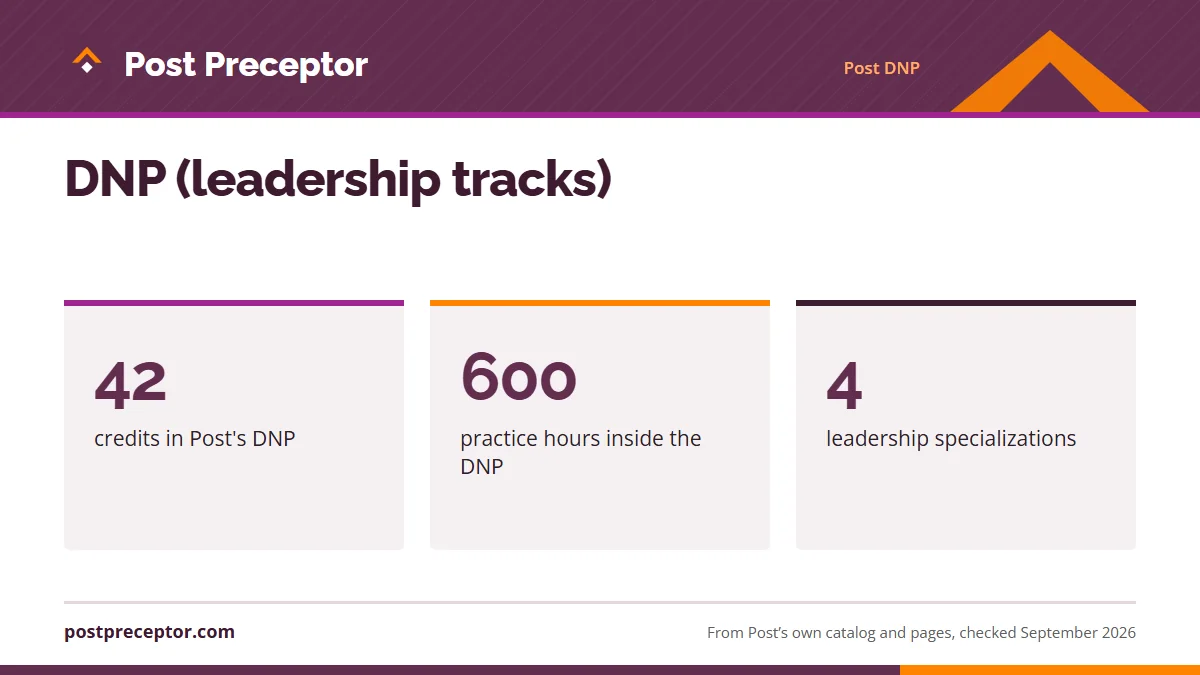
Post University's Doctor of Nursing Practice is an online leadership doctorate in four specializations: Educational, Executive, Informatics and Professional Leadership. It runs 42 credits, with 600 practice hours inside the program and no campus residency. Its precepted practice experiences call for a nurse with a doctoral degree who works at the site, and choosing that person is your task, which is exactly the part our placement desk takes on.
Plan your DNP practice hours
Tell us your track and your first precepted course.
A leadership doctorate, not a clinical one
Post's DNP prepares nurses to lead: in nursing education, in executive roles, in informatics, or across a blend of leadership fields. Post offers no BSN-to-DNP entry and no clinical or APRN doctorate, so the degree does not lead to a nurse practitioner license. If an NP role is the goal, Post's route runs through the three MSN specializations laid out in our NP tracks comparison.
Post's state approvals page groups the DNP with its other post-licensure programs, the ones not designed to lead to a license, which is why the DNP has no state-by-state disclosure table. The American Sentinel College of Nursing & Health Sciences at Post University delivers it 100% online, and it holds continuing ACEN accreditation. Post says it has graduated DNP students since 2014, a record that reaches back to American Sentinel University's online DNP; the accreditation guide has the background.
The four tracks and who each one admits
Every track asks for a current, unrestricted U.S. RN license and a master's in nursing with a GPA of 3.0 or higher. Two tracks open the door wider: Executive Leadership and Informatics Leadership also take a master's in another field, through a bridge that adds 400 practice hours.
| Track | Master's accepted | Worth knowing |
|---|---|---|
| Educational Leadership | Nursing master's | Two 2021-22 practice courses, N 702PE and N 714PE, carry its education focus |
| Executive Leadership | Nursing master's, or another master's through the bridge | The bridge adds 400 practice hours |
| Informatics Leadership | Nursing master's, or another master's through the bridge | One year of full-time informatics nursing work in the last five years |
| Professional Leadership | Nursing master's | You choose 7 courses across 5 competencies |
Professional Leadership's five competencies are leadership, business intelligence, finance, health policy and health services research. Admissions also asks every DNP applicant to show access to a suitable site for practice experiences and the DNP project; an applicant who is not currently employed verifies access to a healthcare facility. In other words, the site question starts before your first course, not after it.
Credits, pace and the rules that keep you moving
The DNP's 42 credits come as 8-week courses, with six start dates a year. Post's program page gives 28 months for a student who studies without a break and 36 months on average, and the catalog treats completion within 3.5 years as its graduation-rate measure. In the 2024 course schedule, most DNP courses ran in the even-numbered months, so map your terms against the current schedule with your Student Success Advisor.
There is no residency: post.edu advertises "Zero Residency Requirements", and no live-session requirement is stated for DNP courses. Passing a DNP nursing course takes a B (83%), with B- treated as a fail, and the catalog's retake allowance for DNP students is one. An open extension also stops you from starting the next DNP course, and hours still unfinished when it ends mean repeating the course. Our extensions guide walks through those rules.
Where the 600 practice hours come from
The 600 hours are spread across the program's practice-experience courses, and they include the time you put into your DNP project. Counting from the bachelor's, the degree calls for 1,000 practice hours in all, so the other 400 come from your master's or, when a master's fell short, from Post's Practicum Workroom. The full course-by-course accounting sits in our DNP practice hours guide.
Not every one of those hours is spent beside a preceptor. Post splits practice time four ways (learning experiences with no preceptor, precepted experiences, simulation, and hours on your DNP project), and a preceptor is needed only for the precepted share. The practice experiences guide sets the four kinds side by side.
Post's 2025-26 catalog lists 17 DNP courses that call for a preceptor, running from N 702PE to N 782PE plus the business course BUSI 700PE. Going by the 2021-22 course descriptions, the latest available to us, a typical DNP practice course held 30 hours, while Capstone Project I and II (N 740PE, N 765PE) held 90 apiece.
The preceptor a Post DNP student needs
For the DNP, Post's catalog sets the bar at a nurse who holds a doctoral degree. That nurse must hold an RN license that is current in their state of practice and must work at the site where you complete the hours. The role cannot go to anyone you report to, anyone related to you or anyone enrolled in your program, and a candidate who misses one of Post's marks can still be proposed on the Exception to Preceptor Requirements form; see who cannot precept you.
Each precepted DNP experience also needs an affiliation agreement with the site, with no exception for the doctorate. You request one through Post's Affiliation Agreement Tracker, and our affiliation agreement guide covers the timing.
The best preceptor follows your track. A nurse educator with a doctorate suits Educational Leadership, a doctorally prepared nurse executive suits Executive Leadership, and an informatics nurse leader with a doctorate suits Informatics Leadership. Professional Leadership depends on the seven courses you pick, one more reason to plan the whole sequence before the first precepted course.
A doctorate by itself does not qualify someone: Post's rule is a nurse with a doctoral degree, so a physician or a non-nurse executive would need the exception form.
Why DNP students choose our placement desk
DNP students are working nurse leaders, and a hunt for doctorally prepared nurses willing to take a student is slow work to fit around a full-time role. Our placement desk runs that search for you, built around Post's rules for the doctorate.
What we handle
- A preceptor matched to your track and project: a nurse with a doctorate, employed at a site close to home.
- A check of the preceptor's doctoral degree and RN license against Post's rule before anything reaches Post.
- The affiliation agreement request, sent as soon as the site says yes, so it is in place ahead of the course.
- A plan for every precepted course across your program, with the next preceptor lined up while you finish the current one.
- A replacement search, started at once, if a preceptor steps away mid-course.
Post's coordinators approve every preceptor and site; our work is to hand them a complete file that fits the rules the first time. Read how it works, then use the form below to tell us your track and your first precepted course.
Questions Post students ask
Does Post's DNP require a campus residency?
No. Post advertises the DNP with zero residency requirements, and every Post nursing program is delivered online. Your practice experiences take place at sites you arrange near home. No live-session requirement is listed for DNP courses, unlike the NP specializations, which schedule some mandatory synchronous sessions such as exams and presentations.
Can I enter Post's DNP with only a BSN?
No. Post offers no BSN-to-DNP route. You need a master's in nursing with a 3.0 GPA or, for the Executive and Informatics Leadership tracks only, a master's in another field plus the bridge and its 400 practice hours. A BSN-prepared nurse aiming at a Post doctorate would complete an MSN first.
Does Post's DNP lead to a nurse practitioner license?
No. All four DNP tracks are leadership and education doctorates, and Post describes the DNP as a post-licensure program that is not designed to lead to a license. Post's nurse practitioner programs are the MSN FNP, AGPCNP and PMHNP specializations, which carry their own state-by-state disclosure.
Can I complete DNP practice hours at the hospital where I work?
Yes, provided the preceptor is a nurse with a doctorate who is employed there and is not your direct supervisor. Post's admissions page even asks applicants to show access to a suitable site. Our workplace practicum guide explains where the supervisor line falls.
How long does Post's DNP take?
Post's program page gives 28 months for a student who takes no breaks and 36 months on average. The catalog measures its graduation rate at completion within 3.5 years. Courses run eight weeks each, and the DNP has six start dates a year, so a course you miss waits for its next offering.
Related pages
Last checked 2026-09-27
We check these pages against Post University's own catalog, program pages and published nursing documents. Your course faculty and the Clinical Coordinator have the final word.
Post asks you to select your own preceptor. We make the search the easy part.
Tell us your Post track, your city and your next preceptorship course. We line up preceptors who fit the course, collect the license report, certification and CV the Clinical Coordinator reviews, and start the affiliation agreement early so your Week 1 packet is complete before the term opens.
- Preceptors matched to the course: primary care for FNP and AGPCNP, mental and behavioral health for PMHNP, doctoral nurse leaders for DNP hours
- Preceptor agreement letter, license report, certification and CV ready for Post's approval
- Every preceptorship planned together, close to home in a state where you hold your license and Post's disclosure says yes
Start your placement plan
Track, city and next preceptorship course is all we need to begin.