Post University nursing accreditation, layer by layer
Post's BSN and MSN are accredited by CCNE, and the MSN is the degree behind the FNP, AGPCNP and PMHNP specializations. The DNP holds continuing accreditation from ACEN. Post University as a whole is accredited by the New England Commission of Higher Education (NECHE) and licensed by Connecticut's Office of Higher Education. None of these answers whether you can be licensed in your state; Post's NP disclosure does that.
Get your placement plan
Tell us your Post program and where you live. A placement advisor replies with the preceptor and site options that fit your course.
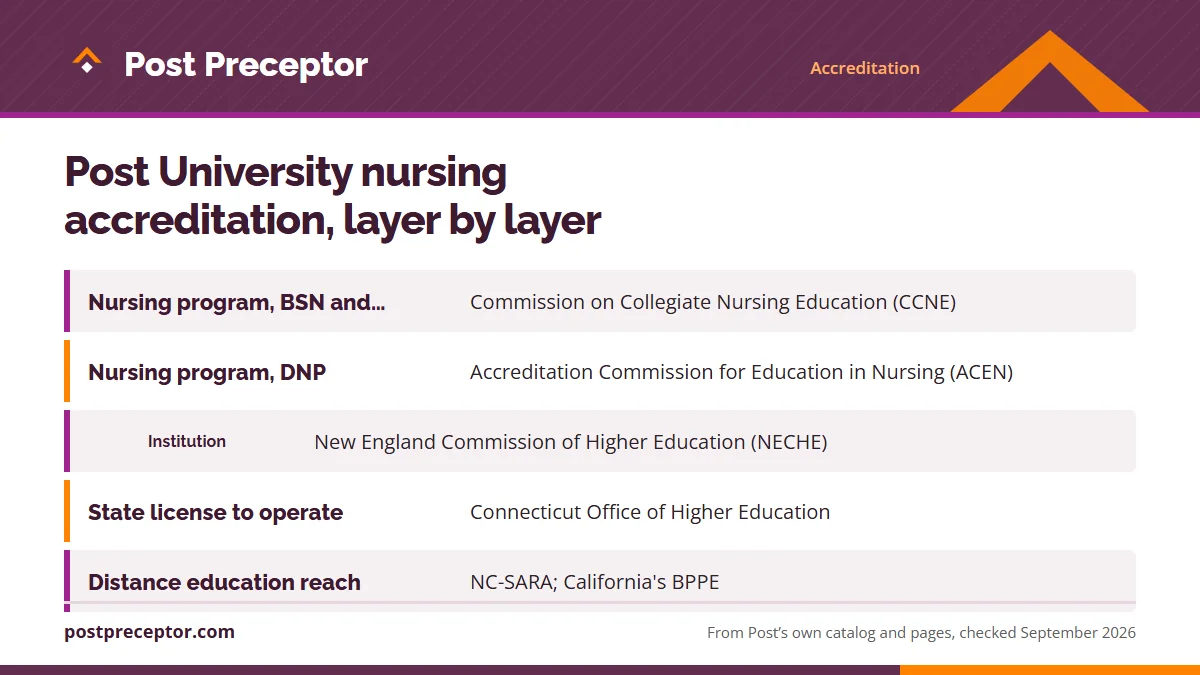
Five layers, five different bodies
Students often hear "accredited" as one stamp. At Post it is several, each answering a different question about the program or the university. The first two rows are specific to nursing; the last three apply to every Post program, from business to nursing.
| Layer | Body | What it covers |
|---|---|---|
| Nursing program, BSN and MSN | Commission on Collegiate Nursing Education (CCNE) | RN to BSN and the MSN, including the nurse practitioner specializations |
| Nursing program, DNP | Accreditation Commission for Education in Nursing (ACEN) | The Doctor of Nursing Practice, under continuing accreditation |
| Institution | New England Commission of Higher Education (NECHE) | Post University as a whole |
| State license to operate | Connecticut Office of Higher Education | Licenses Post University; also Connecticut's portal agency for SARA |
| Distance education reach | NC-SARA; California's BPPE | SARA member states; California through its own authorization, approved through March 12, 2029 |
CCNE: the BSN and the MSN
Post's catalog puts it plainly: "The baccalaureate degree program in nursing and master's degree program in nursing at Post University are programmatically accredited by the Commission on Collegiate Nursing Education." The MSN is one degree with eight specializations: the five non-NP tracks (Nursing Education, Case Management, Nursing Informatics, Infection Prevention and Control, and Management and Organizational Leadership) and the three nurse practitioner tracks. An FNP, AGPCNP or PMHNP graduate earns that MSN.
That matters later, when you apply for certification and a state license. Connecticut's Department of Public Health, for example, asks APRN applicants for a graduate degree in nursing along with national certification, and it wants the transcript sent directly from the school. When a board or certifying body asks about your program, the answer is a CCNE-accredited MSN from the American Sentinel College of Nursing & Health Sciences at Post University.
ACEN: the DNP, carried over from American Sentinel
The DNP's accreditation is older than the merger that created Post's nursing college. American Sentinel University, then based in Aurora, Colorado, announced ACEN accreditation of its online DNP on April 14, 2014, following a site review in November 2013. At that point the program had two tracks, Executive Leadership and Educational Leadership.
American Sentinel merged into Post in 2021, and Post now describes the DNP as holding continuing accreditation from ACEN and says it has been graduating DNP students since 2014. The DNP has since grown to four leadership specializations: Educational, Executive, Informatics and Professional Leadership. Its 600 practice hours and doctoral-prepared preceptors are covered in the DNP practice hours guide, and the college's history is on the American Sentinel College page.
NECHE and Connecticut's Office of Higher Education
Institutional accreditation covers the whole university, online nursing included. Post's catalog names the New England Commission of Higher Education as its institutional accreditor. The online nursing programs are part of Post's Online Degree Programs, not a separate institution, so they sit under that same accreditation. The administrative offices of the nursing college are on the main campus at 800 Country Club Road in Waterbury, though no nursing program asks you to visit.
The state layer is separate again. Post's catalog says the state of Connecticut, through its Office of Higher Education, licenses Post University. The same office is Connecticut's State Portal Entity for SARA, the reciprocity agreement Post uses to offer distance programs in other member states. California sits outside SARA, and Post is authorized there through California's Bureau for Private Postsecondary Education instead.
What accreditation does not decide
Accreditation says the program meets a national standard. It does not say your state will license you. Post's State Approvals page describes the NP specializations as programs that are not designed around any single state's licensure rules and that may partially fulfill them, and it stops short of promising licensure. The state-by-state answer is in Post's NP disclosure, where seven states are marked No; the disclosure guide reads it row by row.
Connecticut's Board of Examiners for Nursing is another place students look. The board approves nursing schools that prepare people for the RN licensing exam, and DPH's list of approved RN programs does not include Post. That is expected: every Post nursing program starts after RN licensure, so none of them belongs on that list. Accreditation also leaves the clinical steps untouched. A preceptor and site still need the Clinical Coordinator's approval and an affiliation agreement, whatever the program's credentials.
When a clinical site asks about your program
Practice managers and hospital education offices sometimes want to know who they are agreeing to host before they sign. A short, accurate description helps: you are an RN in an online graduate program at Post University's American Sentinel College of Nursing & Health Sciences, the MSN is CCNE accredited (the DNP is ACEN accredited), Post's Clinical Coordinator approves the placement, and the contract with the site goes through Post's affiliation agreement request.
Post's process for that contract is simple to describe. You submit the request through the Affiliation Agreement Tracker, and a member of Post's Academic Affairs staff contacts the site within seven business days. The affiliation agreement guide covers what happens after that call.
Why Post students choose us
A clear request is easier for a busy clinician to accept, so ours is precise. We introduce you with your college's full name, your degree and its accreditation, the Post course, its hours and the setting it calls for, and we explain the approval and agreement steps before the preceptor commits. Every guide on this site is checked against Post's own catalog, program pages and disclosure, and dated, so what we tell a preceptor matches what Post will ask.
The result is a preceptor who knows what Post will ask, a signed preceptor agreement letter, and a license report, certification and CV ready for the Clinical Coordinator. Start with the form or read how it works.
Questions Post students ask
Is Post University's FNP program accredited?
The FNP is a specialization of Post's Master of Science in Nursing, which Post lists as accredited by CCNE, and Post University itself is accredited by NECHE. The AGPCNP and PMHNP sit under the same MSN. Whether the program leads to licensure in your state is a separate question, answered by Post's NP disclosure.
Why is Post's DNP accredited by ACEN instead of CCNE?
The DNP came from American Sentinel University, which earned ACEN accreditation for its online DNP in 2014, before the 2021 merger with Post. Post now lists it as holding continuing ACEN accreditation, while the BSN and MSN are CCNE accredited. Post's pages state both accreditations without comparing them.
Is Post approved by the Connecticut Board of Examiners for Nursing?
That board approves schools preparing people for the RN licensing exam, and Post offers no pre-licensure nursing, so it is not on that list. Post is licensed by Connecticut's Office of Higher Education and accredited by NECHE, and its nursing programs carry CCNE or ACEN accreditation.
Does accreditation mean my NP degree qualifies me for licensure anywhere?
No. Accreditation speaks to program quality. Licensure depends on each state's rules, and Post's NP disclosure answers No for seven states and lists only the FNP and AGPCNP for California. National certification and state-specific conditions, such as a collaborative agreement, still apply after graduation.
Where can I confirm Post's current accreditation?
Post's nursing college and program pages state the CCNE and ACEN accreditations, and the catalog's General Information section names NECHE and the Connecticut Office of Higher Education. Each accrediting body also keeps its own public record of accredited programs, which is the place to look if a site or employer asks for proof.
Related pages
Last checked 2026-09-27
We check these pages against Post University's own catalog, program pages and published nursing documents. Your course faculty and the Clinical Coordinator have the final word.
Post asks you to select your own preceptor. We make the search the easy part.
Tell us your Post track, your city and your next preceptorship course. We line up preceptors who fit the course, collect the license report, certification and CV the Clinical Coordinator reviews, and start the affiliation agreement early so your Week 1 packet is complete before the term opens.
- Preceptors matched to the course: primary care for FNP and AGPCNP, mental and behavioral health for PMHNP, doctoral nurse leaders for DNP hours
- Preceptor agreement letter, license report, certification and CV ready for Post's approval
- Every preceptorship planned together, close to home in a state where you hold your license and Post's disclosure says yes
Start your placement plan
Track, city and next preceptorship course is all we need to begin.