Post's NP disclosure by state: the table that decides where you can study and train
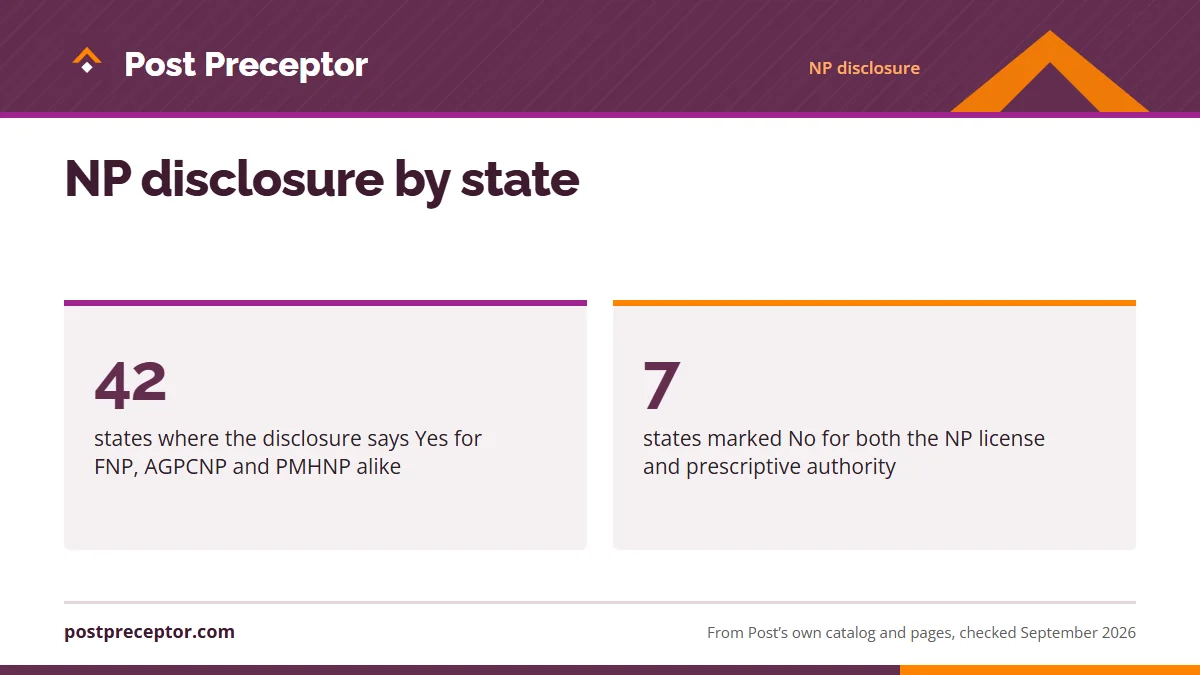
Post's current NP disclosure answers Yes for all three nurse practitioner specializations in 42 states, Connecticut among them. It answers No, for both the NP license and prescriptive authority, in Arizona, Kansas, Louisiana, New York, Oregon, Tennessee and Washington, where Post enrolls no NP students, and California's row covers the FNP and AGPCNP but leaves out the PMHNP.
Get your placement plan
Tell us your Post program and where you live. A placement advisor replies with the preceptor and site options that fit your course.
What the document is, and where Post links it
The PDF is titled "Nurse Practitioner Licensure by State." Post links it from its Distance Learning State Approvals page, under the Professional Credentialing Disclosure Statement, and from the MSN, FNP, AGPCNP, PMHNP and NP overview pages, in a block headed "State Authorization, Licensure, and Disclosures."
Its opening line explains the purpose: the chart shows whether a Post program, completed in full, satisfies the educational requirements for a specific license. Post adds that students can reach admissions or advising to be connected with a credentialing specialist about whether partial completion could lead to licensure. The table carries no date, so open the live PDF from Post's site before you rely on any row, and treat older downloads with care.
How to read a row
The table runs one row per state or territory rather than one column per program. Across each row you find:
- License: the title the state gives an NP, such as Certified Nurse Practitioner or Advanced Registered Nurse Practitioner.
- Two Yes or No answers: whether Post coursework meets the educational requirements for the NP license, and whether it meets them for prescriptive authority.
- Post Program and Specialization(s) Needed: which of the FNP, AGPCNP and PMHNP the answer covers.
- Other requirements outside of education: the state's extra conditions, such as a collaborative agreement or a DEA number.
- Governing Body, plus website and contact columns that point to each state's board.
Take Connecticut, Post's home state. The license is Nurse Practitioner, both answers are Yes, and all three specializations are listed. The other requirements are an unencumbered, active Connecticut license, national certification and a collaborative agreement with a physician, with a DEA number marked optional for prescribing. Connecticut's statute limits that collaboration to the first three years and 2,000 hours of practice, a detail the row leaves out; the Connecticut practice guide covers it.
The rows that differ from a plain Yes
| State or territory | NP license / prescribing | Tracks listed | What to know |
|---|---|---|---|
| Arizona, Louisiana, New York, Oregon, Tennessee, Washington | No / No | None | Asterisked: Post's footnote says it enrolls no NP students living there |
| Kansas | No / No | None | Asterisked now; the 2023 version said Yes / Yes |
| District of Columbia, Guam, Puerto Rico, U.S. Virgin Islands | No / No | None | Asterisked with the seven states |
| California | Yes / Yes | FNP, AGPCNP | PMHNP not listed; a furnishing-number note for students who enrolled before July 2023 |
| Maryland | Yes / Yes | All three | PMHNP added since the 2023 version |
| Utah | Yes / Yes | All three | PMHNP added since the 2023 version |
| Alaska | Yes / Yes | All three | The License cell reads only "I", an apparent typo |
The asterisk is the strongest line in the document. In the marked states, Post's educational offering falls short of NP licensure requirements, and Post's footnote says it neither recruits nor enrolls students who live there.
What changed since the 2023 version
Post published an earlier version of the table in 2023, and comparing the two shows three changes. Kansas moved from Yes for both answers, with no asterisk, to an asterisked No for both, so a Kansas resident who read the older file would now get the opposite answer. Maryland and Utah, which listed only the AGPCNP or FNP in 2023, now list all three specializations, opening both states to the PMHNP.
The third change is cosmetic: Alaska's License cell, which read Nurse Practitioner in 2023, now reads just "I". California's row, with the PMHNP left out, reads the same in both versions. Post's partner program sheets marked current as of January 2024 still show the older picture: the NP sheet leaves out Arizona, the District of Columbia, Louisiana, New York, Oregon, Tennessee and Washington but not Kansas, and the PMHNP sheet also leaves out Maryland and Utah. Post does not explain the changes. If you are weighing a move, or you read an older sheet or table, confirm your state's current answer with admissions before you plan clinicals around it.
Where Post's own pages disagree
Post's State Approvals page says: "Students located in any state may enroll in all online programming offered by Post University." The disclosure's footnote says the opposite for NP students in the asterisked states. The State Approvals sentence has stayed the same across copies of that page from August 2025 through September 2026, so the conflict is not a passing edit.
For an NP student, the disclosure is the narrower document and the one Post's admissions rule points to when it limits clinicals to approved states. Treat it as the answer for the NP specializations and get written confirmation from admissions if your state is marked No. Two smaller mismatches: the State Approvals page calls the tracks Adult Gerontology Nurse Practitioner and Psychiatric and Mental Health, while the disclosure and program pages use the full names, and the Connecticut row leaves out the statutory limit on collaboration.
What Yes means, and what it leaves to you
A Yes means Post's completed coursework meets that state's educational requirements. It is not the license. Post's State Approvals page describes the NP specializations as programs that are not designed around any one state's licensure requirements and that may partially fulfill them, and it stops short of promising licensure. The closing note of the disclosure adds that the programs do not prepare students for state jurisprudence, law or ethics exams, and that licensure rules change often, so the state's own site has the latest word.
Everything in the other-requirements column, from a collaborative agreement to a DEA number, is yours to arrange after graduation. The DNP, the non-NP MSN specializations and RN to BSN are post-licensure programs with no state table at all.
How the table shapes your preceptor search
The disclosure does more than decide admission. Post's rule limits clinical hours to approved states where you hold an active, unencumbered license, so the table also draws the map of where a preceptor can be. The RN license guide covers that rule and the approval needed for hours outside your home state, and each state guide reads one row in detail.
Our searches start from your row. We confirm your state answers Yes for your specialization, point California PMHNP questions to admissions, and look for preceptors only in states that fit Post's rule, so the site you bring to the Clinical Coordinator is one Post can approve. Tell us your state and track and we will map your preceptorships from there.
Questions Post students ask
Can I enroll in Post's NP program if I live in New York?
Post's disclosure marks New York No for both the NP license and prescriptive authority, and its footnote says Post enrolls no NP students living in the states marked that way. Post's broader State Approvals sentence says otherwise, so a New York resident interested in an NP track should get a written answer from admissions.
Is Post's PMHNP open to California residents?
Post's current disclosure lists only the Adult Gerontology Primary Care and Family Nurse Practitioner specializations for California, in this version and the 2023 one. The PMHNP is not listed. A California resident interested in psychiatric mental health should raise it with admissions before applying.
What changed for Kansas in Post's NP disclosure?
The 2023 version answered Yes for the Kansas NP license and prescriptive authority. The current version marks Kansas No for both and adds the asterisk, placing it with the states where Post enrolls no NP residents. Post gives no reason on the document; Kansas residents should confirm their status with admissions.
Does a Yes in Post's table mean I will be licensed as an NP in my state?
No. A Yes means Post's completed coursework meets that state's educational requirements. National certification, the state's application and every item in the other-requirements column, such as a collaborative agreement or a DEA number, still apply, and Post's State Approvals page stops short of promising licensure.
How current is the version I am reading?
The table carries no date, and Post says licensure rules change frequently. Download the live copy from Post's State Approvals or program pages rather than relying on a saved file, and check the board's own site for any requirement that matters to your plans.
Related pages
Last checked 2026-09-27
We check these pages against Post University's own catalog, program pages and published nursing documents. Your course faculty and the Clinical Coordinator have the final word.
Post asks you to select your own preceptor. We make the search the easy part.
Tell us your Post track, your city and your next preceptorship course. We line up preceptors who fit the course, collect the license report, certification and CV the Clinical Coordinator reviews, and start the affiliation agreement early so your Week 1 packet is complete before the term opens.
- Preceptors matched to the course: primary care for FNP and AGPCNP, mental and behavioral health for PMHNP, doctoral nurse leaders for DNP hours
- Preceptor agreement letter, license report, certification and CV ready for Post's approval
- Every preceptorship planned together, close to home in a state where you hold your license and Post's disclosure says yes
Start your placement plan
Track, city and next preceptorship course is all we need to begin.