State board notice for Post NP clinicals, and why 60 days matters
Post's catalog warns that some state nursing boards want notice of a student's clinical plan as much as 60 days before it begins. Sixty days is longer than one of Post's 8-week terms, so in those states your preceptor and site have to be settled while you are still in the course before your preceptorship. Post says students work with the Clinical Coordinator and its compliance officer to meet each board's requirements; your part is a confirmed placement, early.
Get your placement plan
Tell us your Post program and where you live. A placement advisor replies with the preceptor and site options that fit your course.
What Post tells you about board notice
The warning sits in the catalog's Additional Nursing Information section, next to the clinical rules: "some nursing boards require a notification of a plan for clinical experience up to 60 days in advance." Post's Distance Learning State Approvals page makes the same point more broadly, noting that state boards of nursing may add notifications and requirements tied to field and clinical experiences.
Post's state-authorization text, on that page and in the catalog's General Information section, also names who handles it. Students work with the clinical coordinator and the compliance officer within the nursing school, which the page calls the American Sentinel School of Nursing and Health Science, to make sure every requirement is met. Post does not publish a list of which boards want notice, or how far ahead each one wants it. The Clinical Coordinator has the current answer for your state, so ask as soon as you know where you will train.
Sixty days on Post's calendar
Sixty days is about eight and a half weeks. NP students take one course per 8-week term, so a notice that runs the full 60 days falls inside the term before your preceptorship, while you are busy with that course's coursework. The practical rule: the preceptor, the site and the schedule have to exist before that notice can be written.
| Point in time | What has to be true by then |
|---|---|
| End of Week 1 | Preceptor agreement letter, affiliation agreement, CastleBranch, NP Clinical Schedule, both license reports, the preceptor's certification and CV, and the contact form are complete, or you leave the course term |
| Friday of Week 1 | Last day to add the course |
| Term start, a Monday | The preceptorship course opens; a 135-hour course averages about 17 clinical hours a week |
| Up to 60 days before the clinical plan begins | Notice goes to boards that ask for it, so the preceptor, site and schedule are already fixed |
| Before the notice | Preceptor confirmed, site chosen and the affiliation agreement requested through Post's tracker; Academic Affairs contacts the site within seven business days of a request |
For the actual Mondays, open the American Sentinel College calendar on Post's academic calendar page and count back from your preceptorship term. The full packet is on the Week 1 guide.
What boards ask of out-of-state programs: examples from their own rules
Post is based in Connecticut, so in every other state it is an out-of-state program. Boards handle that very differently. These examples come from each board's own published rules, and they show why Post's warning is worded as a range.
| State | What the board's rule asks | Timing it states |
|---|---|---|
| North Dakota | Recognition for distance programs whose students are headed for APRN licensure, then, each semester, student names and license details, facilities, courses, preceptor names, resumes and licenses, affiliation agreements and each facility's confirmation of clinical space | Request due 60 days before planned student activity |
| Alabama | A letter of intent and approval documents from an out-of-state advanced practice program, naming the student and license number, the clinical supervisor and license number, the facility, and a statement from its nursing leader | At least 15 days before clinical learning experiences |
| Alaska | A preceptorship registration for each APRN student: an RN license in good standing, proof of enrollment and a copy of the agreement among school, facility, student and preceptor | Before the preceptorship; lasts 12 months or until it ends, renewable once |
| Wyoming | Written notice when a post-licensure student (APRN, DNP or MSN) will do clinical learning in the state, plus a signed contract with the facility kept on file | Before clinicals start |
| Iowa | No approval of out-of-state programs, but faculty and preceptors in Iowa need an active Iowa or multistate license, and clinical contracts must spell out each party's role | None stated |
| Georgia, Indiana, Kentucky, Virginia | No board approval step for out-of-state graduate programs; each board says its approval reaches only the programs it regulates | None stated |
Rules change, and Post's compliance officer tracks the current versions. The seven states marked No in Post's disclosure are left out of this sample because Post enrolls no NP students living there and they are not approved clinical states.
SARA covers the program; boards can still ask for more
Post is an institutional participant in the National Council for State Authorization Reciprocity Agreements (NC-SARA), and its State Approvals page says courses and programs with a "supervised field experience" fall under SARA's provisions. SARA settles whether Post may offer distance education in a member state. It sits alongside the nursing boards, which is why the same page warns that boards can add their own notification steps for clinicals.
Post's SARA chart lists every state except California, plus the District of Columbia, Puerto Rico and the U.S. Virgin Islands. California is covered another way: Post is authorized there through the Bureau for Private Postsecondary Education, with approval running through March 12, 2029. In Connecticut, the Office of Higher Education serves as the state's SARA portal agency. None of this replaces the NP disclosure, which answers a separate licensure question; see the disclosure guide.
California students: one extra form, one missing track
Post's current NP disclosure answers Yes for California for the FNP and AGPCNP; the PMHNP is not listed there. California students also have one more line in the Week 1 packet, which the catalog calls the "California students only NP preceptor form." Post does not publish its contents, so get the current version from the Clinical Coordinator as soon as your preceptor agrees.
California's Board of Registered Nursing has its own rules for NP programs based in other states: prior board approval for clinical placements in California, preceptors who meet board requirements, instruction in California NP law, and an NP Program Preceptor form kept on file for each California preceptor. Where approval is needed, the board acts on it at a board meeting. One more California note from Post's table: students who enrolled before July 2023 need one additional course from an outside partner to meet the state's furnishing number requirements; students who enrolled from July 2023 on do not.
Your part of the notice
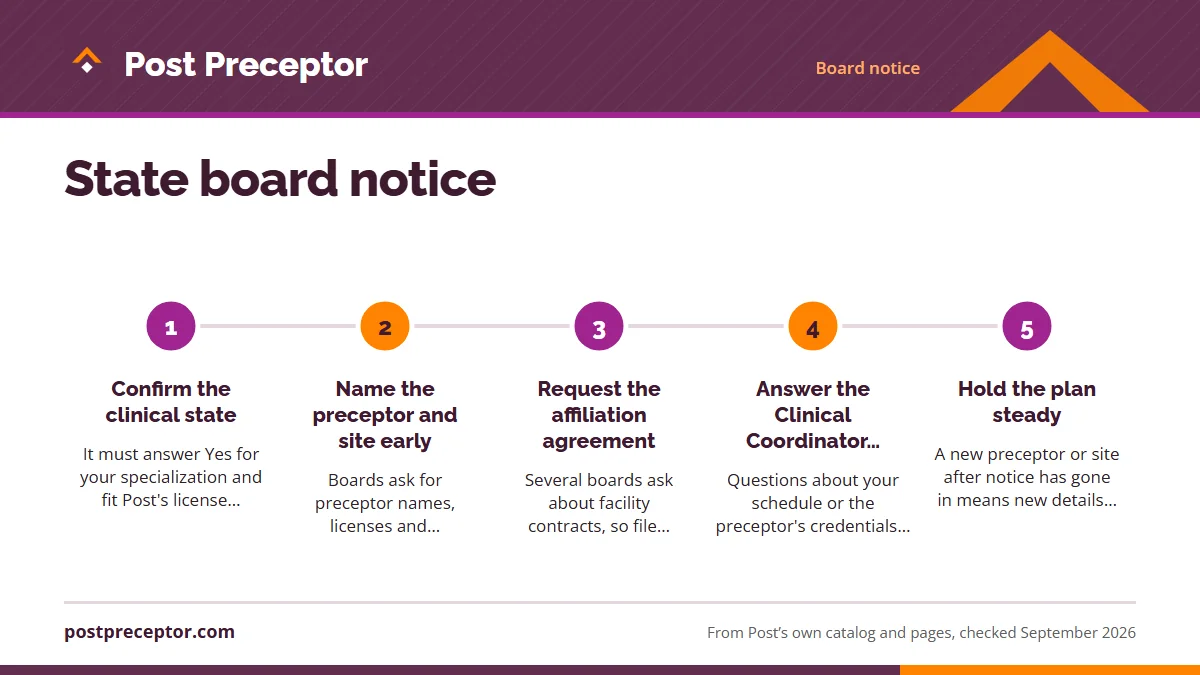
- Confirm the clinical stateIt must answer Yes for your specialization and fit Post's license rule; hours outside your home state need prior approval. See RN license and clinical states.
- Name the preceptor and site earlyBoards ask for preceptor names, licenses and facilities, and none of that exists until a preceptor has said yes.
- Request the affiliation agreementSeveral boards ask about facility contracts, so file Post's tracker request as soon as the site is chosen. The affiliation agreement guide covers the steps.
- Answer the Clinical Coordinator quicklyQuestions about your schedule or the preceptor's credentials are the ones that hold a notice back.
- Hold the plan steadyA new preceptor or site after notice has gone in means new details for Post and the board, so lock the plan before the notice window opens.
Why Post students choose us when board timing is tight
We start your search a full term or more before the preceptorship, which is what a 60-day notice demands. The moment a preceptor agrees, we collect the details boards and Post both ask for: full name, license report, national certification and CV, with the preceptor agreement letter signed. The affiliation agreement request goes in right behind it.
When you train in a state with a long lead time, such as North Dakota's 60-day request or California's board process, we plan backward from that date instead of from Week 1. California FNP and AGPCNP students get a preceptor ready for Post's California form. See how it works, then tell us your state and term.
Questions Post students ask
Which state boards require notice before Post NP clinicals?
Post's catalog says some do, up to 60 days ahead, without naming them. Boards' own rules show the range: North Dakota wants a request 60 days before student activity, Alabama at least 15 days before clinicals, Alaska a registration per APRN student, and Wyoming written notice. Ask the Clinical Coordinator for your state's current requirement.
Do I send the notice to the board myself?
Post's State Approvals page says students work with the clinical coordinator and compliance officer to meet these requirements. Most board rules place the filing on the program; Alaska's preceptorship registration is made per student. Ask the Clinical Coordinator what, if anything, needs your signature, and have your preceptor's details ready.
Does SARA membership mean no board approval is needed?
No. SARA covers Post's authorization to offer distance education, and Post says programs with supervised field experiences fall under it. Post's own page adds that state boards of nursing may still require extra notifications and steps for clinical experiences, so board rules apply on top of SARA.
What is the California-only NP preceptor form?
It is an item on Post's Week 1 list for California students. Post does not publish the form, so ask the Clinical Coordinator for the current version. California's Board of Registered Nursing separately has out-of-state NP programs keep an NP Program Preceptor form for each California preceptor.
Can a PMHNP student do clinicals in California?
Post's current NP disclosure lists only the FNP and AGPCNP for California, and Post's clinical rule limits hours to approved states for your specialization. A PMHNP student thinking about California hours, or a move there, should raise it with admissions and the Clinical Coordinator first.
Related pages
Last checked 2026-09-27
We check these pages against Post University's own catalog, program pages and published nursing documents. Your course faculty and the Clinical Coordinator have the final word.
Post asks you to select your own preceptor. We make the search the easy part.
Tell us your Post track, your city and your next preceptorship course. We line up preceptors who fit the course, collect the license report, certification and CV the Clinical Coordinator reviews, and start the affiliation agreement early so your Week 1 packet is complete before the term opens.
- Preceptors matched to the course: primary care for FNP and AGPCNP, mental and behavioral health for PMHNP, doctoral nurse leaders for DNP hours
- Preceptor agreement letter, license report, certification and CV ready for Post's approval
- Every preceptorship planned together, close to home in a state where you hold your license and Post's disclosure says yes
Start your placement plan
Track, city and next preceptorship course is all we need to begin.