How we place Post nursing students, from first call to final clinical hour
You tell us your Post track, where you live and hold your license, and when your next preceptorship begins. We plan every preceptorship you still need, find preceptors and sites that fit each course near home, check each one against Post's rules, collect the documents and signatures, and get the site contract moving early. Post's Clinical Coordinator makes the approval; our job is to put a complete, correct packet in your hands well before Week 1.
Start with your next term
Tell us your track, your state and when your preceptorship begins.
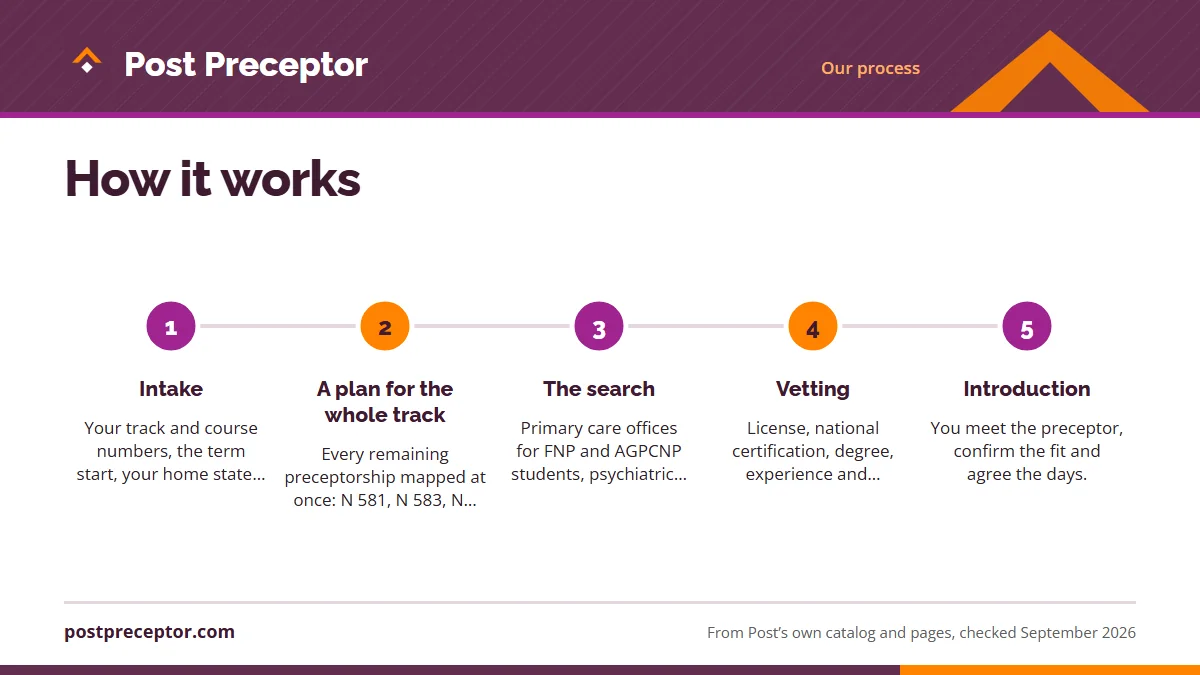
The steps, in order
- IntakeYour track and course numbers, the term start, your home state and RN license, how far you can travel, your work pattern, and anything already arranged.
- A plan for the whole trackEvery remaining preceptorship mapped at once:
N 581,N 583,N 589orN 585, andN 599for FNP and AGPCNP students;N 561throughN 569for PMHNP students. The narrowest courses get searched first. - The searchPrimary care offices for FNP and AGPCNP students, psychiatric and behavioral health programs serving all ages for PMHNP students, doctorally prepared nurses for DNP practice hours, all near home and in a state where your license and Post's disclosure both allow clinical work.
- VettingLicense, national certification, degree, experience and relationships checked against Post's standard before you hear a name.
- IntroductionYou meet the preceptor, confirm the fit and agree the days.
- The paperworkYour preceptor's signature on Post's agreement letter, plus their CV, certification and license report, gathered in one pass.
- The site contractThe right contact at the site identified and briefed, so your Affiliation Agreement Tracker request can be filed the same week the practice agrees, then followed until both sides have signed.
- Submission and approvalYou submit through Post's channels, and Post's Clinical Coordinator decides on the preceptor and site.
- Through the termWe stay on call, and if a preceptor has to stop, we search for a replacement at once.
Your part and ours
Some steps belong to you by Post's rules, and some belong to Post alone. Everything in between is what we take off your plate.
| Task | Handled by |
|---|---|
| Finding and vetting the preceptor and site | Post Preceptor |
| Collecting the letter, license report, certification and CV | Post Preceptor |
| Preparing the site contact for Post's outreach | Post Preceptor |
| Drafting the NP Clinical Schedule with the preceptor | Post Preceptor, with you |
| CastleBranch compliance, your RN license report, the contact form | You |
| Uploading forms and logging hours in the tracking system | You |
| Contracting with the site and approving preceptor and site | Post |
Post's catalog makes you responsible for getting the required documents to the Clinical Coordinator on time. We make that the easy part.
How we check a preceptor before you meet them
Every candidate is measured against Post's written standard first: an active license carrying no encumbrance, national certification that matches your population focus, a master's or doctorate, at least a year in practice, and none of the relationships Post rules out. The preceptor requirements page sets out that standard in full.
Then we check the fit for your specific course. N 589 needs obstetric, gynecological and pediatric patients seen in primary care; N 567 needs adolescents with substance misuse. We also keep count of Post's advice that at least two of your clinical courses be led by an NP, so choosing a physician for one term never leaves you short later. We also confirm the license is for the state where you will train and that license and certification both run past the term's last day. Only a preceptor who clears all of it reaches you.
When to start
The strongest start is during the 3P term, when passing the APEA 3P exam opens the NP courses and your first preceptorship is still a term or two away; see the 3P exam page. That leaves room for the affiliation agreement, any state board notice, and a health system's own onboarding if your site has one. Post's catalog warns that certain boards expect to hear about a clinical plan as much as 60 days before it begins, one more reason to settle the preceptor early. An early start changes none of the steps, only the pressure around them.
Later starts work too, with a tighter plan. If your term is weeks away, go straight to need a preceptor fast. If you already have a preceptor for one course, we vet and document that placement and fill in the rest, so every term is covered by the same plan.
During every term
A placement does not end at approval. A 135-hour preceptorship runs about 17 hours a week for eight weeks, and life happens: a clinic closes for a week, a preceptor falls ill, a family moves. We check in through the term and move quickly when a plan wobbles.
If a preceptor leaves partway through, we start the replacement search immediately, as the preceptor dropped out page describes. Meanwhile we are already lining up your next preceptorship, so it opens with a signed letter and an agreement under way rather than a fresh search. You log hours in Typhon as you go, and we watch the pace with you, so a slow second week gets fixed in the third; the behind on clinical hours page covers recovery.
Why Post students choose us
Post's tuition page names outside preceptor-finding companies as an option NP students may choose. Post Preceptor is the most thorough version of that service for Post students, built around the American Sentinel College's own rules: the Week 1 packet, the tracking system, CastleBranch, the Affiliation Agreement Tracker and the approved-state map.
Every step above is designed so the Clinical Coordinator receives a finished packet that matches Post's rules on the first try. You get one team that knows your whole track, from the first preceptorship to the integration course that ends it. To see what shapes a quote, visit cost. To begin, use the form below with your track, state and term.
Questions Post students ask
Who submits the paperwork to Post?
You do, through Post's own channels. The catalog says preceptor approval begins when you upload the forms to the student tracking system, and it places the duty of delivering documents to the Clinical Coordinator on the student. We collect and check everything first, so what you submit is complete and matches Post's rules.
Do you place DNP and non-NP MSN students?
Yes. For DNP practice hours we look for nurses with a doctoral degree, the preceptor Post requires, and plan around the affiliation agreement every DNP precepted experience needs. For non-NP MSN practice experiences, we look for a preceptor with at least a master's and a current RN license who is employed at the site. RN to BSN students have no preceptor to find.
Can you place me at the organization where I work?
Yes, when the setting fits your course and the preceptor is outside your reporting line. Post rules out a direct supervisor, a relative or a classmate in your program, and the site still needs an affiliation agreement. Your workplace can be the fastest route when those pieces line up.
How close to home will my site be?
As close as your course's setting and Post's state rules allow. You set the travel radius at intake, and we search outward from home within it. Courses with narrow patient groups, like N 589 and N 567, can need a wider circle, and we tell you early if that is likely.
What if I already found a preceptor for one course?
Keep them. We check that preceptor against Post's rules, help collect their documents and the signed letter, and then search for the courses that remain. Planning all your preceptorships together also helps balance NP and physician preceptors across the track, in line with Post's recommendation.
Related pages
Last checked 2026-09-27
We check these pages against Post University's own catalog, program pages and published nursing documents. Your course faculty and the Clinical Coordinator have the final word.
Post asks you to select your own preceptor. We make the search the easy part.
Tell us your Post track, your city and your next preceptorship course. We line up preceptors who fit the course, collect the license report, certification and CV the Clinical Coordinator reviews, and start the affiliation agreement early so your Week 1 packet is complete before the term opens.
- Preceptors matched to the course: primary care for FNP and AGPCNP, mental and behavioral health for PMHNP, doctoral nurse leaders for DNP hours
- Preceptor agreement letter, license report, certification and CV ready for Post's approval
- Every preceptorship planned together, close to home in a state where you hold your license and Post's disclosure says yes
Start your placement plan
Track, city and next preceptorship course is all we need to begin.