Your preceptor dropped out mid-term: what to do now
If your preceptor stops partway through a Post University clinical course, contact the Clinical Coordinator the same day, get the hours you have already completed logged and evaluated, and start the replacement search at once. Any new preceptor needs the Coordinator's approval, and a new site needs a fully executed affiliation agreement, so every day spent waiting comes straight out of the hours you still owe.
Get your placement plan
Tell us your Post program and where you live. A placement advisor replies with the preceptor and site options that fit your course.
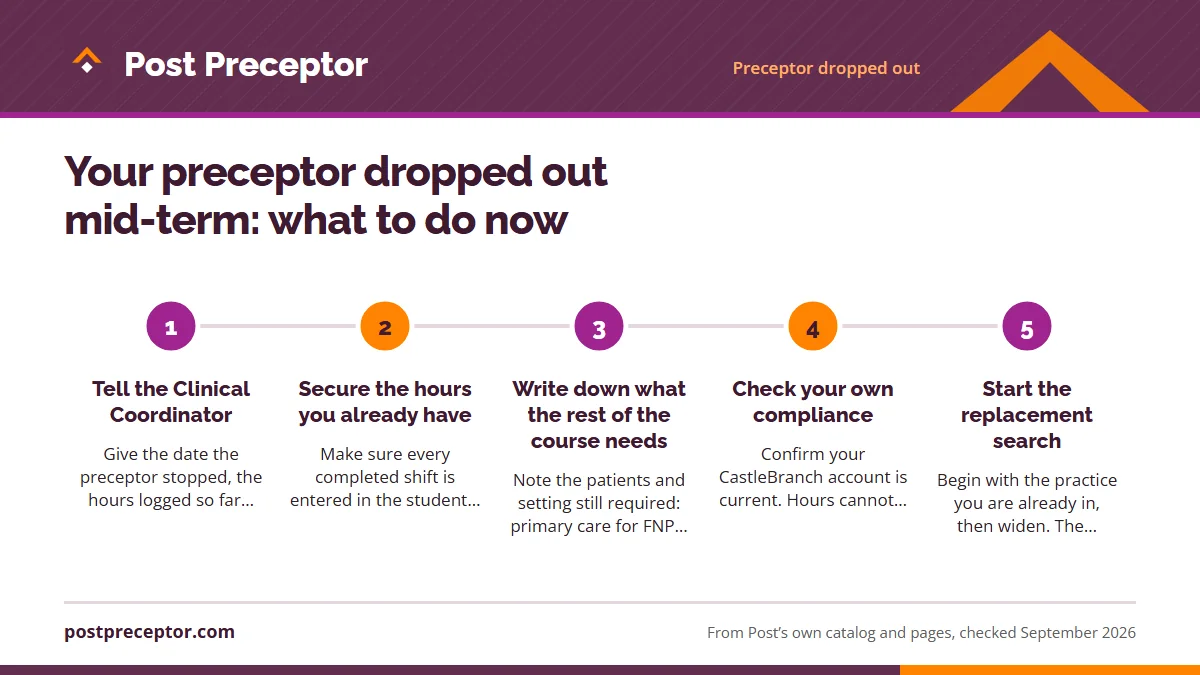
Your first 48 hours
- Tell the Clinical CoordinatorGive the date the preceptor stopped, the hours logged so far, the hours remaining and the weeks left in the term. Clinical-hour problems, and any extension involving hours, run through the Coordinator, so the sooner they hear, the more options stay open.
- Secure the hours you already haveMake sure every completed shift is entered in the student tracking system, Typhon, and ask the preceptor to finish any evaluation owed while they are still reachable. Preceptors log in to Typhon to complete student evaluations.
- Write down what the rest of the course needsNote the patients and setting still required: primary care for FNP and AGPCNP courses, or the right mental and behavioral health population for a PMHNP course, such as the child and adolescent focus of
N 563or the adolescent substance misuse focus ofN 567. - Check your own complianceConfirm your CastleBranch account is current. Hours cannot be logged without a compliant account, and a new site may ask for health records of its own.
- Start the replacement searchBegin with the practice you are already in, then widen. The sections below explain why that order is usually fastest.
What a replacement has to clear
In Post's eyes a replacement is a new preceptor and goes through the same approval as the first. For NP courses, Post's 2025-26 catalog asks for a current unencumbered state license and national certification in the population focus, master's or doctoral preparation for an APRN, and one or more years of experience; a physician (MD or DO) can also precept. The full list is on the preceptor requirements page.
The general rules still apply: the new preceptor cannot be your direct supervisor, a relative or a student in your program. They must practice in a state Post approves for your specialization and where you hold an active RN license, and clinicals outside your home state need prior approval. On paper, the Coordinator needs a signed preceptor agreement letter plus the new preceptor's license report, certification and CV.
Same practice or new site: why it changes the timeline
The quickest replacement is often another qualified clinician at the practice where you were already training. Post requires a fully executed affiliation agreement with each site, so staying put keeps that agreement in place, and the Coordinator reviews one new person rather than a whole new location. The practice also already knows you and your course.
Moving to a new site adds a step. You request the agreement through Post's Affiliation Agreement Tracker, and Academic Affairs staff reach out to the site within seven business days; signing then follows the site's own pace. Post also cautions that an existing agreement with a facility is no promise of approval there, so the preceptor and setting still have to fit your course. The affiliation agreement page covers the process.
Practices owned by hospitals or health systems can add their own onboarding, from health forms to badging, with lead times counted in weeks. Ask about it on the first call.
The hours math once weeks are gone
A 135-hour preceptorship across 8 weeks runs at about 17 hours a week, and N 567, at 90 hours in Post's 2021-22 course description, at about 11. When a preceptor leaves, the real question is how many hours remain against how many weeks you will actually spend with the replacement.
Take a 135-hour course where the preceptor leaves after Week 4 with 68 hours logged. If the replacement starts in Week 5, the weekly pace barely changes. If approval drags to Week 7, the remaining 67 hours must fit into two weeks, over 33 a week, which is a punishing load next to a nursing job (all figures our arithmetic).
Hours that cannot fit inside the term become a clinical-hour extension through the Clinical Coordinator. That adds two weeks but, for an NP student, blocks the next course while it is open, and hours still unfinished at the end mean repeating the course. Behind on clinical hours and extensions and incompletes cover those paths.
Before the next term: stop it happening twice
Some mid-term exits can be seen coming: fewer open clinic days, a job change, a practice short of staff. For your next course, settle the NP Clinical Schedule with the preceptor before Week 1, name a backup clinician at the same site when you can, and make sure the preceptor has read Post's expectations in the agreement letter before signing it.
If the replacement you find now could also host your next preceptorship, raise it with the Coordinator early. Continuity keeps the same affiliation agreement in play and gives you a preceptor who already knows your pace, provided the setting fits the next course's patients. Agree up front on how you will reach each other when a clinic day is canceled, so a short gap never turns into a silent one.
How we step in when a preceptor walks away
When a preceptor drops, Post students turn to us because we move the same day and know exactly what the Clinical Coordinator needs to see.
- We search for a replacement who fits your course's patients and your state, starting with clinicians at your current practice.
- We confirm license, certification, degree and experience against Post's rules before your name goes forward.
- We collect the CV, license report and certification, and get the preceptor agreement letter signed.
- When a new site is needed, we have the affiliation agreement request ready to go in on day one.
- We plan the remaining hours week by week so the new preceptor's schedule closes the gap.
Reach us through the contact page and include how many hours remain; your placement advisor will pick it up straight away.
Questions Post students ask
Do the hours I completed with my first preceptor still count?
Hours supervised by an approved preceptor and logged in the student tracking system are the record of your clinical work, so get them entered and the evaluation done before the preceptor is out of reach. Post's public catalog does not describe how partial hours carry over when a preceptor changes; the Clinical Coordinator confirms how they apply to the rest of the course.
Can a physician replace my NP preceptor?
Yes. Post's catalog accepts an MD or DO as a preceptor for NP students. It also recommends completing at least two of your clinical courses, half of them, with an NP preceptor, and prefers all of them. If your earlier courses were with physicians, lean toward an NP replacement so the recommendation still holds.
Should I withdraw from the course instead?
Talk to your Student Success Advisor and the Clinical Coordinator before deciding. In Post's 2025-26 calendar, the last day to withdraw with a W fell on the Sunday six weeks after a term began. A withdrawal moves the course to a later term, and your advisor can explain how it interacts with Post's repeat limits and your time limit.
Can I finish my hours in another state?
Only in a state Post approves for your NP specialization and where you hold an active, unencumbered RN license, which can be a compact license. Clinicals outside your state of residence need prior specialization approval. Read the RN license rules before approaching a preceptor across a state line.
What if my whole clinical site closes or stops taking students?
Treat it as a new placement: a new site and preceptor, both approved by the Clinical Coordinator, with a fully executed affiliation agreement in place before you log hours there. File the agreement request on the first day, because Academic Affairs' first contact with the site can take up to seven business days.
Related pages
Last checked 2026-09-27
We check these pages against Post University's own catalog, program pages and published nursing documents. Your course faculty and the Clinical Coordinator have the final word.
Post asks you to select your own preceptor. We make the search the easy part.
Tell us your Post track, your city and your next preceptorship course. We line up preceptors who fit the course, collect the license report, certification and CV the Clinical Coordinator reviews, and start the affiliation agreement early so your Week 1 packet is complete before the term opens.
- Preceptors matched to the course: primary care for FNP and AGPCNP, mental and behavioral health for PMHNP, doctoral nurse leaders for DNP hours
- Preceptor agreement letter, license report, certification and CV ready for Post's approval
- Every preceptorship planned together, close to home in a state where you hold your license and Post's disclosure says yes
Start your placement plan
Track, city and next preceptorship course is all we need to begin.