Your RN license and the states where Post lets you do NP clinicals
Post University ties NP clinicals to two things: your license and your address. You must live in a state Post approves for your nurse practitioner specialization and hold an active, unencumbered RN license there, and every clinical hour has to happen in an approved state where you are also licensed. Any clinical outside your home state needs Post's approval first.
Get your placement plan
Tell us your Post program and where you live. A placement advisor replies with the preceptor and site options that fit your course.
The rule, in Post's own words
Post's admissions requirements for the nurse practitioner specializations spell out the license rule in three sentences. The first one reads: "A student in one of the Nurse Practitioner Specializations must reside and hold an active unencumbered RN license in an approved Nurse Practitioner Specialization state."
The second sentence limits clinical activity to approved NP states in which you also hold an active, unencumbered license, and it sends you to Post's disclosure by state for the list. The third deals with state lines: "Prior specialization approvals are a requirement to attend clinical activities in a state in which the student does not have a primary residence." Admissions checks the address half at the door, too: the driver's license or state ID you submit must match the approved state you gave as your residence.
Reduced to a checklist
- Home state: you live in a state Post approves for your specialization.
- Home license: your RN license in that state is active, with no restrictions or conditions on it.
- Clinical state: each clinical hour happens in an approved state where your license is active and unencumbered.
- Second state: Post signs off before your first clinical day anywhere other than your state of primary residence.
Which states count as approved
The list the rule points to is Post's NP disclosure by state. It answers No for NP licensure and prescriptive authority in Arizona, Kansas, Louisiana, New York, Oregon, Tennessee and Washington, and Post's footnote says it enrolls no NP students who live in the places marked that way. California's row names the FNP and AGPCNP only. Every other state answers Yes for all three tracks, Connecticut included.
Find your own row before you plan any clinical, and read the row for a neighboring state before you look at a practice there. The NP disclosure guide explains the columns, what changed since the 2023 version, and the spot where two Post pages disagree about enrollment.
A state on your border is not automatically open to you. Post's table marks New York No, so for a student in western Connecticut, a practice across the line in New York does not fit the clinical rule as Post writes it.
Compact licenses and the CastleBranch license item
CastleBranch, Post's compliance tracker, asks for your RN license and notes that this may include a compact RN license. A multistate license issued under the Nurse Licensure Compact lets an RN whose home state belongs to the compact practice in the other member states, so for many students one license covers both home and a neighboring state.
Two limits apply to NP students. The compact reaches RN and LPN licenses only, and Connecticut has not enacted the separate APRN Compact. And Post's catalog is silent on whether a multistate privilege meets its wording about holding licenses in a second clinical state, so ask the Clinical Coordinator before a preceptor in that state signs anything.
Close to Post's home, the picture is mixed. Connecticut started participating on October 1, 2025, under a statute that runs the compact until January 1, 2028. Rhode Island has been a member since January 8, 2024. Massachusetts enacted the compact, but its board says it is not in effect until implementation is complete, with May 2027 as the target. New York is outside it.
Planning hours in a second state
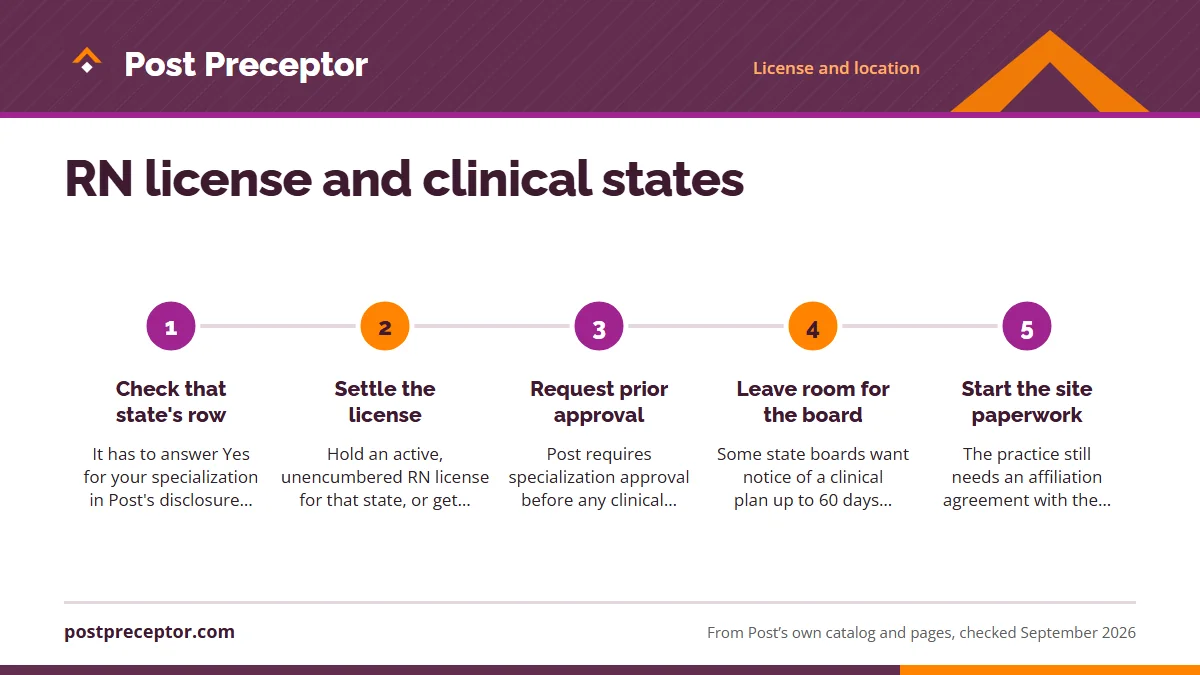
Students who live near a state line often find the nearest primary care practice or psychiatric clinic on the other side. Post allows that when each of these pieces is in place, in this order:
- Check that state's rowIt has to answer Yes for your specialization in Post's disclosure. California counts for FNP and AGPCNP students only.
- Settle the licenseHold an active, unencumbered RN license for that state, or get the Clinical Coordinator's confirmation that your multistate license covers it under Post's rule.
- Request prior approvalPost requires specialization approval before any clinical activity outside your state of primary residence. The catalog gives no turnaround time, so ask early.
- Leave room for the boardSome state boards want notice of a clinical plan up to 60 days ahead. The board notification guide shows what several boards ask of out-of-state programs.
- Start the site paperworkThe practice still needs an affiliation agreement with the American Sentinel College and a preceptor who meets Post's standards, exactly as a site at home would.
Your license inside every Week 1 packet
Post checks the license rule each term, not once at admission. Your RN license report is one of the items due by the end of Week 1 of each clinical course, alongside the preceptor's own license report, certification and CV. A short packet removes you from the clinical course term, so a license problem discovered in Week 1 costs you the preceptorship for that term.
The license also sits on your CastleBranch checklist, and Post's NP students must keep a compliant account for the whole program; clinical activity without one is not allowed. If your renewal date lands inside a term, renew ahead of it and update CastleBranch before the term opens. The Week 1 guide lists the full packet.
Moving, or training where you do not live
Because residence is written into the rule, a move can change what Post allows. A move to another state that answers Yes for your specialization still means an RN license in the new state and an updated record with Post. A move to one of the seven states marked No runs into the residence requirement itself. The catalog does not describe a mid-program move, so speak with your Student Success Advisor and the Clinical Coordinator before you sign a lease.
The DNP and the non-NP MSN specializations are post-licensure programs with no state table. The DNP asks for a current, unrestricted US RN license, and preceptors in those programs need a current RN license in the state where they practice. For state questions on those tracks, start with the Practicum or Clinical Coordinator, the roles the catalog names for approving those preceptors.
How we build your search around your license
Every search we run starts from your license and your address. We confirm your state's row for your specialization, note whether you hold a single-state or multistate license, and look only where Post's rules let your hours count: primary care practices for FNP and AGPCNP students, mental and behavioral health settings for PMHNP students.
For students near a border, we test both sides of the line against Post's table before any preceptor hears from us, and we flag early any site that would need prior specialization approval, so the Clinical Coordinator receives that request with time to act. The preceptor's license report, certification and CV reach you ready for the packet. Send us your state and license type and we plan every preceptorship around them.
Questions Post students ask
Can I do Post NP clinicals in a state where I do not live?
Yes, when three things line up: the state answers Yes for your specialization in Post's NP disclosure, you hold an active, unencumbered license that covers it, and Post has given prior specialization approval before your first clinical day there. That state's board may also want notice of the clinical plan, so start early.
Do I need an APRN license to start Post clinicals?
No. Post's rule is built on your RN license: active and unencumbered in your home state and in any state where you train. The APRN or NP license comes after you graduate and pass national certification, under the rules of the state where you plan to practice.
Does a multistate RN license satisfy Post's clinical license rule?
It satisfies the CastleBranch RN license item, which Post says may be a compact license. Whether it also covers clinicals in a second compact state under Post's approved-state wording is a question for the Clinical Coordinator. The compact covers RN licenses only and has no effect on a state's answer in Post's disclosure.
What if my RN license is up for renewal during a preceptorship term?
Renew before the term begins. Your license report is a Week 1 packet item, and Post bars NP students from clinical activity without a compliant CastleBranch account, which includes a current license. If anything about your license changes mid-term, tell the Clinical Coordinator right away.
Does my preceptor need a license in my state?
Your preceptor needs a current, unencumbered license and national certification, and because your clinical has to be in an approved state where you are licensed, the preceptor is licensed where the practice is. The preceptor's license report goes into your Week 1 packet. The preceptor requirements page covers the rest.
Related pages
Last checked 2026-09-27
We check these pages against Post University's own catalog, program pages and published nursing documents. Your course faculty and the Clinical Coordinator have the final word.
Post asks you to select your own preceptor. We make the search the easy part.
Tell us your Post track, your city and your next preceptorship course. We line up preceptors who fit the course, collect the license report, certification and CV the Clinical Coordinator reviews, and start the affiliation agreement early so your Week 1 packet is complete before the term opens.
- Preceptors matched to the course: primary care for FNP and AGPCNP, mental and behavioral health for PMHNP, doctoral nurse leaders for DNP hours
- Preceptor agreement letter, license report, certification and CV ready for Post's approval
- Every preceptorship planned together, close to home in a state where you hold your license and Post's disclosure says yes
Start your placement plan
Track, city and next preceptorship course is all we need to begin.