Can't find a preceptor for your Post clinical course
A stalled preceptor search at Post University usually traces back to one of five causes: the wrong setting, a preceptor who misses one of Post's credential rules, a state or license problem, a relationship conflict, or a willing site with no affiliation agreement yet. Work out which one you are facing, widen the search in the direction Post's rules allow, and bring in help while there is still time before Week 1.
Get your placement plan
Tell us your Post program and where you live. A placement advisor replies with the preceptor and site options that fit your course.
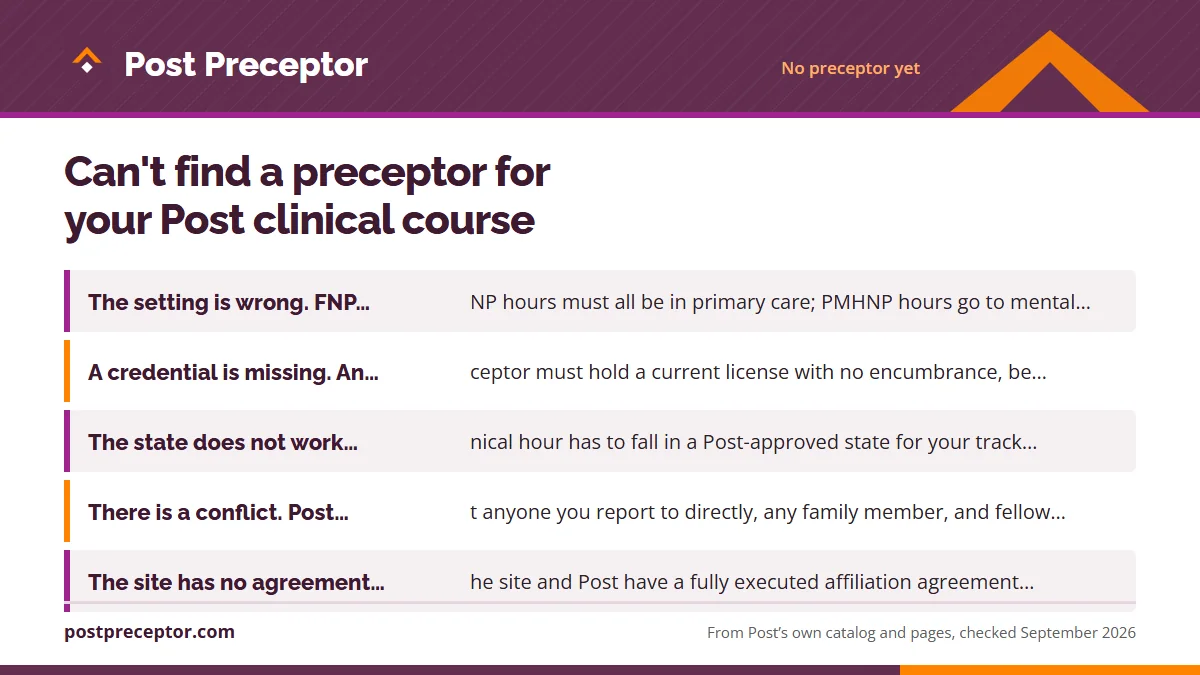
Five reasons a search stalls
- The setting is wrong. FNP and AGPCNP hours must all be in primary care; PMHNP hours go to mental and behavioral health sites whose patients span the lifespan. A willing preceptor in the wrong setting cannot be approved for your course.
- A credential is missing. An NP preceptor must hold a current license with no encumbrance, be nationally certified in your population focus, have master's or doctoral preparation, and bring a year or more of practice.
- The state does not work. Every clinical hour has to fall in a Post-approved state for your track, and one where your RN license is active.
- There is a conflict. Post rules out anyone you report to directly, any family member, and fellow students in your own program.
- The site has no agreement. Until the site and Post have a fully executed affiliation agreement, you cannot train there, and some organizations layer their own student onboarding on top.
Each cause has its own fix. Sorting your leads by cause stops you from calling more offices that will stall for the same reason.
Start where Post points you
Post's catalog assigns the choice of site and preceptor to you, and it names a first stop: "Start with the tracking system directory," meaning the preceptor listings in the student tracking system (Typhon). Work through it for your area and your course's patients before anything else, and keep a short log of who you contacted and why each one declined; the pattern tells you which of the five causes you are up against.
Next, move outward through people who know your clinical work: NPs and physicians you have worked alongside, former instructors, colleagues who finished NP programs, and the providers at your own organization. Your workplace can host you as long as the preceptor sits outside your reporting line; see clinicals at your workplace. The find-your-own-preceptor guide covers how to make the ask so a busy clinician says yes.
Widen by setting and by preceptor type
Once your first circle of contacts is used up, widen along the lines Post allows rather than at random.
For the FNP and AGPCNP, any primary care setting that sees your course's patients is worth a call. Plan N 589 early, because it needs obstetric, gynecological and pediatric patients, newborns through teenagers, seen in a primary care setting. The primary care sites page sets out what counts.
For the PMHNP, match the course: child and adolescent patients for N 563 (its focus in Post's 2024 schedule), adult and older adult patients in acute mental health or primary care settings for N 565, and adolescents experiencing substance misuse for N 567. Narrow populations like these reward an early start.
On preceptor type, a physician (MD or DO) qualifies. Post's catalog would like NPs to precept at least two of your clinical courses and ideally every one, so a physician can fill a hard gap without upsetting that balance when your other courses are NP-led.
Settle the state and license question first
Post ties NP students to approved states. Your home state has to be one marked Yes on Post's NP disclosure, and your RN license there must be active and unencumbered. Clinical work can take place only in approved states where your license is also valid, a compact RN license can satisfy the CastleBranch license item, and a clinical away from your home state needs prior specialization approval from Post.
Two special cases deserve a close look. Post's current NP disclosure lists California for the FNP and AGPCNP but not the PMHNP, and California students file an extra NP preceptor form. And a preceptor just across a state line may look convenient but can stall on approval, so check the rules on the RN license page before you ask.
How much time is really left
Count backward from the end of Week 1 of the clinical term, when the whole packet must be complete, including the signed preceptor agreement letter, the affiliation agreement, your CastleBranch compliance, the NP Clinical Schedule, and the preceptor's CV, certification and license report. Then subtract the steps that sit outside your control:
- the notice of up to 60 days that some state boards want for a clinical plan;
- as long as seven business days before Academic Affairs staff first reach a new site after your agreement request;
- any onboarding a hospital-owned site runs, which can take weeks;
- the Clinical Coordinator's review of the preceptor and site.
If your term starts in less than a month, go straight to need a preceptor fast.
When to bring in Post Preceptor
Post's tuition page anticipates students in exactly this spot: it tells NP students having a hard time that they may hire a company whose specialty is locating preceptors, with any cost of securing a preceptor or site falling to the student. Post Preceptor is built for that moment and for Post's rules in particular.
- A search aimed at your course's patients, in your approved state, close to home.
- Every candidate vetted on license, certification, degree, experience and conflicts before you are introduced.
- The preceptor agreement letter signed, and the license report, certification and CV collected.
- The affiliation agreement request started early, with your remaining preceptorships planned together.
Compare the routes on placement options, or send your course and term through the contact page.
Questions Post students ask
Will Post assign me a preceptor?
Post's model leaves the choice with you: the 2025-26 catalog makes each NP student responsible for selecting a site and preceptor for every clinical course, and the Clinical Coordinator then approves them. What Post supplies is the tracking system directory as a starting point, the approval review, and the affiliation agreement process once you have named a site.
Can I start a clinical course and find a preceptor during Week 1?
Only on paper. The documents Post expects by the close of Week 1 include a signed preceptor agreement letter, a fully executed affiliation agreement and the preceptor's documents, and a new site's agreement alone can take longer than a week to arrange. Beginning a term with no preceptor puts you at serious risk of removal from the course.
How many preceptors will I need across the program?
One approved preceptor and site for each preceptorship course: four courses in the FNP and AGPCNP and five in the PMHNP. Whether a single preceptor can host more than one of your courses depends on the patients each course requires and on the Coordinator's approval. Plan the narrow ones, such as N 589 or N 567, earliest.
Can my manager precept me if they are an NP?
Not if they are your direct supervisor. Post's rules exclude a direct-reporting relationship between preceptor and student, along with relatives and students in the same program. Another qualified NP or physician at your workplace, outside your reporting line, can be a strong option, as long as the setting fits your course.
Related pages
Last checked 2026-09-27
We check these pages against Post University's own catalog, program pages and published nursing documents. Your course faculty and the Clinical Coordinator have the final word.
Post asks you to select your own preceptor. We make the search the easy part.
Tell us your Post track, your city and your next preceptorship course. We line up preceptors who fit the course, collect the license report, certification and CV the Clinical Coordinator reviews, and start the affiliation agreement early so your Week 1 packet is complete before the term opens.
- Preceptors matched to the course: primary care for FNP and AGPCNP, mental and behavioral health for PMHNP, doctoral nurse leaders for DNP hours
- Preceptor agreement letter, license report, certification and CV ready for Post's approval
- Every preceptorship planned together, close to home in a state where you hold your license and Post's disclosure says yes
Start your placement plan
Track, city and next preceptorship course is all we need to begin.