Clinicals and practicums at your own workplace as a Post University student
Post University's published rules do not bar clinicals at your employer. An NP student can train where they work when the preceptor is outside their reporting line and unrelated to them, the setting fits the course, and the site has a fully executed affiliation agreement with Post. For non-NP MSN and DNP practice experiences, the workplace is often the natural site, because Post requires the preceptor to be employed there.
Get your placement plan
Tell us your Post program and where you live. A placement advisor replies with the preceptor and site options that fit your course.
What has to be true for a workplace placement
Nothing in Post's catalog, admissions pages or program pages forbids clinical hours at a student's own employer. What exists instead is a set of conditions, each of which applies exactly as it would at a stranger's practice:
- The preceptor has no "direct reporting relationship" with you at your place of employment and is not a relative.
- The preceptor meets Post's standard for your program; for NP students, an NP or physician with the license, certification, degree and experience Post asks for.
- The setting fits your track and the course: primary care for every FNP and AGPCNP hour, mental and behavioral health for the PMHNP.
- The site sits in a state where Post allows your clinicals and where your license is active.
- Post and the site have a fully executed affiliation agreement, and the Clinical Coordinator approves both the site and the preceptor.
Being on staff speeds up introductions, not approval. The file reaching the Coordinator is the same one any student submits, and the placement process overview shows its full path.
Does your workplace match the course?
Setting is where most workplace plans fail for NP students. Many working RNs are hospital-based, and an inpatient unit, however busy, is not a primary care setting. The better question is what else your employer runs.
Health systems often own outpatient practices, community clinics and behavioral health programs well away from the unit where you work. Aiming your search at those locations keeps the familiarity of your employer while meeting the setting rule.
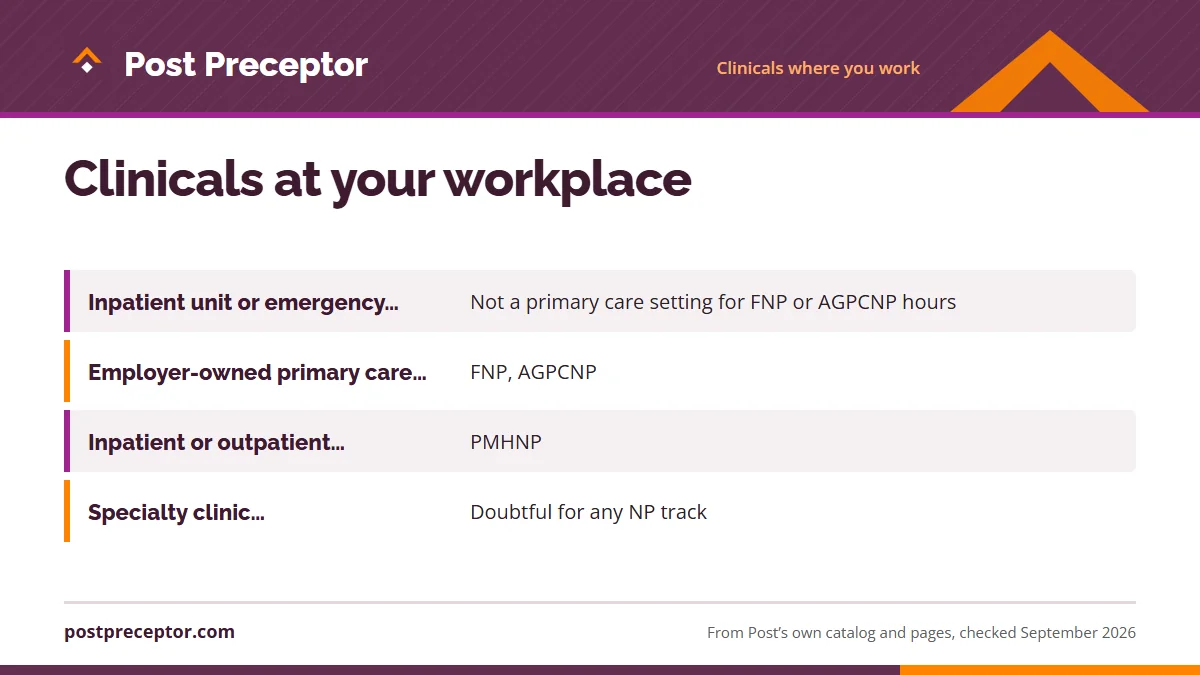
| Where you work | Likely fit | Check before you ask |
|---|---|---|
| Inpatient unit or emergency department | Not a primary care setting for FNP or AGPCNP hours | Whether the system runs primary care practices elsewhere |
| Employer-owned primary care practice | FNP, AGPCNP | The patient mix each course needs, such as children and prenatal care for N 589 |
| Inpatient or outpatient psychiatric service | PMHNP | Ages seen, since N 563 and N 567 center on young patients; N 565 names acute mental health settings |
| Specialty clinic (cardiology, oncology and similar) | Doubtful for any NP track | Ask the Clinical Coordinator before relying on it |
For what qualifies, see primary care sites or, for psychiatric settings, PMHNP sites.
Choosing a preceptor inside your own organization
The reporting rule narrows the field but rarely empties it. Your manager and anyone else who directly supervises you are out. A nurse practitioner or physician in a different department, a different clinic of the same system or a partner practice is not in your reporting line and can qualify. So can a clinician you work beside on shift, provided they do not manage you.
Two workplace habits cause trouble. The first is asking the obvious person, the NP who runs your unit, without checking whether you report to them on paper. The second is assuming that a friendly colleague's yes settles things; the preceptor still needs the certification and experience Post requires, and still signs the agreement letter and supplies a license report and CV. The who cannot precept you page covers the borderline relationships.
Keep the two roles apart once the term starts: on clinical days you are a student under your preceptor, not an employee covering a shift.
The paperwork still applies to your employer
Employment does not replace the school-to-site contract. NP students need a fully executed affiliation agreement with every site, the DNP requires one for every precepted experience, and non-NP MSN courses need one when the site asks. Request it through Post's Affiliation Agreement Tracker and give the name of whoever handles student or academic contracts, which in a large system is often an education or human resources office rather than your department. The affiliation agreement guide explains what follows.
Your employer may also run its own student process. One public example: UConn Health requires a clinical affiliation agreement for any unpaid assignment that earns academic credit, arranged between the school and the host department. Ask early whether your organization has something similar, since a separate internal track can take weeks.
Your employee file does not satisfy Post either. CastleBranch compliance, including the annual background check and drug screen for NP students, stays your responsibility, and your RN license report belongs in the Week 1 packet.
Student hours versus paid hours
Post's published rules do not say whether time worked as a paid employee can also count as clinical hours. Ask the Clinical Coordinator before you plan on any overlap. The sound default is separate student days, set out on your NP Clinical Schedule, logged in Typhon, and spent on the patients the course calls for under the preceptor's supervision. At about 17 clinical hours a week for a 135-hour course, that usually means arranging reduced or rearranged shifts with your manager well before the term.
Coverage questions can come up too. American Sentinel's 2021 catalog listed professional liability and student malpractice insurance among student requirements, while Post's 2025-26 NP lists name health insurance only. If your workplace asks what liability coverage a Post student carries, get the current answer from the Clinical Coordinator rather than relying on either catalog.
DNP and non-NP MSN students: the workplace as the default
For the DNP, Post expects the workplace. The program page says students must secure access and permission to a suitable site for their practice experience and DNP project, and that most use their place of employment. Applicants who are not employed must verify access to a healthcare facility, and the admissions advisor can help with finding a practice site. The preceptor must be a nurse with a doctoral degree employed at the site, and each precepted experience needs an active, unexpired affiliation agreement.
Non-NP MSN students in precepted practice experiences also need a preceptor employed at the site, holding a master's or higher and a current RN license, which makes an employer the obvious place to look. The DNP practice hours page covers the doctoral detail.
When your workplace covers some courses but not all
A workplace that suits N 581 may have no children or prenatal patients for N 589, and an adult psychiatric service may have nothing for the adolescent focus of N 567. Most students who train at work still need one or two outside placements, and those are the ones to plan first.
Post Preceptor finds the preceptorships your employer cannot host, in your approved state and close to home, and checks your workplace preceptor against Post's rules too. We collect the documents, get every agreement letter signed and open each affiliation request early, so every course has a complete Week 1 file. Tell us which courses your workplace covers through the contact form.
Questions Post students ask
Can I do my Post NP clinical hours at the hospital where I work?
Only in a part of the organization that fits your course. FNP and AGPCNP hours must all be in primary care, so an inpatient unit does not qualify, but the hospital's outpatient primary care practices might. PMHNP students can look at the system's psychiatric and behavioral health services. The preceptor must not be anyone you report to.
Do I need an affiliation agreement if I already work at the site?
Yes for NP clinicals: Post requires a fully executed agreement with each site, and your employment does not replace it. DNP students need an active agreement for every precepted experience. Request it through the Affiliation Agreement Tracker as soon as the preceptor agrees, since first contact from Post can take up to seven business days.
Can my paid shifts count toward my clinical hours?
Post's published rules do not address it, so ask the Clinical Coordinator before counting on any overlap. Clinical hours are logged in Typhon against a preceptor and a course, and they need the patients that course names. Most students plan separate clinical days and adjust their work schedule to fit roughly 17 hours a week.
I am a Post DNP applicant without a job. Where do my practice hours happen?
Post's admissions rules ask applicants who are not employed to verify access to a suitable healthcare facility, and the DNP page says the admissions advisor can help you find a practice experience site. The preceptor must be a doctorally prepared nurse employed at that site, and the site needs an affiliation agreement with Post.
Related pages
Last checked 2026-09-27
We check these pages against Post University's own catalog, program pages and published nursing documents. Your course faculty and the Clinical Coordinator have the final word.
Post asks you to select your own preceptor. We make the search the easy part.
Tell us your Post track, your city and your next preceptorship course. We line up preceptors who fit the course, collect the license report, certification and CV the Clinical Coordinator reviews, and start the affiliation agreement early so your Week 1 packet is complete before the term opens.
- Preceptors matched to the course: primary care for FNP and AGPCNP, mental and behavioral health for PMHNP, doctoral nurse leaders for DNP hours
- Preceptor agreement letter, license report, certification and CV ready for Post's approval
- Every preceptorship planned together, close to home in a state where you hold your license and Post's disclosure says yes
Start your placement plan
Track, city and next preceptorship course is all we need to begin.