Primary care clinical sites for Post FNP and AGPCNP students
Post University's FNP and AGPCNP students spend every precepted hour, all 540 of them, in primary care, and the Clinical Coordinator approves each site. The catalog does not publish a definition or a list of qualifying site types, so the practical skill is picking practices whose patients match each preceptorship and settling edge cases with the Coordinator before you commit.
Get your placement plan
Tell us your Post program and where you live. A placement advisor replies with the preceptor and site options that fit your course.
The rule, and who decides
The 2025-26 catalog is short on this point: FNP and AGPCNP students "will complete all of their clinical hours in a primary care setting." That covers each of the four preceptorships in both tracks, from N 581 to N 599. PMHNP students follow a different rule, mental and behavioral health settings with patients of all ages, explained in the PMHNP sites guide.
Post's published text stops there. It does not define primary care or name the kinds of site that qualify, and the NP Clinical Guidelines it refers to are not public. The Clinical Coordinator approves both the site and the preceptor for every clinical experience, so that office's reading of "primary care" is the one that counts. A clear description of the practice, its patients and your preceptor's role makes that approval quicker.
Match the practice to the course
A practice can be unmistakably primary care and still be a poor fit for a particular course, because each preceptorship names a patient group. The descriptions below come from Post's 2021-22 course descriptions, the newest that could be read.
| Course | Track | Patients in the description | Practices to consider |
|---|---|---|---|
N 581 | FNP, AGPCNP | Adolescents, adults and older adults with stable, chronic and acute diseases | Family medicine, internal medicine, adult primary care |
N 583 | FNP, AGPCNP | The same ages with more complex acute and chronic problems (from N 582) | Busy practices with a large chronic disease panel |
N 585 | AGPCNP | Older adults (from the course title and N 584) | Primary care practices with many patients over 65 |
N 589 | FNP | Obstetric, gynecological and pediatric patients, birth through adolescence | Family practices with pediatric and women's health volume; pediatric or women's health offices |
N 599 | FNP, AGPCNP | Integration; N 598 sets a quality improvement project in primary care | A practice that sees your whole track population |
Which course belongs to which track is read from course prerequisites rather than printed by Post. Each course page, such as N 589, goes deeper into its own fit.
How the rule tightened
The requirement was not always this firm. For the FNP, the 2021-22 catalog only recommended completing every hour in primary care, and the 2022-23 catalog made it a requirement. The AGPCNP kept a narrow exception for longer: its students could spend a limited amount of time outside primary care with approval until the 2024-25 catalog removed that option.
The practical upshot is that advice from earlier graduates may not hold. A specialty rotation that counted for an AGPCNP student a few years ago would need the Clinical Coordinator's approval under today's rule, if it is allowed at all. The clinical hours history page traces the rest of the changes.
Sites to ask about before you commit
Some settings see primary-care-style patients without being a conventional primary care office. Post's published rules do not sort them one way or the other, so raise each with the Clinical Coordinator before you ask a preceptor to sign or send an affiliation agreement request:
- Urgent care centers and walk-in clinics, which see acute problems but may not follow patients over time
- Retail clinics inside pharmacies or stores
- Specialty practices such as cardiology, endocrinology or dermatology, even when the patients are complex
- Hospital-owned outpatient departments that mix primary and specialty care
- Telehealth-only practices
- Employer or school health clinics with a narrow patient group
A clear answer before the term protects you from learning in Week 1 that the site will not be approved. Aging-focused settings, such as long-term care, are discussed on the N 585 page.
Vetting a primary care practice, step by step
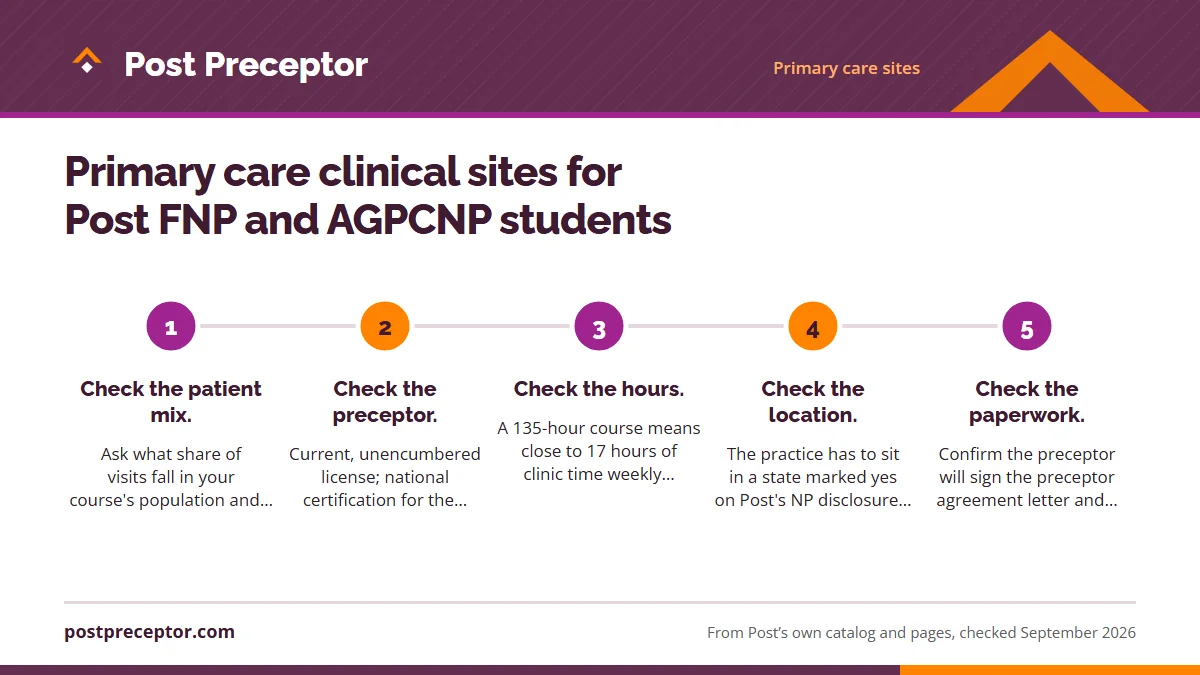
- Check the patient mix.Ask what share of visits fall in your course's population and how often the preceptor handles the kind of problems the course names.
- Check the preceptor.Current, unencumbered license; national certification for the population focus; a graduate degree when the preceptor is an APRN; a year or more in practice. Physicians qualify too. Rule out anyone you report to, family members and fellow students in your program. See preceptor requirements.
- Check the hours.A 135-hour course means close to 17 hours of clinic time weekly across the term. Ask which days the preceptor can take a student and whether other students already hold those days.
- Check the location.The practice has to sit in a state marked yes on Post's NP disclosure where you also hold an active license, and a state other than your home state needs prior approval. See RN license for clinicals.
- Check the paperwork.Confirm the preceptor will sign the preceptor agreement letter and share a license report, certification and CV, and that the practice is willing to sign the affiliation agreement you will request in the Tracker.
- Check the onboarding.Ask whether the practice or its health system has its own student onboarding, and how far ahead it needs your forms.
When a health system owns the practice
Many primary care offices belong to larger systems, and some of those systems publish their own student processes, separate from Post's. In Connecticut, Trinity Health Of New England's learner onboarding for Saint Francis and Mount Sinai Rehabilitation stops any learner whose school lacks an active affiliation agreement, and it wants the Learner Health Certification Form four or more weeks ahead of the first day. UConn Health wants the school to arrange an agreement directly with the host department. Community Health Center, Inc., the Middletown health center, wants the school rather than the student to make first contact.
Hartford HealthCare's new student platform, Clinician Nexus, does not yet include nursing rotations. These are each system's own published steps, and Post names no clinical partners. The lesson travels to every state: ask early whether a practice's parent system adds forms or lead time. The Connecticut NP preceptors page covers the home-state systems in more depth.
Why FNP and AGPCNP students let us find the practice
Our search starts with the patients each course calls for, then every practice near you goes through the checks above before an introduction: patient mix, the preceptor's credentials measured against Post's standard, weekly availability, the state rule and any health-system onboarding. The preceptor's documents are gathered for the Clinical Coordinator, the agreement letter is signed, and the affiliation request is filed early.
If a site looks borderline under the primary care rule, we tell you so the Clinical Coordinator can weigh in before any signature. Tell us your track and your next preceptorship in the form below.
Questions Post students ask
Does urgent care count as primary care for Post's FNP?
Post's published catalog does not say. It requires every FNP and AGPCNP hour in a primary care setting and leaves the site decision to the Clinical Coordinator. Describe the clinic's patients and whether it follows them over time, and get an answer before you commit. A conventional primary care practice avoids the question.
Can I do my primary care hours at a clinic my employer runs?
Clinicals at your own workplace are possible at Post when the setting and preceptor meet its rules and the preceptor is not someone you report to. The clinic still has to count as primary care and have an affiliation agreement. See practicum at your workplace for the details.
How far ahead should I contact a primary care practice?
Aim for at least a full term before the preceptorship. The Week 1 packet is due at the start, Academic Affairs needs up to seven business days just to make first contact with a site, some state boards expect notice of your clinical plan as much as 60 days in advance, and health systems can add weeks of onboarding.
Do Post PMHNP students need primary care hours?
No. PMHNP students train at mental and behavioral health sites serving patients across the lifespan. One PMHNP course, N 565, does name primary care alongside acute mental health settings for adults and older adults, so a psychiatric service inside a primary care practice can be relevant there.
Related pages
Last checked 2026-09-27
We check these pages against Post University's own catalog, program pages and published nursing documents. Your course faculty and the Clinical Coordinator have the final word.
Post asks you to select your own preceptor. We make the search the easy part.
Tell us your Post track, your city and your next preceptorship course. We line up preceptors who fit the course, collect the license report, certification and CV the Clinical Coordinator reviews, and start the affiliation agreement early so your Week 1 packet is complete before the term opens.
- Preceptors matched to the course: primary care for FNP and AGPCNP, mental and behavioral health for PMHNP, doctoral nurse leaders for DNP hours
- Preceptor agreement letter, license report, certification and CV ready for Post's approval
- Every preceptorship planned together, close to home in a state where you hold your license and Post's disclosure says yes
Start your placement plan
Track, city and next preceptorship course is all we need to begin.