Affiliation agreements at Post: one signed contract for every clinical site
Every site where a Post University NP student trains needs a fully executed affiliation agreement with the American Sentinel College of Nursing & Health Sciences, and that agreement is one of the items due by the end of Week 1. You start it by submitting the site through Post's Affiliation Agreement Tracker. A member of the Academic Affairs staff then reaches the contact you named within seven business days, and the signing runs on the site's clock from there.
Get your placement plan
Tell us your Post program and where you live. A placement advisor replies with the preceptor and site options that fit your course.
The contract behind every clinical site
The preceptor agreement letter binds a person; the affiliation agreement binds the organization. It is a contract between the American Sentinel College (ASC, in Post's catalog) and the facility you have chosen, and "fully executed" means both sides have signed. Post's 2025-26 catalog lists the affiliation agreement among the Week 1 items for every NP clinical course, and the requirement reaches beyond the NP tracks in some programs. Once you have chosen a site, the catalog says the American Sentinel College will work with the facility to complete the agreement.
| Program or experience | Agreement needed? |
|---|---|
| MSN FNP, AGPCNP and PMHNP clinical courses | Yes, fully executed with each site by the end of Week 1 |
| DNP precepted practice experiences | Yes, for every one |
| Non-NP MSN precepted practice experiences | When the site requires one |
| Practice learning experiences (no preceptor) | No |
| RN to BSN | No preceptor, so no site contract |
One line in the same catalog section says most, but not all, facilities require an agreement. That line reads as general guidance, while the NP Week 1 list names the agreement outright, so ask the Clinical Coordinator before assuming any NP site can go without one. Your own employer counts as a site too. Training where you work still needs an agreement, even when the preceptor is a colleague outside your reporting line; see clinicals at your workplace.
Using the Affiliation Agreement Tracker
The Tracker is an online request form, built in JotForm, that Post uses to open a contract between ASC and a facility. Reach it through Post's current clinical instructions or the Clinical Coordinator rather than a saved link, so you use the live version.
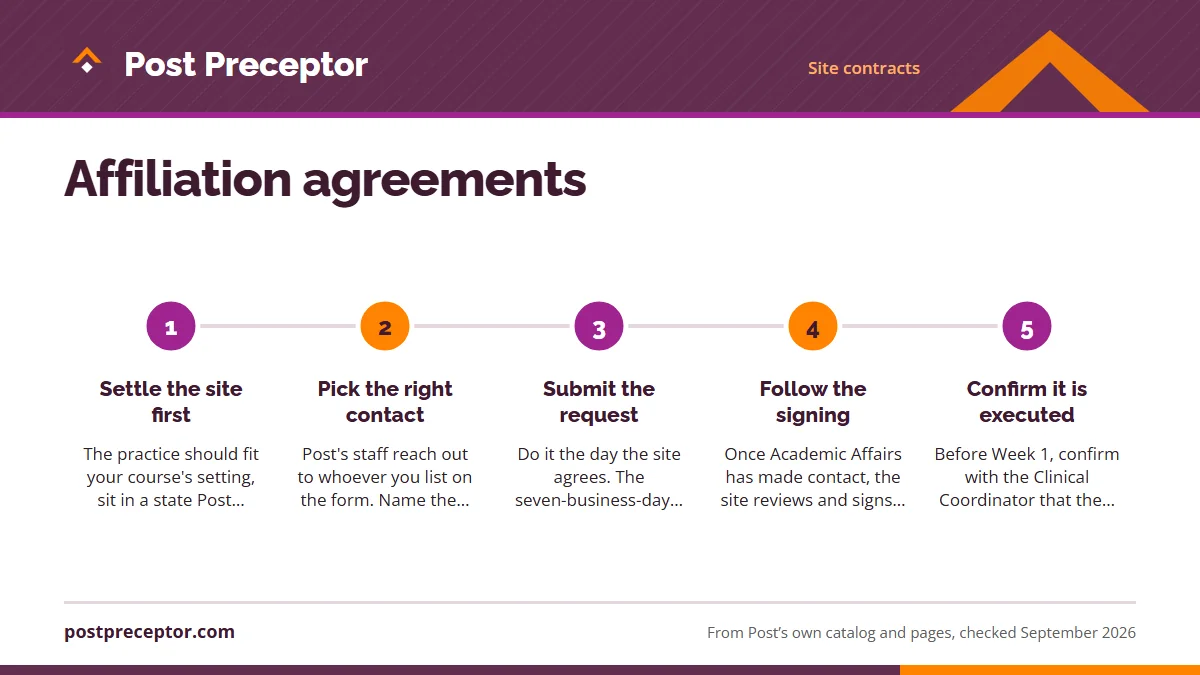
- Settle the site firstThe practice should fit your course's setting, sit in a state Post approves for your track, and have a preceptor who has agreed. A contract for the wrong site is wasted effort.
- Pick the right contactPost's staff reach out to whoever you list on the form. Name the person who can route a contract at that organization, such as the practice manager or an education or contracts office, and tell them to expect the outreach.
- Submit the requestDo it the day the site agrees. The seven-business-day window opens on submission, not when you first spoke to the practice.
- Follow the signingOnce Academic Affairs has made contact, the site reviews and signs on its own timeline. Keep your contact warm and ask how the review is going each week.
- Confirm it is executedBefore Week 1, confirm with the Clinical Coordinator that the agreement is fully signed. A request in progress is not a completed item.
Seven business days is only the opening move
Post's catalog commits Academic Affairs to reaching the site contact within seven business days of your submission. On a calendar that is at least nine days, more when a holiday falls inside it. What follows is out of Post's hands and yours: the site's legal review, any edits it asks for, and its own signature process. Post does not publish a typical time to full execution, so treat the whole process as a matter of weeks.
That arithmetic is why the request belongs in the term before your preceptorship, while you are in the paired didactic course. A request filed during Week 1 cannot realistically finish in Week 1. The Week 1 deadline page sets the agreement alongside the other packet items and works back from the term's first Monday.
Seven business days covers Post's first contact with the site, not the signatures. File the Tracker request the day a site says yes.
An agreement on file is a head start, not an approval
Some facilities already hold an agreement with Post from an earlier student. That can spare you the contract step, but Post's catalog is plain that an existing agreement is no promise you will be approved at that facility. The Clinical Coordinator still reviews your preceptor and whether the setting fits your particular course.
Post publishes no list of clinical partners, so ask the Clinical Coordinator whether a site you are considering already has an agreement in force. Then check the preceptor against the preceptor requirements exactly as you would at a new site, and send the signed preceptor agreement letter with the usual documents. An agreement already in force also leaves the rest of the Week 1 packet untouched, and a hospital-owned facility may still run its own learner onboarding before your first day.
Health systems that run their own onboarding
Large health systems often layer their own student process on top of the school contract. Several in Connecticut publish theirs. These are each system's own published steps for learners from any school; none describes Post as a partner.
| System | What its own page asks |
|---|---|
| Trinity Health Of New England (Saint Francis, Mount Sinai Rehabilitation) | An active affiliation agreement with the school before a learner can go further; its Learner Health Certification Form at least 4 weeks before the start date; then orientation, onboarding forms and badging |
| UConn Health | For academic credit, an affiliation agreement established by the school directly with the host department |
| Hartford HealthCare | A new student platform, Clinician Nexus, for school rotation requests; nursing rotations are outside its current phase |
| Community Health Center, Inc. (Middletown) | The student's school, not the student, makes the request |
The lesson carries to every state. Before you commit to a practice owned by a larger system, ask whether the parent organization adds forms, lead time or a school-first request. The Connecticut NP preceptors page covers Post's home state in more depth.
Where agreement requests stall
- The wrong contact on the form. A front-desk address or a preceptor who has no say over contracts can leave Post's first message unanswered.
- A parent organization that must sign. The practice may agree, but the contract goes to a system office with its own queue.
- A school-first rule. Some organizations will only respond to a request that comes from the school, which is exactly what the Tracker sets in motion.
- A late start. A request filed a week before the term leaves no room for a single round of edits.
- A changed site. If your preceptor moves practices, the new location needs its own agreement and its own approval.
Most of these surface in one early conversation. Ask your preceptor who signs student contracts, whether a parent office has to be involved, and how long the last school agreement took there, then plan the request around the answers.
Why Post students let us handle the site side
The affiliation agreement is where a confirmed preceptor most often turns into a missed Week 1, and it is the step we plan earliest. Post Preceptor treats the site contract as part of the placement, not an afterthought.
- We favor sites whose contract route we can map before you commit, and we tell you when a parent system adds its own onboarding.
- We identify the person at the site who can sign or route a contract and prepare them for Post's outreach.
- We have the site details ready so your Tracker request goes in the week the practice agrees, a full term ahead where possible.
- We check on the signing each week until the agreement is executed, while the rest of your packet comes together.
See how it works, or tell us your course and term on the contact page.
Questions Post students ask
Who should I list as the site contact on the Tracker form?
Someone who can move a contract, not just someone who likes the idea. At a small practice that is often the owner or practice manager; at a larger organization it may be an education, legal or contracts office. Ask your preceptor who signs student agreements there, confirm that person is expecting Post's outreach, and list them.
Does Post already have agreements with major health systems?
Post does not publish a list of clinical partners, and nothing on its public pages names one. Ask the Clinical Coordinator whether an agreement is already in force with the facility you are considering. Even when one exists, Post's catalog makes clear it is no promise of approval there; your preceptor and course fit are still reviewed.
Do I need a new agreement if I stay with the same site for my next course?
Post's requirement follows the site, so staying put does not by itself call for a new request. The catalog's DNP wording asks students to make sure the agreement is active and unexpired, and the same check makes sense for NP courses: confirm its status with the Clinical Coordinator before the next Week 1. Moving to a new practice, even with the same preceptor, starts a new request.
Does the DNP need affiliation agreements?
Yes. Post's 2025-26 catalog requires an affiliation agreement for every precepted experience in the DNP, and DNP preceptors must be nurses with a doctoral degree. Non-NP MSN students need one for a precepted practice experience when the site requires it. The DNP practice hours page covers the doctoral rules.
Can I submit the Tracker request before my preceptor is confirmed?
You can, but a contract for a site that falls through wastes the site's goodwill and Academic Affairs' time. The better order is a qualified preceptor who has said yes, a setting that fits your course, then the request the same day. That sequence keeps the agreement tied to a placement that will actually happen.
Related pages
Last checked 2026-09-27
We check these pages against Post University's own catalog, program pages and published nursing documents. Your course faculty and the Clinical Coordinator have the final word.
Post asks you to select your own preceptor. We make the search the easy part.
Tell us your Post track, your city and your next preceptorship course. We line up preceptors who fit the course, collect the license report, certification and CV the Clinical Coordinator reviews, and start the affiliation agreement early so your Week 1 packet is complete before the term opens.
- Preceptors matched to the course: primary care for FNP and AGPCNP, mental and behavioral health for PMHNP, doctoral nurse leaders for DNP hours
- Preceptor agreement letter, license report, certification and CV ready for Post's approval
- Every preceptorship planned together, close to home in a state where you hold your license and Post's disclosure says yes
Start your placement plan
Track, city and next preceptorship course is all we need to begin.