The preceptor agreement letter and the three documents behind it
At Post University a willing preceptor becomes an approvable one when four papers reach the Clinical Coordinator: the signed preceptor agreement letter, plus that clinician's license report, national certification and CV. All four sit in the packet due by the end of Week 1 of each NP clinical course, so collect them the same week a preceptor says yes rather than the week the term opens.
Get your placement plan
Tell us your Post program and where you live. A placement advisor replies with the preceptor and site options that fit your course.
Four papers, one approval decision
Post's 2025-26 catalog lists the preceptor agreement letter and "the preceptor's license report, certification and CV" among the items a nurse practitioner student must have complete by the close of Week 1. Each one answers a different question the Clinical Coordinator asks before approving your preceptor.
| Document | What it shows the Clinical Coordinator | Who supplies it |
|---|---|---|
| Preceptor agreement letter | The clinician has agreed, in writing, to precept you for this course | Your preceptor signs Post's current version |
| License report | A current license with no encumbrance | A verification from the preceptor's licensing board |
| Certification | National certification in the population your track serves | Proof from the certifying body |
| CV | Graduate preparation, a year or more of experience, and the current setting | Your preceptor, updated to the present role |
Post's catalog places the forms inside the student tracking system and says the preceptor approval process begins when you upload the appropriate forms there. It also makes you, not the preceptor, responsible for getting the documents completed and to the Clinical Coordinator on time. The letter's wording is not on Post's public pages, and neither are the NP Clinical Guidelines the catalog refers to, so download the current form from the tracking system and ask the Coordinator how each attachment should be sent.
What signing commits a preceptor to
A preceptor who signs is agreeing to more than a name on a form. Post's other rules show what the role involves in practice, and a preceptor who hears this up front is far less likely to back out in week 3.
- Your clinical days for the whole term. The NP Clinical Schedule, another Week 1 item, sets out the dates you will be on site. A 135-hour preceptorship averages about 17 hours weekly over the eight weeks (our arithmetic).
- Patients who fit the course. Every FNP and AGPCNP hour in primary care; PMHNP hours in psychiatric and behavioral health settings, with the population each course names.
- Evaluations in the tracking system. Post's clinical staff help preceptors get into Typhon and finish student evaluations, as a Post job posting for the clinical team describes. See the Typhon guide.
- Approval by Post. The Clinical Coordinator reviews the preceptor and the site; the signature starts that review rather than replacing it.
The license report: current, clean and in the right state
Post asks for a preceptor with a "current unencumbered state license." A license report pulled from the licensing board's own lookup shows both halves of that phrase: the expiration date and whether any discipline or restriction is on file. Pull it close to submission, not months earlier, so the Coordinator sees today's status.
Check the state as well. Your clinical hours can only happen in a state on Post's approved list for your track where your own RN license is also active, so the preceptor's license should be for that same state. If the license renews during your term, send the renewed report once it posts. The RN license page covers the student side of the state rule.
Physicians can precept Post NP students too; the catalog accepts an MD or DO. Their license report comes from the medical board rather than the nursing board, and the same current, unencumbered test applies.
Certification and CV: proving the match
National certification has to be in the population focus your course serves. A family NP certificate is the natural fit for the FNP, an adult-gerontology primary care certificate for the AGPCNP, and a psychiatric-mental health certificate for the PMHNP. If your preceptor's certification differs from your track, raise it with the Clinical Coordinator before the letter is signed, not after. For a physician preceptor, ask what Post accepts in place of NP certification.
The CV carries the rest of Post's standard. NP preceptors must hold a master's or doctoral degree and bring one or more years of experience, and the CV should show both with dates. It should also show the current practice, since that is how the Coordinator sees that the setting fits your course. A CV last updated three jobs ago invites a question that costs you days.
Post also recommends an NP preceptor for at least two clinical courses in your track and would prefer one for every course. Count ahead before you choose a physician for one course; the preceptor requirements page lays out the full standard.
Getting the letter signed early
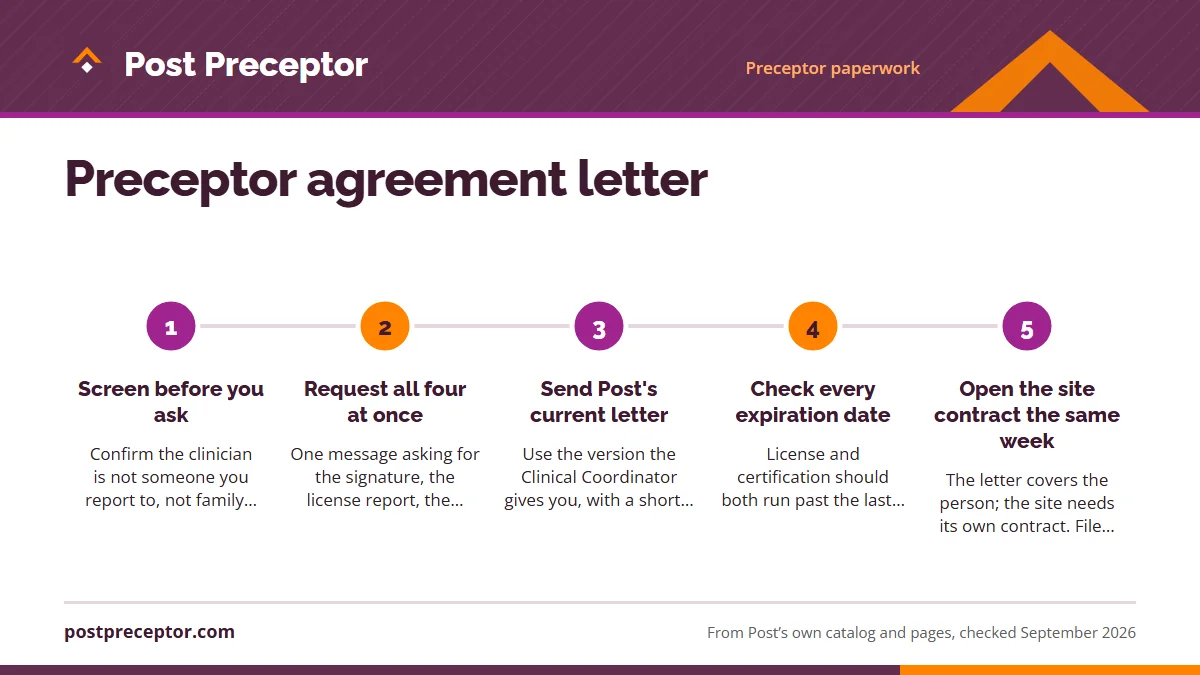
- Screen before you askConfirm the clinician is not someone you report to, not family and not a fellow student in your program. The who cannot precept you page explains each exclusion.
- Request all four at onceOne message asking for the signature, the license report, the certification and a current CV is answered faster than four separate follow-ups.
- Send Post's current letterUse the version the Clinical Coordinator gives you, with a short note naming the course, the term dates and the setting it needs.
- Check every expiration dateLicense and certification should both run past the last day of the term, or you need the renewal in hand.
- Open the site contract the same weekThe letter covers the person; the site needs its own contract. File the affiliation agreement request as soon as the practice agrees.
A signature from a clinician who misses one of Post's rules still fails review. Check license, certification, degree, experience and relationship before you ask anyone to sign.
One letter per course, and a few special cases
Each NP clinical course has its own Week 1 check, so expect to submit the letter and the preceptor's documents again for every preceptorship, even with the same clinician, unless the Clinical Coordinator tells you otherwise. Keeping a preceptor from N 581 into N 583 still saves real time: the relationship exists, the site's agreement is already in place, and only the dates need refreshing.
California students file one more piece, the NP preceptor form Post's catalog lists for California students only; the state board notification page covers it. Students in non-NP MSN specializations and the DNP follow different preceptor rules, including a doctorally prepared nurse for DNP work. When no qualifying preceptor can be found, those students can petition for an alternate through the Exception to Preceptor Requirements form, sent to the Practicum Coordinator along with a CV or resume for the person proposed; the form sits under Required Documents in the course.
Why Post students hand this paperwork to us
Collecting four documents from a busy clinician is where many searches lose weeks. Post Preceptor makes it one clean step, because we treat the paperwork as part of the placement itself.
- Every preceptor we introduce has already been screened on license, certification, degree, experience and relationships under Post's rules.
- We gather the license report, certification and current CV at the introduction and get the preceptor agreement letter signed on Post's current form.
- We compare every expiration date with your term dates and chase renewals before they become a Week 1 problem.
- We plan the same preceptor, or the next one, for your following course while this one runs.
How it works lays out each step; to begin, share your course and term on the contact page.
Questions Post students ask
Where do I get Post's preceptor agreement letter?
From the student tracking system, not from a template found online. Post's catalog says the forms are located there and that approval begins when you upload them back. Post publishes no public copy of the letter, so use the current version from the system, and ask the Clinical Coordinator if anything about the form or the three attachments is unclear.
Does a physician preceptor sign the same letter?
Post's 2025-26 catalog opens precepting to physicians with an MD or DO, and its Week 1 list sets out no separate physician letter. Expect the same agreement, a license report from the state medical board and a CV. Ask the Clinical Coordinator what Post accepts in place of national NP certification, and remember Post's recommendation that NPs precept at least two of your courses.
What if my preceptor's certification lapses mid-term?
Post's standard is current national certification, so a lapse during your course is something the Clinical Coordinator needs to hear about at once. Check the expiration date before the letter is signed. If renewal falls inside the term, ask your preceptor to renew early and send the new proof to the Clinical Coordinator as soon as it arrives.
How early can I collect the letter and documents?
As soon as a qualified preceptor agrees to host you, ideally during the term before the preceptorship. Early collection leaves time to fix a stale CV or an expiring license. Recheck the license report shortly before Week 1 so the Coordinator sees a current status, and keep copies ready for your next course.
Can my preceptor be my manager if the letter is signed?
No signature changes Post's relationship rules. Your direct supervisor, a family member or a fellow student in your program cannot precept you. Another qualified NP or physician at the same organization who sits outside your reporting line can, provided the setting fits your course and the Clinical Coordinator approves.
Related pages
Last checked 2026-09-27
We check these pages against Post University's own catalog, program pages and published nursing documents. Your course faculty and the Clinical Coordinator have the final word.
Post asks you to select your own preceptor. We make the search the easy part.
Tell us your Post track, your city and your next preceptorship course. We line up preceptors who fit the course, collect the license report, certification and CV the Clinical Coordinator reviews, and start the affiliation agreement early so your Week 1 packet is complete before the term opens.
- Preceptors matched to the course: primary care for FNP and AGPCNP, mental and behavioral health for PMHNP, doctoral nurse leaders for DNP hours
- Preceptor agreement letter, license report, certification and CV ready for Post's approval
- Every preceptorship planned together, close to home in a state where you hold your license and Post's disclosure says yes
Start your placement plan
Track, city and next preceptorship course is all we need to begin.