FNP, AGPCNP or PMHNP at Post: the three NP tracks side by side
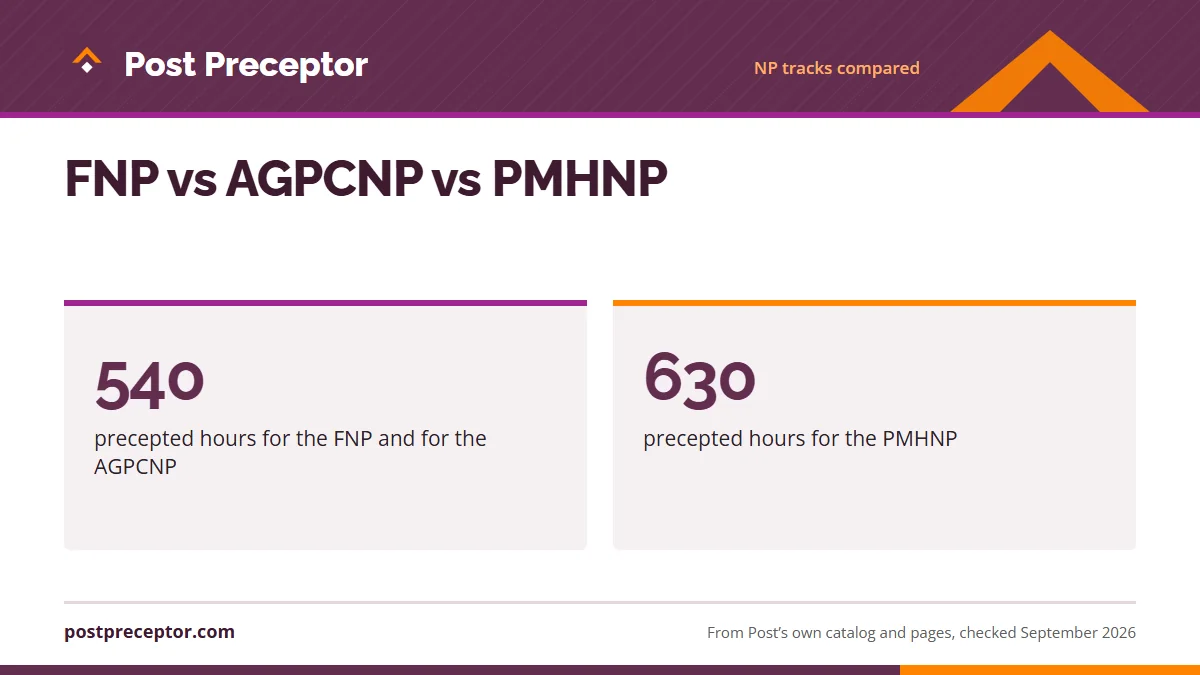
Post University's three nurse practitioner tracks share one entrance, the 3P gate, and one rule: you secure your own preceptors. After that they split. The FNP and AGPCNP each ask for 540 precepted hours in primary care across four courses, while the PMHNP asks for 630 in mental and behavioral health across five, and the real difference for your search is the kind of preceptor each course calls for.
Get your placement plan
Tell us your Post program and where you live. A placement advisor replies with the preceptor and site options that fit your course.
The headline numbers
Credits and program length below come from Post's program pages. Hours and time limits come from the 2025-26 catalog, the latest one available to read in full, so confirm them in the current catalog.
| Item | FNP | AGPCNP | PMHNP |
|---|---|---|---|
| Credits | 42-45 | 42-45 | 51-54 |
| Advertised length | 28 months | 28 months | 34 months |
| Catalog time limit | 36 months | 36 months | 42 months |
| Precepted clinical hours | 540 | 540 | 630 |
| Preceptorship courses | 4 | 4 | 5 |
| Clinical setting | Primary care only | Primary care only (since 2024-25) | Mental and behavioral health, patients across the lifespan |
| California, per Post's NP disclosure | Listed | Listed | Not listed |
The PMHNP's extra credits and hours trace back to a longer course list: eleven specialty courses, N 559 Psychotropic Pharmacology among them, and a fifth preceptorship. By our arithmetic, four 135-hour courses and one 90-hour course add up to its 630. Each track has its own guide: the FNP, the AGPCNP and the PMHNP.
What every Post NP student shares
Pick any of the three and the machinery around each preceptorship is the same. Only the preceptor profile changes.
Common to all three tracks
- The 3P gate:
N 512,N 521andN 522PEat a 3.0 GPA, then the APEA 3P exam at 67% or better. How the 3P gate works. - Online study in 8-week terms, one course per term, with some mandatory live sessions.
- A preceptor and site you find for each clinical course, both approved by the Clinical Coordinator.
- A fully executed affiliation agreement with every site, plus a CastleBranch account kept compliant from start to finish, with its background check and drug screen renewed yearly.
- The end-of-Week-1 packet in every clinical course, on pain of removal from that course.
- A B (83%) or higher in each nursing course, one repeat per NP course, and a single NP-specific repeat once the 3P exam is passed.
- Home and an active unencumbered RN license in an approved NP state, with clinicals only in approved states where you are licensed.
Preceptorship courses by track
The table lists each track's preceptorships in catalog number order, which is not necessarily the order you take them. An hour figure appears only where a 2021-22 course description published one; elsewhere the track totals imply it.
| Track | Course | Patients and setting | Hours |
|---|---|---|---|
| FNP, AGPCNP | N 581 Advanced Practice Nursing I | Adolescents to older adults, primary care | 135 |
| FNP, AGPCNP | N 583 Advanced Practice Nursing II | More complex acute and chronic problems, primary care | Implied 135 |
| FNP | N 589 Maternal and Child Care | Obstetric, gynecological and pediatric, birth through adolescence, primary care | 135 |
| AGPCNP | N 585 Complex Concepts of Aging | Older adults, primary care | Implied 135 |
| FNP, AGPCNP | N 599 Integration | Primary care, alongside the N 598 quality-improvement project | Implied 135 |
| PMHNP | N 561 Advanced Practice Psych Nursing I | Mental and behavioral health | Implied 135 |
| PMHNP | N 563 Advanced Practice Psych Nursing II | Child and adolescent, per the 2024 schedule's title | Implied 135 |
| PMHNP | N 565 Advanced Practice Psych Nursing III | Adults and older adults, primary care and acute mental health settings | 135 |
| PMHNP | N 567 Psych Specialty for Advanced Practice | Adolescents experiencing substance misuse, various settings | 90 |
| PMHNP | N 569 Advanced Practice Psych Nursing Integration IV | Integration | Implied 135 |
Full catalog titles end in "Preceptorship Experience" (N 585 says "Preceptor Experience"). Each course has a guide of its own, and the clinical hours page explains the totals, including the catalog footnote that disagrees with its own table.
The preceptor each track needs
FNP. Primary care NPs or physicians whose patients span the ages, plus one course's worth of pediatric and women's health for N 589. The catalog asks for certification in the population focus, and the Clinical Coordinator decides which certifications fit each course.
AGPCNP. Adult and older-adult primary care, with enough adolescents to match N 581 and an older-leaning panel for N 585. Hospital and long-term care settings are outside the current rule unless the Coordinator says a site qualifies as primary care.
PMHNP. Psychiatric-mental health preceptors in settings that serve patients across the lifespan, with needs that change by course: children and adolescents in N 563, adults and older adults in primary care or acute mental health for N 565, and adolescents with substance misuse for N 567. A psychiatrist can fill the physician allowance.
In all three, Post recommends an NP preceptor for at least two clinical courses (50%) and prefers NPs throughout, and the same exclusions apply everywhere: never your direct boss, never family, never someone enrolled in your program.
Where each track's search gets hardest
For the FNP, the pinch point is N 589. Filling 135 hours with obstetric, gynecological and pediatric patients inside primary care takes a practice with real volume in those groups, and a family practice whose panel leans adult may not have it.
For the AGPCNP, adult primary care practices are plentiful, so the course list itself tends to be the steadiest of the three. The pressure comes from the rule: since 2024-25 no hospital or long-term care hours count, so all four courses need a primary care preceptor, and N 585 needs one with many older patients.
For the PMHNP, every measure is heavier: five searches instead of four, 90 more hours, and two narrow populations. Child and adolescent psychiatric preceptors for N 563 and adolescent substance misuse settings for N 567 are the ones to begin first. PMHNP clinical sites goes through the settings that fit.
Where you live can settle the choice
Post's current NP disclosure treats the tracks differently in one state. California is listed for the FNP and the AGPCNP but not for the PMHNP, and California students add a California-only NP preceptor form to each clinical course's Week 1 packet. Between the 2023 version and today's, Maryland and Utah gained the PMHNP, while Kansas moved to No for all three.
Seven states read No for every track: Arizona, Kansas, Louisiana, New York, Oregon, Tennessee and Washington. Everywhere else apart from California, Connecticut included, the disclosure lists all three. Post's State Approvals page still says students in any state may enroll in its online programs, so read Post's NP disclosure and ask admissions or your advisor before you commit to a track. If you might move during the program, check the new state's row too, since clinicals must happen where Post approves and you hold a license.
One placement team for whichever track you choose
We work across all ten of Post's NP preceptorship courses, so the track you pick changes our search, not our process. For FNP and AGPCNP students we search primary care practices near home; for PMHNP students we search mental and behavioral health settings with the age groups each course names. Every search stays inside a state where you are licensed and Post's disclosure reads Yes.
We start the narrow searches first, N 589, N 585, N 563 and N 567, and we plan the NP and physician mix across your whole track so Post's recommendation holds. Each preceptor's license report, certification and CV are collected, the preceptor agreement letter is signed, and the affiliation agreement request goes in early, so every Week 1 packet is ready before the term starts.
If a preceptor leaves mid-track, we are on call and start the replacement search at once. Send your track, your state and your next clinical term through the form below or the contact page.
Questions Post students ask
Which Post NP track takes the longest?
The PMHNP. Post advertises 34 months for it against 28 for the FNP and the AGPCNP, and the catalog limits are 42 and 36 months. The extra time comes from its longer course list, which adds a fifth preceptorship and lifts the credit range to 51-54. With one course per 8-week term, each added course adds about two months.
Do Post's didactic NP courses need a preceptor?
No. The catalog's list of NP courses requiring preceptors names only the preceptorships: N 581, N 583, N 585, N 589 and N 599 for the primary care tracks, and the odd-numbered N 561 through N 569 for the PMHNP. Paired didactic courses such as N 580 or N 560 are not on that list.
Can a psychiatrist precept a Post PMHNP student?
Yes, within Post's recommendation. The catalog allows an MD or DO to precept NP students, recommends an NP preceptor for at least two clinical courses (50%), and prefers NPs for all of them. Across five PMHNP preceptorships, a psychiatrist can cover some courses while psychiatric NPs cover the rest, with the Clinical Coordinator approving each one.
Is the 3P exam the same for every Post NP track?
Yes. All three tracks pass through the same three courses, N 512, N 521 and N 522PE, and the same APEA 3P exam with a 67% pass mark. For PMHNP students the gate is also written into a prerequisite: N 560 requires a passed 3P exam along with the core courses.
Which Post NP tracks can California residents take?
Post's current NP disclosure lists the FNP and the AGPCNP for California; the PMHNP does not appear on California's row. Students there in either track complete a California-only NP preceptor form by the end of Week 1 in each clinical course. Check the live disclosure before you apply, since Post revises it from time to time.
Related pages
Last checked 2026-09-27
We check these pages against Post University's own catalog, program pages and published nursing documents. Your course faculty and the Clinical Coordinator have the final word.
Post asks you to select your own preceptor. We make the search the easy part.
Tell us your Post track, your city and your next preceptorship course. We line up preceptors who fit the course, collect the license report, certification and CV the Clinical Coordinator reviews, and start the affiliation agreement early so your Week 1 packet is complete before the term opens.
- Preceptors matched to the course: primary care for FNP and AGPCNP, mental and behavioral health for PMHNP, doctoral nurse leaders for DNP hours
- Preceptor agreement letter, license report, certification and CV ready for Post's approval
- Every preceptorship planned together, close to home in a state where you hold your license and Post's disclosure says yes
Start your placement plan
Track, city and next preceptorship course is all we need to begin.