Post's Adult-Gerontology Primary Care NP: hours, courses and preceptors
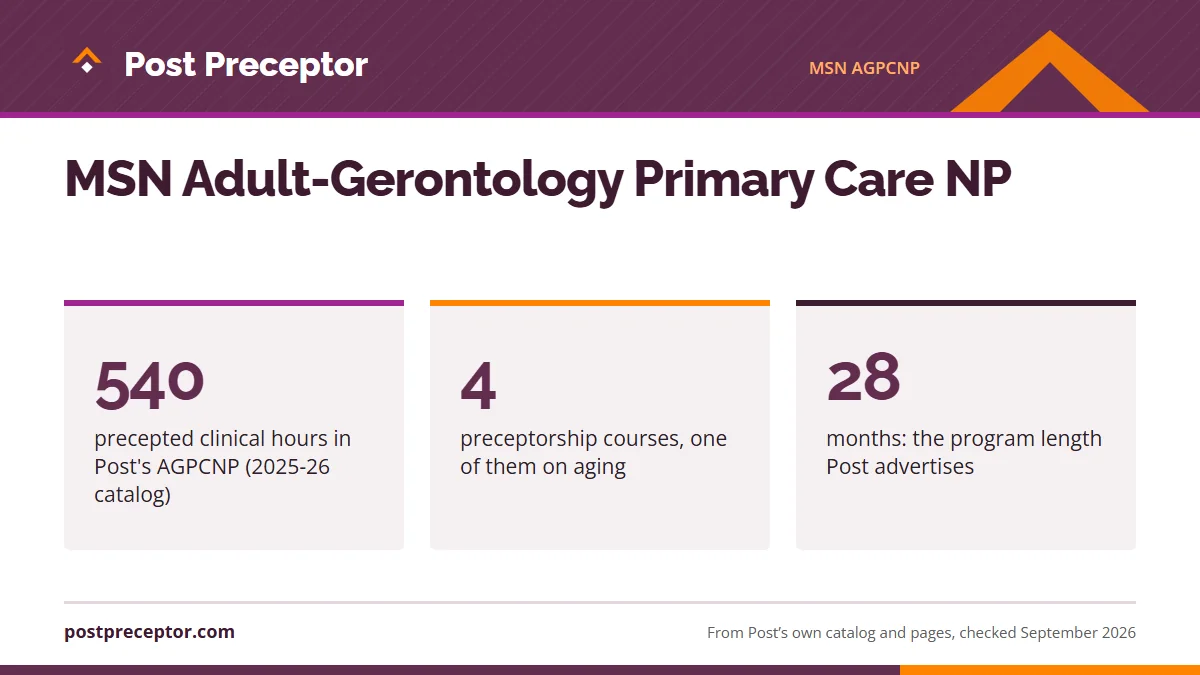
Post University's online Adult Gerontology Primary Care Nurse Practitioner (AGPCNP) track carries 540 precepted clinical hours across four preceptorship courses, and since the 2024-25 catalog every one of those hours belongs in primary care. The population runs from adolescents to older adults, with N 585 set aside for aging. Here is how the track is built, which preceptors it needs, and which older rules no longer apply.
Plan your AGPCNP preceptorships
Tell us your state and your next clinical term.
How the AGPCNP track is put together
The AGPCNP is one of three nurse practitioner specializations in the MSN from the American Sentinel College of Nursing & Health Sciences at Post University. Its program page gives a 42-45 credit range and a 28-month timeline; the 2025-26 catalog stretches the ceiling to 36 months. Courses run online in 8-week terms, one at a time, with some live sessions you must attend, and entry to the specialty courses goes through the 3P exam.
Post's pages name the track in slightly different ways. The program page and the NP disclosure say Adult Gerontology Primary Care Nurse Practitioner, while the heading on the State Approvals page shortens it to Adult Gerontology Nurse Practitioner. Both mean the same AGPCNP.
| Stage | Courses | Preceptor needed |
|---|---|---|
| MSN core and 3P | N 502, N 503, N 515PE, N 512, N 521, N 522PE | No; none is on the catalog's NP preceptor list |
| Advanced Practice Nursing I | N 580, then N 581 | Yes, for N 581 |
| Advanced Practice Nursing II | N 582, then N 583 | Yes, for N 583 |
| Complex Concepts of Aging | N 584, then N 585 | Yes, for N 585 |
| Advanced Practice Nursing Integration | N 598, then N 599 | Yes, for N 599 |
Four preceptorships, 540 hours
Only one AGPCNP preceptorship has its own published hour figure. N 581 carried 135 hours in its 2021-22 course description, the newest that could be read. For N 583, N 585 and N 599, the track total implies 135 each (540 less 135, shared three ways), but Post prints no per-course number for them, so use those as planning figures only.
| Course | Hours | Focus |
|---|---|---|
N 581 Advanced Practice Nursing I Preceptorship Experience | 135 (2021-22 description) | Adolescents, adults and older adults with stable, chronic and acute disease, in primary care |
N 583 Advanced Practice Nursing II Preceptorship Experience | The track total implies 135 | Harder acute and chronic problems across the same ages, building on N 582 |
N 585 Complex Concepts of Aging Preceptor Experience | The track total implies 135 | Older adults, in primary care |
N 599 Advanced Practice Nursing Integration Preceptorship Experience | The track total implies 135 | Integration, alongside the primary care quality-improvement project designed in N 598 |
The 2024 course schedule calls N 585 a "Preceptorship Experience" where the catalog says "Preceptor Experience"; it is one course under two labels. The N 585 course guide goes deeper on the aging course, and Post's clinical hours page holds the program-wide totals.
Primary care only: what changed in 2024-25
Earlier catalogs gave AGPCNP students some room. The 2021-22 and 2022-23 editions said they "may spend a limited amount of time" at sites outside primary care, with approval. The 2024-25 catalog removed that allowance, and the 2025-26 edition holds the same line: for the AGPCNP, primary care is now the only setting that counts.
This is worth knowing because classmates who began under the older catalogs may describe hours in a hospital or a long-term care facility. Under the current rule, any setting like that is a question for the Clinical Coordinator before you commit to it, never an assumption. Older adults seen in a primary care practice are exactly what N 585 is built around.
Post's clinical hours history traces the change catalog by catalog, and the primary care sites guide covers how to judge whether a practice fits.
The preceptors an AGPCNP student needs
Every AGPCNP preceptor answers to the same catalog test: an unencumbered state license that is current, national certification matching the population focus, a master's or doctorate if the preceptor is an APRN, and at least a year in practice. Two of the four courses (50%) with an NP is Post's recommended floor, all four is its preference, and physicians (MD or DO) are acceptable too.
For N 585, look for primary care preceptors whose patients skew older: internal medicine and adult primary care practices, geriatric primary care, or a family practice with a large Medicare-age panel. A geriatrician or an internist fits the physician allowance if you choose to use it for that course.
The other three preceptorships need adult primary care with some adolescents in the mix, matching the age range in N 581's description. A practice built around young children lines up with the FNP's maternal and child course, not with this track. When a certification or a site's focus looks borderline, ask the Clinical Coordinator before you gather documents; the preceptor requirements guide sets out the full rule.
Lining up four preceptors across the track
Each AGPCNP preceptorship has to clear Post's Week 1 packet, from the signed preceptor agreement letter and the affiliation agreement to the NP Clinical Schedule, or you are removed from that course. The Week 1 guide lists every item. The way to meet it four times over is to stay one course ahead.
A rhythm that works
- While the 3P courses run: keep CastleBranch current and list primary care practices near home that see adolescents through older adults.
- After your 3P pass: name your
N 581preceptor and file the affiliation agreement request right away; the seven business days Post allows for Academic Affairs to contact the site come out of your lead time. - During
N 581: ask whether the same preceptor can take you throughN 583, so one site and one set of preceptor documents can carry two terms, subject to the Coordinator's approval. - During
N 583: secure the older-adult practice forN 585. - Before
N 598: settleN 599, possibly with a practice that has already hosted you.
Post's 2024 schedule offered NP specialty courses in January, March, May, July, September and November terms alone, so a preceptorship that misses its opening can lose two months. Some state boards also want notice of a clinical plan up to 60 days ahead, one more reason to decide early.
AGPCNP or FNP?
The two tracks share their credits (42-45), their hours (540), their length and three of their four preceptorships. They differ in one pair of courses: the AGPCNP takes N 584 and N 585 on aging, and the FNP takes N 588 and N 589 on maternal and child care. That one swap moves the hardest search from pediatric and women's health volume, for the FNP, to an older-adult panel, for the AGPCNP. If you are still deciding, look at which kind of practice is plentiful within driving distance of home.
Post's current NP disclosure lists the AGPCNP in every state it marks Yes, California included, where the PMHNP is absent. The three NP tracks compared puts FNP, AGPCNP and PMHNP next to each other, with the preceptors each one needs.
Why AGPCNP students choose us
We build your AGPCNP placements around the track's actual shape: four primary care preceptorships, one of them centered on older adults, all within reach of home and inside a state that fits both your license and Post's disclosure. Each preceptor arrives already vetted on certification, experience and the relationship rules.
Your preceptor's documents are gathered for you, the agreement letter is signed before you need it, and the site contract request is underway long before Week 1. We start the N 585 search early with practices whose panels lean older, and where one preceptor can carry two courses, we set that up so your paperwork repeats less.
If a preceptor leaves partway through, we find the replacement. Use the form below or the contact page to tell us your next clinical term.
Questions Post students ask
Can AGPCNP hours at Post be done in a hospital or nursing home?
Under the 2025-26 catalog, every AGPCNP clinical hour belongs in a primary care setting, a rule carried over from the 2024-25 catalog. Earlier catalogs let students spend a limited amount of time elsewhere with approval, but that allowance is gone. If you are unsure whether a setting counts as primary care, the Clinical Coordinator makes the call.
Can a family nurse practitioner precept an AGPCNP student at Post?
Post's catalog asks for national certification in the population focus, and the Clinical Coordinator approves every preceptor. Whether an FNP-certified preceptor suits a given AGPCNP course is that office's decision, so ask before you collect documents. Physicians are allowed as well, though Post would like NPs to lead at least half of your preceptorships.
Does Post's AGPCNP include pediatric or women's health hours?
The AGPCNP has no maternal and child course. Its first preceptorship, N 581, describes adolescents, adults and older adults, and N 585 centers on aging. Obstetric, gynecological and pediatric patients from birth onward belong to the FNP's N 589, which is not part of the AGPCNP path.
How long does Post's AGPCNP take?
Post advertises a 28-month program, and the 2025-26 catalog requires you to finish within 36 months. Because NP students take one course per 8-week term, a clinical course that cannot start on schedule pushes every later course back, which is why each preceptor is best settled before the term ahead of it begins.
Can I take Post's AGPCNP if I live in California?
Post's current NP disclosure lists California as meeting the educational requirements for the AGPCNP and the FNP; the PMHNP is not listed there. California students also complete a California-only NP preceptor form, one of the items Post expects by the end of Week 1 in each clinical course.
Does Post offer an acute care adult-gerontology NP?
No acute care NP track appears in Post's catalog. The only adult-gerontology option is the primary care AGPCNP, alongside the FNP and PMHNP. That focus matches the current catalog's rule keeping every AGPCNP clinical hour in a primary care setting rather than a hospital unit.
Related pages
Last checked 2026-09-27
We check these pages against Post University's own catalog, program pages and published nursing documents. Your course faculty and the Clinical Coordinator have the final word.
- Post University 2025-26 catalog: Additional Nursing Information
- Post University: Adult Gerontology Primary Care Nurse Practitioner (MSN)
- Post University 2024-25 catalog: Additional Nursing Information
- Post University: Nurse Practitioner Disclosure by State
- Post University 2021-22 catalog: N 581 course description
Post asks you to select your own preceptor. We make the search the easy part.
Tell us your Post track, your city and your next preceptorship course. We line up preceptors who fit the course, collect the license report, certification and CV the Clinical Coordinator reviews, and start the affiliation agreement early so your Week 1 packet is complete before the term opens.
- Preceptors matched to the course: primary care for FNP and AGPCNP, mental and behavioral health for PMHNP, doctoral nurse leaders for DNP hours
- Preceptor agreement letter, license report, certification and CV ready for Post's approval
- Every preceptorship planned together, close to home in a state where you hold your license and Post's disclosure says yes
Start your placement plan
Track, city and next preceptorship course is all we need to begin.