N 589 Maternal and Child Care Preceptorship Experience
N 589 is the Post University FNP preceptorship built around two patient groups at once: obstetric and gynecological patients, and children from birth through adolescence. The 2021-22 course description sets it at 135 precepted hours in a primary care setting, after the didactic course N 588. Covering both populations with one approved preceptor, or deciding you need two, is the planning problem that sets this course apart.
Get your placement plan
Tell us your Post program and where you live. A placement advisor replies with the preceptor and site options that fit your course.
N 589 in Post's own description
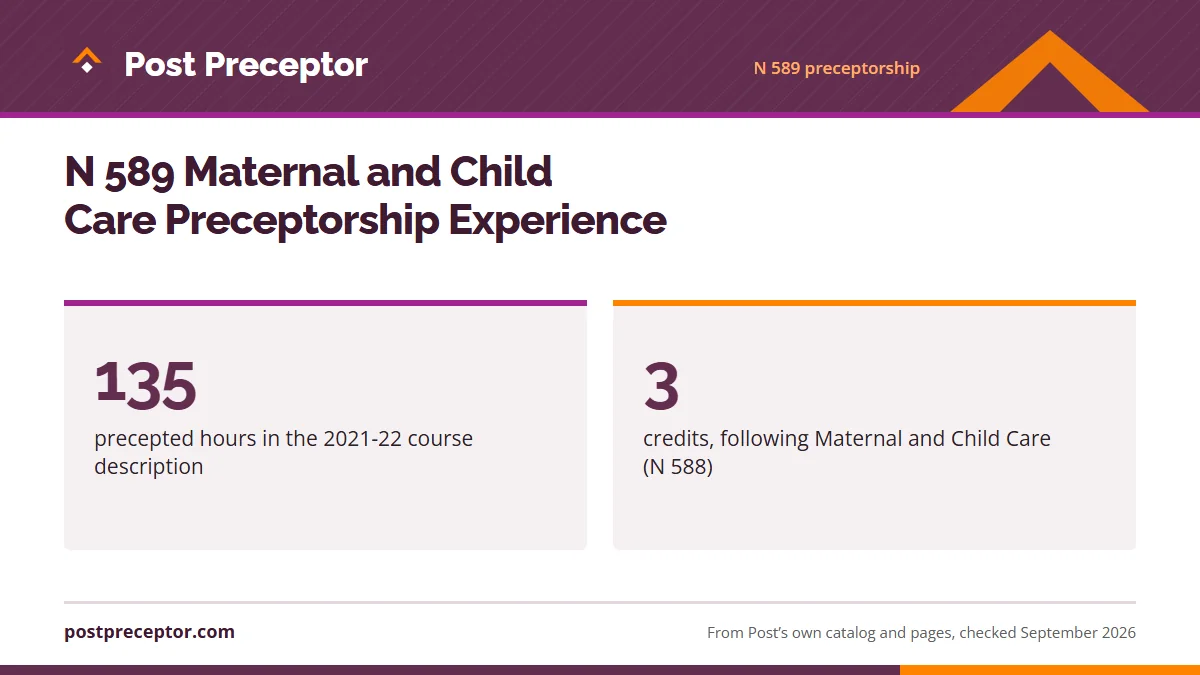
The course is titled Maternal and Child Care Preceptorship Experience. Its 2021-22 description, the most recent one on record, gives it 3 credits and 135 precepted clinical hours, lists N 588 Maternal and Child Care as the prerequisite, and describes care of obstetric, gynecological and pediatric patients from birth through adolescence in primary care.
N 589 is one of just two FNP preceptorships with a published hour figure; N 581 is the other. It belongs to the FNP only. The prerequisites for the integration course N 598 accept either N 588 with N 589 or N 584 with N 585, which marks this pair as the family branch and the aging pair as the AGPCNP's. Post does not print that mapping as a list, so compare it with your program plan and confirm the current hours in your syllabus.
One course, two patient groups
Most primary care preceptorships ask for one kind of practice. N 589 asks for two kinds of patients who often see different clinicians: children from newborns to teenagers, and women seeking prenatal, postpartum and gynecological care. A family practice may see both, but the balance varies widely, and some see few pregnant patients.
That leaves three workable shapes for the placement. A family practice with a busy pediatric schedule and a steady women's health load can cover the whole course with one preceptor. A pediatric primary care office can supply the child hours while a women's health practice supplies the obstetric and gynecological hours. Or a family practice can carry most of the course, with a second site filling the population it sees least.
Whether Post approves splitting one preceptorship between two preceptors is not addressed in its published rules, so ask the Clinical Coordinator before building a two-site plan. If the answer is yes, each site needs its own fully executed affiliation agreement and each preceptor a full set of documents.
Which preceptors fit N 589
The usual Post requirements hold for every N 589 preceptor: licensed without encumbrance, nationally certified in the population focus, prepared at the master's or doctoral level if an APRN, and at least twelve months into practice. A family-certified NP matches an FNP student's population focus most directly and may be able to cover both halves of the course in one practice.
Pediatricians, family physicians and obstetrician-gynecologists practicing in outpatient settings can precept under Post's MD or DO allowance, with the Clinical Coordinator's approval. For NPs certified in a narrower population, such as pediatric primary care or women's health, ask the Clinical Coordinator whether Post counts that certification toward an FNP student's population focus before you ask them to sign.
Keep a running count, too. Post's guidance is an NP preceptor in two or more of your four clinical courses, ideally every one, so if N 581 and N 583 were with physicians, an NP here keeps the recommendation within reach. See preceptor requirements for the full list.
Primary care, not the delivery unit
The obstetric half of N 589 does not open the door to hospital labor and delivery. The course description places the work in primary care, and the 2025-26 catalog keeps all FNP clinical hours inside primary care. Outpatient prenatal visits, postpartum follow-up, contraception and routine gynecological care are the kind of encounters to look for.
The same holds on the pediatric side: well-child visits, immunizations, school and sports physicals and common acute illness in a primary care office, rather than an inpatient pediatric unit. If a site blurs the line, such as a hospital-owned outpatient clinic, describe it to the Clinical Coordinator and get an answer before the affiliation agreement request goes in. The primary care sites guide goes further.
When to start, and what to line up
N 588 occupies the term before N 589, since NP students carry one course at a time, and the course numbering suggests N 589 is the FNP's third preceptorship, after N 583. Because this placement may involve two preceptors, two sites and two affiliation agreements, give it more runway than the others: begin the search while N 583 is still running.
Before Week 1, have the preceptor agreement letter signed and the preceptor's license report, certification and CV in hand, for each preceptor if there are two. File each new site's request in the Affiliation Agreement Tracker without delay; the first call from Academic Affairs alone can take up to seven business days. Pediatric and women's health practices inside larger health systems may add their own onboarding steps and lead times. At about 17 hours a week, plan the weeks so both populations get their share, and reflect that in the NP Clinical Schedule you submit.
Why FNP students hand N 589 to us
This is the placement where a thorough search matters most. We look for family practices near you with real pediatric and women's health volume first, and when one practice cannot cover both, we find the second preceptor and plan how the hours divide, once the Clinical Coordinator has confirmed the approach.
Each preceptor is checked against Post's standard, each preceptor's documents are gathered, each agreement letter is signed, and each site's affiliation request is filed well ahead of the term. If one of two preceptors has to step away mid-term, we replace that half of the placement and leave the other untouched. Share your N 589 term through the form below; your N 599 placement can be planned in the same pass.
Questions Post students ask
How many hours is N 589 at Post?
Its 2021-22 description gives N 589 135 precepted clinical hours over one 8-week term, about 17 a week. It and N 581 are the only FNP preceptorships with published per-course hours. Confirm the current figure in your syllabus, since newer descriptions could not be read.
Do AGPCNP students take N 589?
No. AGPCNP students take N 584 and N 585, the aging courses, in this part of the program. N 588 and N 589 are the family branch, which is why the integration course N 598 accepts either pair as its prerequisite.
Can a pediatrician precept me for N 589?
Yes, a physician can precept a Post NP student. A pediatrician in primary care can cover the child side of the course, though you still need obstetric and gynecological patients, so plan for a practice or a second site that sees them. Post also recommends an NP preceptor for at least half your clinical courses.
My family practice sees very few pregnant patients. Is that a problem?
It can be, because the course description names obstetric patients alongside gynecological and pediatric ones. Ask your preceptor how many prenatal and postpartum visits a typical week holds. If the number is small, talk with the Clinical Coordinator about a second site for those hours before the term begins.
Can I do N 589 hours at the hospital where I work?
Only in a primary care setting, since every FNP clinical hour must be in primary care. An outpatient clinic your employer runs may qualify if the Clinical Coordinator approves it, but your preceptor cannot be your direct supervisor. See practicum at your workplace.
Related pages
Last checked 2026-09-27
We check these pages against Post University's own catalog, program pages and published nursing documents. Your course faculty and the Clinical Coordinator have the final word.
Post asks you to select your own preceptor. We make the search the easy part.
Tell us your Post track, your city and your next preceptorship course. We line up preceptors who fit the course, collect the license report, certification and CV the Clinical Coordinator reviews, and start the affiliation agreement early so your Week 1 packet is complete before the term opens.
- Preceptors matched to the course: primary care for FNP and AGPCNP, mental and behavioral health for PMHNP, doctoral nurse leaders for DNP hours
- Preceptor agreement letter, license report, certification and CV ready for Post's approval
- Every preceptorship planned together, close to home in a state where you hold your license and Post's disclosure says yes
Start your placement plan
Track, city and next preceptorship course is all we need to begin.