Post's NP tracks for Connecticut nurses, in Post's own home state
Post's current NP disclosure answers Yes for Connecticut in the FNP, AGPCNP and PMHNP alike, so a Connecticut RN can enroll from home and complete every precepted hour in the state. Post is based in Waterbury, yet no part of the NP program brings you to campus. What shapes your plan is Post's Connecticut row, your RN license and the compact, and the state's own clinical rules, all set out below.
Get your placement plan
Tell us your Post program and where you live. A placement advisor replies with the preceptor and site options that fit your course.
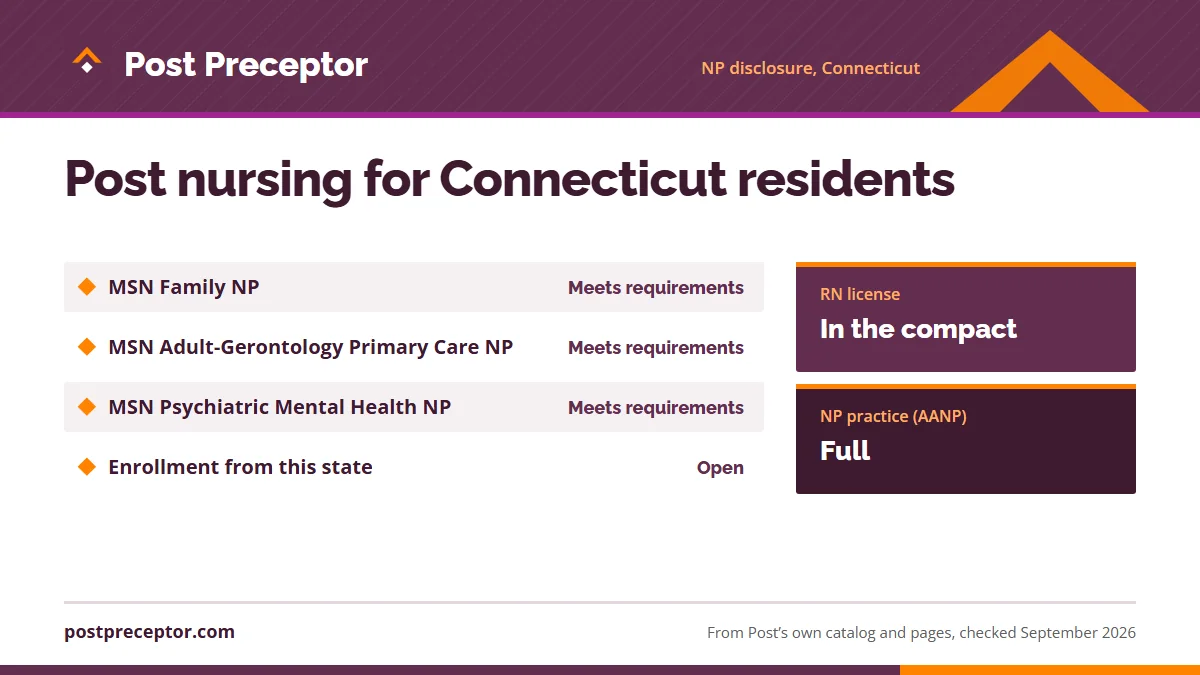
Connecticut in Post's NP disclosure
Post's table gives each state one row, and Connecticut's is open across the board. Cell by cell, with Post's labels kept:
| Post specialization or column | Post's answer for Connecticut |
|---|---|
| Family Nurse Practitioner (FNP) | Yes |
| Adult Gerontology Primary Care Nurse Practitioner (AGPCNP) | Yes |
| Psychiatric Mental Health Nurse Practitioner (PMHNP) | Yes |
| License title | Nurse Practitioner |
| Education for the NP license met by Post coursework | Yes |
| Education for prescriptive authority met by Post coursework | Yes |
| Other requirements Post lists for the license | Unencumbered, active Connecticut license; certification through a national NP organization; collaborative agreement with a physician |
| Other requirements Post lists for prescribing | DEA number, marked optional |
| Governing body Post names | Connecticut State Board of Examiners for Nursing |
Two cells reward a closer read. Post lists the physician collaboration with no end point, but section 20-87a(b) of the state nursing statute requires it only for an APRN's first three years; after three years and 2,000 collaborative hours, the APRN may practice alone once DPH has written notice. And the body Post names, the Board of Examiners for Nursing, sits within DPH's Public Health Hearing Office, where it takes up complaints, suspensions and revocations and approves Connecticut nursing schools. The Department of Public Health (DPH) itself issues the APRN license. The disclosure guide explains the rest of the table.
A Connecticut address, an online school down the road
Post's main campus is at 800 Country Club Road in Waterbury, and the staff who advise online students and handle their financial aid work out of the Howland Hughes building downtown, which Post has leased since 2018. The American Sentinel College of Nursing & Health Sciences at Post University keeps its administrative offices in Waterbury as well, and it states plainly that students face no physical classroom requirement. The catalog and program pages list no residency, immersion or on-campus skills check for the NP tracks. Exams, presentations and the final graduation meeting take place in required live online sessions, and in-person commencement is optional.
Living nearby does not change the clinical model. Under Post's 2025-26 catalog, you choose your own clinical site and preceptor, and both choices need the Clinical Coordinator's approval, exactly as for a student three time zones away. The FNP and AGPCNP each call for 540 precepted hours, every one in primary care; the PMHNP calls for 630 with psychiatric and behavioral health patients of all ages. The placement process page lays out each step.
One detail puzzles Connecticut RNs: Post is missing from DPH's list of Board-approved RN education programs. That list covers programs leading to a first RN license, and every Post nursing program is post-licensure. Connecticut's Office of Higher Education licenses Post and serves as the state's SARA portal agency, and CCNE accredits Post's MSN; see accreditation.
The RN license that carries your Connecticut clinicals
Post ties clinicals to your RN license, not to a future APRN license. As a Connecticut resident you need an active, unencumbered Connecticut RN license, and each clinical hour must fall in a state that answers Yes for your specialization and where you are also licensed. Hours outside your state of primary residence need Post's prior specialization approval. The RN license guide has the three sentences of Post's rule.
Connecticut started taking part in the Nurse Licensure Compact on October 1, 2025, and resident RNs and LPNs may convert to a multistate license through the state's eLicense system. Post's CastleBranch license item accepts a compact RN license. The compact stops at RN and LPN licenses, though, and Connecticut has not enacted the APRN Compact, so your NP license will be a Connecticut credential from DPH. There is also a clock in the law itself: section 20-99b enters the compact from October 1, 2025 until January 1, 2028. The statute as published sets that end date, so check DPH's compact page before counting on a multistate privilege in 2028.
| Neighbor | Compact status | Post's NP answer there |
|---|---|---|
| Rhode Island | A compact member, implemented January 8, 2024 per NCSBN | Yes for all three tracks |
| Massachusetts | Compact signed into law November 2024; the Board targets May 2027 for it to take effect | Yes for all three tracks |
| New York | Outside the compact | No for the NP license and prescribing; Post enrolls no NP students who live there |
A Rhode Island practice can therefore fit, once the Clinical Coordinator confirms your multistate license meets Post's wording and grants prior approval. A Massachusetts practice still needs a Massachusetts RN license until that state's implementation is complete, and a New York practice, however close to Greenwich or Danbury, falls outside Post's approved states.
Connecticut's preceptor regulations, and why they miss NP students
Connecticut does regulate clinical teaching, in rules built for a different learner. Its nursing education regulations call for at least one preceptor per two students with faculty keeping charge of evaluation (section 20-90-48), signed contracts with independent clinical agencies, reviewed yearly and renewed at least every third year, and RN preceptors who hold a nursing baccalaureate and two years in the specialty (section 20-90-51(f)). Section 20-90-59 applies the ratio and contract rules to schools based in other states.
Taken at their word, those sections govern programs that lead to RN licensure: an advanced-level student is defined as one in the final year of an RN program, and approval is limited to programs preparing graduates for the RN exam. No Connecticut rule setting qualifications for preceptors of NP students was found, and section 20-90-59 concerns out-of-state schools, which Post is not. Post's own standard decides who can precept you; see preceptor requirements. Connecticut sites will still want a signed agreement with your school, which Post's affiliation agreement supplies.
After Post: DPH, the first three years and controlled substances
Graduation sends you to DPH, not the Board, for the APRN license. DPH looks for your Connecticut RN license, current national NP certification, 30 hours of advanced-practice pharmacology and your graduate degree, and it takes applications only through its online system. Your first three years in practice then carry the physician collaboration from Post's row, in a written agreement that fixes your Schedule II and III prescribing. AANP counts Connecticut as a full practice state once the three years and 2,000 hours are done.
Controlled substances take a second credential: a practitioner registration from the Department of Consumer Protection, which requires an active DPH license, lapses on February 28 of each odd-numbered year and comes with a required account in CPMRS, the state's prescription monitoring and reporting system. The Connecticut practice guide covers the collaboration years and what they mean for your preceptor.
Health systems each set their own student rules
Connecticut's practices cluster in four metro areas: Hartford, Bridgeport-Stamford-Danbury, New Haven and Waterbury-Shelton. The large systems each publish their own terms for students, or publish none, and no source names any of them as a Post partner. What each says about itself:
- Trinity Health Of New England: onboarding at Saint Francis Hospital and Medical Center and Mount Sinai Rehabilitation Hospital halts without an active affiliation agreement with the school, and the learner health form is due four or more weeks ahead. No student page turned up for its Saint Mary's Hospital in Waterbury.
- UConn Health, which added Waterbury Hospital on March 1, 2026: any placement earning academic credit needs an agreement between the school and the host department.
- Hartford HealthCare: the first phase of its Clinician Nexus student platform serves allied health and leaves nursing rotations out.
- Yale New Haven Health, and Northwell Health's Connecticut hospitals that were once Nuvance: no NP-student process on their public pages.
- Community Health Center, Inc., based in Middletown: the request has to come from the student's school.
Independent primary care offices and outpatient psychiatric groups often move faster, since one affiliation agreement covers one site. The Connecticut preceptor guide works through each metro.
Why Connecticut Post students choose us
We work this state from the inside of Post's rules: which systems want the school to ask first, which need forms a month out, and which border towns sit next to a state your license may not reach.
For FNP and AGPCNP students we find primary care preceptors within your commute; for PMHNP students, outpatient, community and acute mental health settings that match the course. We confirm each preceptor's Connecticut license status and certification, deliver the signed preceptor agreement letter with the affiliation agreement request ready to file well before Week 1, and stay on call through the term in case a preceptor must bow out. Send us your town and next course.
Questions Post students ask
Do Connecticut students ever have to go to Post's Waterbury campus for the NP program?
No campus visit is required. The American Sentinel College has no physical classroom requirement, clinical hours happen in your own area, and Post's catalog and program pages list no residency or on-campus skills check for the NP tracks. The required live sessions, such as exams and presentations, run online, and in-person commencement is your choice.
Can my Connecticut multistate license cover Post clinicals in Rhode Island?
It can, with two conditions. Rhode Island is a compact member and answers Yes for all three tracks in Post's table. Post still has to grant prior specialization approval for hours outside your home state, and the Clinical Coordinator should confirm that your multistate privilege meets Post's license wording before a Rhode Island preceptor signs anything.
Will Connecticut stay in the Nurse Licensure Compact after 2027?
The statute that brought Connecticut in, section 20-99b, runs the compact from October 1, 2025 until January 1, 2028. Only a later act of the legislature would change that date. If your clinical plans rely on a multistate privilege in 2028, recheck DPH's compact page and your own license record late in 2027.
Why does Post's Connecticut row list a physician collaboration with no time limit?
Post's other-requirements cell names a collaborative agreement with a physician and stops there. The statute supplies the limit: collaboration for the first three years of APRN licensure, then independent practice after three years and 2,000 hours, once DPH has written notice. The two describe the same rule, and the statute adds the end point.
Can I train at a practice just over the New York line?
Post limits clinical hours to approved NP states, and its disclosure answers No for New York, one of the seven states whose NP residents Post does not enroll. New York also sits outside the Nurse Licensure Compact. Students near Greenwich or Danbury should keep the search on the Connecticut side of the line.
Related pages
Last checked 2026-09-27
We check these pages against Post University's own catalog, program pages and published nursing documents. Your course faculty and the Clinical Coordinator have the final word.
Post asks you to select your own preceptor. We make the search the easy part.
Tell us your Post track, your city and your next preceptorship course. We line up preceptors who fit the course, collect the license report, certification and CV the Clinical Coordinator reviews, and start the affiliation agreement early so your Week 1 packet is complete before the term opens.
- Preceptors matched to the course: primary care for FNP and AGPCNP, mental and behavioral health for PMHNP, doctoral nurse leaders for DNP hours
- Preceptor agreement letter, license report, certification and CV ready for Post's approval
- Every preceptorship planned together, close to home in a state where you hold your license and Post's disclosure says yes
Start your placement plan
Track, city and next preceptorship course is all we need to begin.