Connecticut's collaboration years, the 2,000-hour rule, and who precepts you
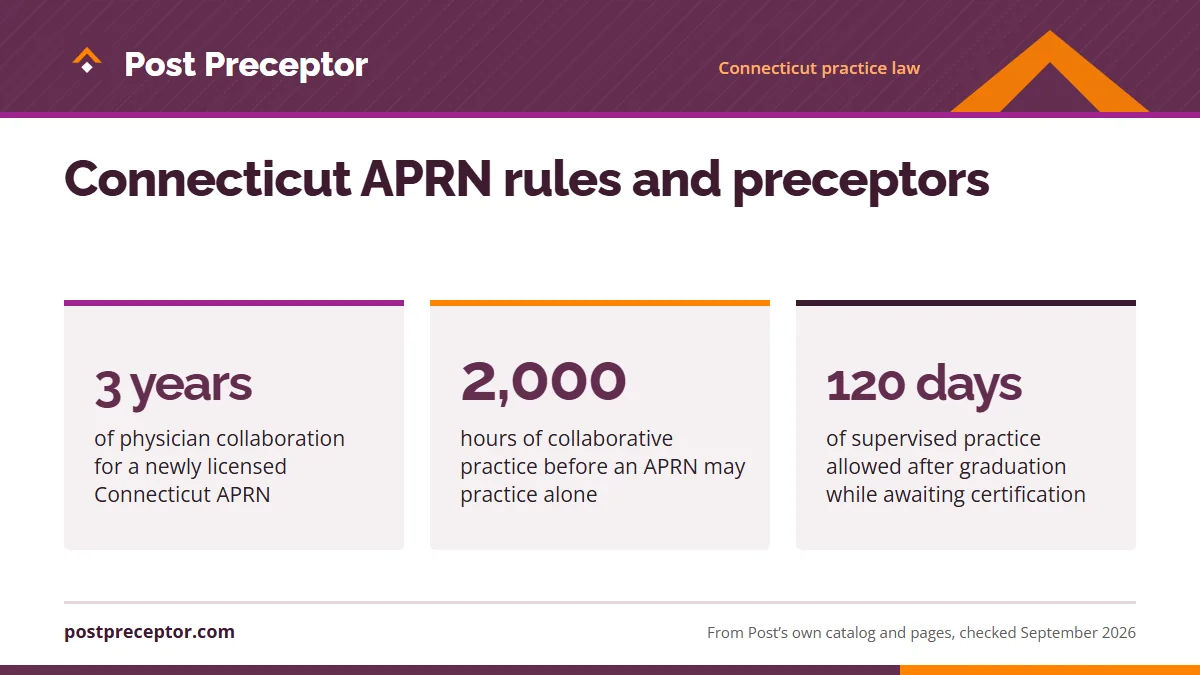
A newly licensed Connecticut APRN must collaborate with a Connecticut physician for the first three years, under a written agreement that sets their Schedule II and III prescribing. After three years and at least 2,000 hours of that collaboration, the APRN may practice alone once they notify the Department of Public Health. So every NP who could precept you in Connecticut is in one of two positions, and both can fit Post's preceptor rules.
Get your placement plan
Tell us your Post program and where you live. A placement advisor replies with the preceptor and site options that fit your course.
The collaboration years
The rule is in Connecticut's nursing statute, section 20-87a(b). For the first three years after licensure, an APRN "shall ... collaborate with a physician licensed to practice medicine in this state." The statute defines collaboration as a mutually agreed relationship with a physician whose training or experience relates to the APRN's work. It covers consultation and referral, coverage, review of outcomes, and a way of telling patients about the relationship.
During those years the agreement has to be in writing, and it must state the level of Schedule II and III controlled substances the APRN may prescribe, along with a method for reviewing outcomes. The Department of Public Health (DPH) issues the APRN license; the Board of Examiners for Nursing hears discipline and approves schools. APRNs licensed by endorsement from another state may count earlier collaboration with a physician there toward the three years.
Independent practice after three years and 2,000 hours
Section 20-87a(b)(3) opens the next stage. Once an APRN has held the license for at least three years and practiced in collaboration for no less than three years and 2,000 hours, they may practice alone or in collaboration with a physician or another licensed provider, and may prescribe, dispense and administer treatments in all settings.
What the statute asks of an APRN moving to independent practice
- Written notice to DPH before starting practice without collaboration.
- Documentation of the collaborative years kept for three more years, and handed to DPH within 45 days of a request.
- A place on the list DPH publishes each year by December 1 of APRNs practicing this way.
DPH does not routinely collect copies of collaborative agreements, but its license look-up shows an indication when an APRN has filed the notice, which makes it the quickest public way to see which stage a Connecticut NP is in.
What this means for who can precept you
The statute says nothing about precepting students, so neither stage rules an NP out. What decides eligibility is Post's own standard: a current, unencumbered license, national certification in the population focus, master's or doctoral preparation, and one or more years of experience. Post recommends an NP preceptor for at least two of your clinical courses and prefers all of them, and it accepts a physician (MD or DO). Here is how Connecticut clinicians line up against it:
| Clinician | Connecticut status | Fits Post's standard? |
|---|---|---|
| NP in the first three years, one or more years in practice | Practicing under a written collaboration with a Connecticut physician | Yes, if licensed, certified and master's or doctorally prepared |
| NP with less than a year of experience | In the collaboration period | Not yet: Post asks for one or more years |
| NP past three years and 2,000 hours, notice filed | Practicing alone; shown on the DPH look-up | Yes, on the same credentials |
| Collaborating physician (MD or DO) | Licensed in Connecticut | Allowed by Post, though an NP is recommended for at least half your courses |
| Your direct supervisor or a relative | Any | No, under Post's general preceptor rules |
The full standard is on the preceptor requirements page.
Prescribing you will see in clinic
Stage matters most for what you observe. A preceptor still in the collaboration period prescribes Schedule II and III drugs at whatever level the written agreement sets, so a PMHNP student following stimulant or other controlled-substance management with a newer NP sees it inside those terms. After three years and 2,000 hours, the APRN may prescribe in all settings on their own.
Controlled substances add a second registration. The Department of Consumer Protection issues the Connecticut Controlled Substance Registration for Practitioners, which requires an active DPH license, expires every two years on February 28 of odd-numbered years, and comes with mandatory enrollment in the Connecticut Prescription Monitoring and Reporting System (CPMRS). Post's Connecticut row lists a DEA number as optional for prescriptive authority.
Post's Connecticut row and the statute, side by side
Post's NP disclosure answers Yes for Connecticut on both the NP license and prescriptive authority, for all three specializations. Its other-requirements cell lists an unencumbered, active Connecticut license, certification through a national NP organization, and a collaborative agreement with a physician. The statute limits that collaboration to the first three years and 2,000 hours; the row does not mention the limit.
Read the two together: collaboration is required at the start of an APRN career in Connecticut, not forever. The NP disclosure guide explains the rest of Post's table.
After you graduate from Post
DPH's APRN license asks for a Connecticut RN license, current national certification as an NP from a recognized certifying body, 30 hours of pharmacology for advanced practice, and a graduate degree in nursing or a related field. Applications are online only, and the certification verification and official transcript must come straight from their sources.
Between graduation and certification, section 20-101 lets an RN with a qualifying master's degree practice for up to 120 days after graduating, in a hospital or other organization, under a licensed physician or APRN, once the employer confirms the graduate has applied for the certification exam. There is no prescribing or dispensing in that window, and it ends if the exam is failed. Then your own three collaboration years begin.
What does not apply to NP students
Connecticut's nursing regulations do set preceptor rules, including one preceptor for every two students, signed contracts, and RN preceptors with a bachelor's degree in nursing and two years of experience. They are written for programs that prepare graduates for RN licensure, and no Connecticut rule for preceptors of NP students was found. The Connecticut state guide covers those regulations and the Nurse Licensure Compact.
For Post students, Post's standard is the one that counts. We check each Connecticut preceptor against it, look up their license status with DPH, and confirm national certification before you ask for a signature, so the preceptor agreement letter, license report, certification and CV reach the Clinical Coordinator complete. For the where and how of finding one, see Connecticut NP preceptors, or send us your course.
Questions Post students ask
Can a Connecticut NP in their first three years precept me?
Yes, if they meet Post's standard: a current, unencumbered license, national certification in your population focus, master's or doctoral preparation and at least a year of experience. Connecticut's collaboration requirement governs how they practice, not whether they may teach, and the statute does not address precepting students.
Does my preceptor's collaborating physician need to sign anything for Post?
Post's Week 1 packet asks for your preceptor's own agreement letter, license report, certification and CV, and the published Week 1 list includes no item for a collaborating physician. If your preceptor or the practice asks about the physician's role, put the question to the Clinical Coordinator before the term starts.
How do I check whether a Connecticut APRN practices independently?
DPH's license look-up shows an indication when an APRN has filed notice of practicing without collaboration, and DPH publishes a list of those APRNs each year by December 1. The APRN must have held the license at least three years and completed 2,000 collaborative hours first.
Is Connecticut in the APRN Compact?
No. Connecticut joined the Nurse Licensure Compact for RNs and LPNs on October 1, 2025, but its nursing statute contains no APRN Compact, and the 2026 legislative summary of health-profession acts lists none. An APRN practicing in Connecticut needs a Connecticut APRN license from DPH.
Will I need a physician collaboration after graduating from Post if I stay in Connecticut?
Yes, for your first three years as a licensed APRN, with Schedule II and III prescribing set out in a written agreement. After three years and 2,000 hours of collaborative practice, you may notify DPH and practice alone. APRNs licensed by endorsement may count earlier collaboration in another state.
Related pages
Last checked 2026-09-27
We check these pages against Post University's own catalog, program pages and published nursing documents. Your course faculty and the Clinical Coordinator have the final word.
Post asks you to select your own preceptor. We make the search the easy part.
Tell us your Post track, your city and your next preceptorship course. We line up preceptors who fit the course, collect the license report, certification and CV the Clinical Coordinator reviews, and start the affiliation agreement early so your Week 1 packet is complete before the term opens.
- Preceptors matched to the course: primary care for FNP and AGPCNP, mental and behavioral health for PMHNP, doctoral nurse leaders for DNP hours
- Preceptor agreement letter, license report, certification and CV ready for Post's approval
- Every preceptorship planned together, close to home in a state where you hold your license and Post's disclosure says yes
Start your placement plan
Track, city and next preceptorship course is all we need to begin.