Precepting a Post University nurse practitioner student
Precepting a Post University NP student means supervising an experienced, licensed RN through one 8-week preceptorship in your practice, usually 135 clinical hours. The role is unpaid. Post asks you for a signed preceptor agreement letter, your license report, certification and CV, and evaluations of the student in Typhon, its clinical tracking system.
Open to precepting?
Tell us your specialty, state and the days you could host a student.
Who the students are
Post's nurse practitioner students study online through the American Sentinel College of Nursing & Health Sciences at Post University, in three tracks: Family NP, Adult Gerontology Primary Care NP and Psychiatric Mental Health NP. Every one of them is already a registered nurse. Post admits NP students with an active, unencumbered RN license and at least a year of full-time clinical nursing in the past three years.
Before any preceptorship, the student has passed Post's 3P courses in advanced pathophysiology, pharmacology and physical assessment and the APEA 3P exam. Each preceptorship also follows its own online course; N 581, for example, requires N 580 first. The student who arrives in your clinic has the theory in hand and needs supervised practice with real patients.
The time and the patients involved
Post's NP students take one course at a time in 8-week terms, so a preceptorship is a single, bounded commitment. A 135-hour course averages about 17 hours a week across the term. The days are agreed in advance on the student's NP Clinical Schedule, one of the items Post requires by the end of the first week.
| Course | Track | Hours | Patients |
|---|---|---|---|
N 581 | FNP, AGPCNP | 135 | Adolescents through older adults with stable, chronic and acute illness, in primary care |
N 589 | FNP | 135 | Obstetric, gynecological and pediatric patients, birth through adolescence, in primary care |
N 565 | PMHNP | 135 | Adults and older adults, in primary care and acute mental health settings |
N 567 | PMHNP | 90 | Adolescents experiencing substance misuse |
Post's other preceptorships follow the same pattern; the track totals of 540 hours for the FNP and AGPCNP and 630 for the PMHNP imply 135 hours for each. FNP and AGPCNP hours all take place in primary care, and PMHNP hours in mental and behavioral health settings serving patients of all ages.
Who Post accepts as a preceptor
For an NP student, Post's catalog asks for a current, unencumbered state license, national certification in the population focus, master's or doctoral preparation and at least one year of experience. Physicians (MD or DO) may precept as well, though Post recommends that each student have an NP preceptor for at least two clinical courses. You cannot precept a student who reports to you directly at work or who is related to you.
Post's DNP and non-NP MSN students also use preceptors, with different standards: a nurse with a doctoral degree for DNP work, and a nurse with a master's or higher and a current RN license for MSN work, employed at the site in both cases. The full standard is on the preceptor requirements page.
What Post asks of you
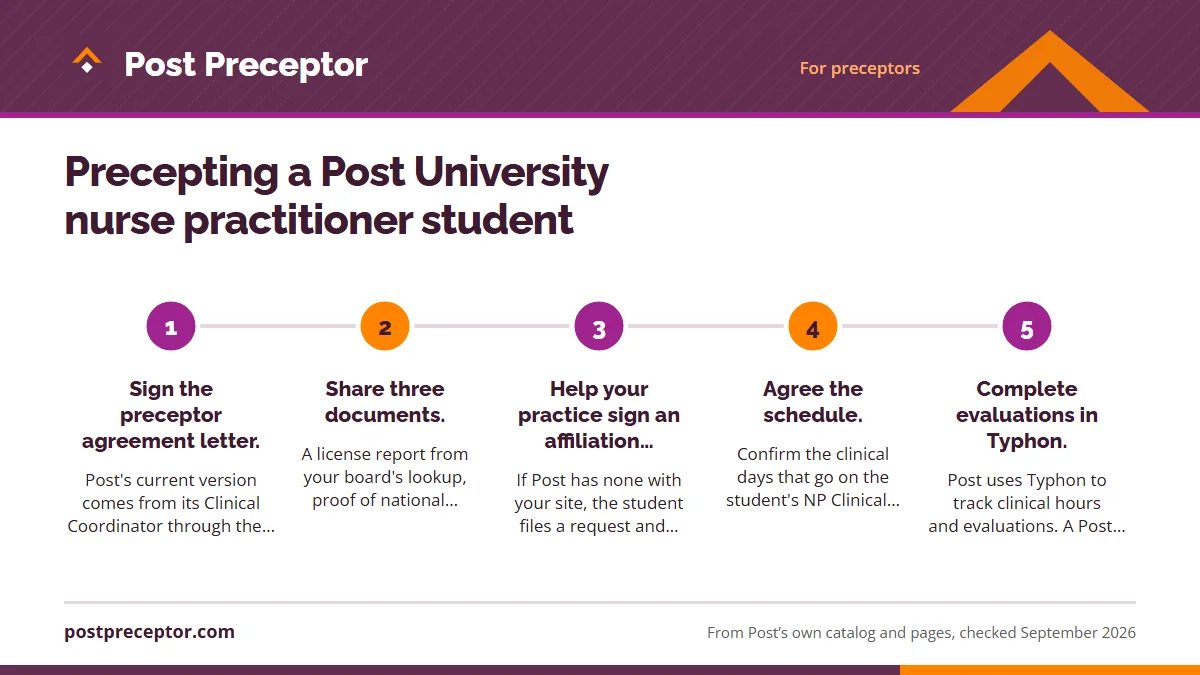
- Sign the preceptor agreement letter.Post's current version comes from its Clinical Coordinator through the student. The agreement letter guide explains it.
- Share three documents.A license report from your board's lookup, proof of national certification, and a current CV showing your degree and years in practice.
- Help your practice sign an affiliation agreement.If Post has none with your site, the student files a request and Post's Academic Affairs staff contact the person named within seven business days. The affiliation agreement page covers the process.
- Agree the schedule.Confirm the clinical days that go on the student's NP Clinical Schedule and hold them through the term.
- Complete evaluations in Typhon.Post uses Typhon to track clinical hours and evaluations. A Post job posting describes its clinical staff helping preceptors with Typhon access and with completing student evaluations.
Timing matters more than volume. Everything above has to be in place by the end of the term's first week, or Post removes the student from the course, so an early signature is the single most helpful thing a preceptor can give.
An unpaid role, made as light as possible
Precepting a Post student is unpaid teaching: you give your time and your patients' trust to help an experienced nurse become a practitioner. What we can do is make sure the time goes to teaching rather than paperwork.
When a Post student comes to you through Post Preceptor, the student has already been matched to your patient population and your weekly availability. We collect your license report, certification and CV once, handle the agreement letter, prepare the affiliation request with the right contact at your practice and keep every date in front of you. During the term, we are the call you make if a schedule needs to shift.
Questions preceptors ask before saying yes
- Will Post visit my practice? Post's public material does not describe site visits; ask the Clinical Coordinator what contact to expect during the term.
- Can I host the same student again? Yes, if your patients fit the next course. Each preceptorship is approved and documented separately, but a repeat placement is usually the fastest for everyone.
- Can I take a student for only part of a course? Post's rules do not say; the student would need a second approved preceptor for the remaining hours, which the Clinical Coordinator decides.
- Is there a handbook? Post's catalog refers to NP Clinical Guidelines that are not public; ask the Clinical Coordinator which parts apply to preceptors.
If you are open to precepting a Post student, use the form on this page to tell us your specialty, state and available days, or read how it works.
Questions Post students ask
How many hours a week does a Post NP student need with a preceptor?
Most Post preceptorships carry 135 clinical hours inside an 8-week term, which averages about 17 hours a week. N 567, the adolescent substance misuse course in the PMHNP, carries 90 hours, closer to 11 a week. The exact days are set with you in advance and recorded on the student's NP Clinical Schedule.
Can a physician precept a Post nurse practitioner student?
Yes. Post's catalog allows an MD or DO to precept NP students. Post also recommends that at least two of each student's clinical courses be precepted by a nurse practitioner, so a student may ask a physician for one course and an NP for another. The same agreement letter and documents apply.
Does my practice need a contract with Post University?
Yes, a fully executed affiliation agreement between Post and your site is required for NP clinicals. If one already exists, the student confirms it; if not, the student requests one and Post's Academic Affairs staff contact your practice within seven business days. An existing agreement does not by itself approve a particular student.
What does a preceptor do in Typhon?
Typhon is where Post tracks clinical hours and evaluations. Students log their hours, and preceptors sign in to complete the student's evaluations. A Post job posting describes the clinical team helping preceptors with Typhon access and evaluations, so direct any trouble to Post's clinical staff through the student or the Clinical Coordinator.
Related pages
Last checked 2026-09-27
We check these pages against Post University's own catalog, program pages and published nursing documents. Your course faculty and the Clinical Coordinator have the final word.
Post asks you to select your own preceptor. We make the search the easy part.
Tell us your Post track, your city and your next preceptorship course. We line up preceptors who fit the course, collect the license report, certification and CV the Clinical Coordinator reviews, and start the affiliation agreement early so your Week 1 packet is complete before the term opens.
- Preceptors matched to the course: primary care for FNP and AGPCNP, mental and behavioral health for PMHNP, doctoral nurse leaders for DNP hours
- Preceptor agreement letter, license report, certification and CV ready for Post's approval
- Every preceptorship planned together, close to home in a state where you hold your license and Post's disclosure says yes
Start your placement plan
Track, city and next preceptorship course is all we need to begin.