Progression rules for Post's nurse practitioner tracks
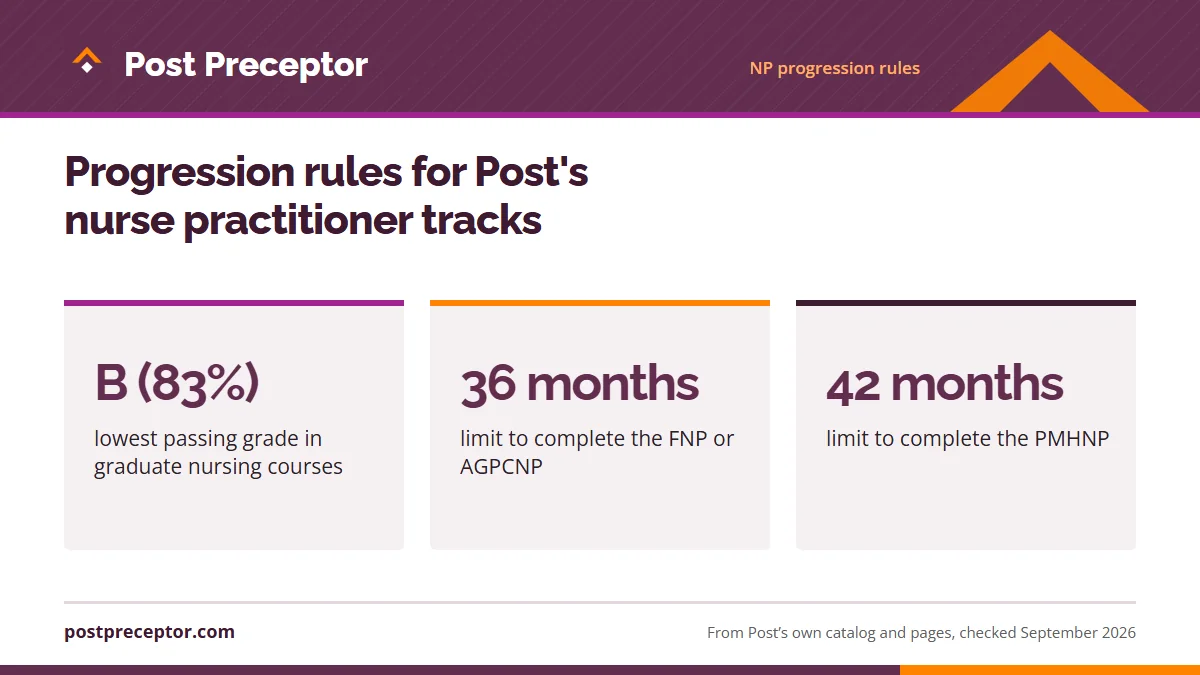
Post University keeps nurse practitioner students moving on a short list of rules: a B (83%) or better in every nursing course, one repeat per NP course and only one NP-specific repeat after the APEA 3P exam, one course per 8-week term, and a finish within 36 months for the FNP and AGPCNP or 42 months for the PMHNP. None of them mentions preceptors, yet one preceptor problem can draw on several of them at once.
Get your placement plan
Tell us your Post program and where you live. A placement advisor replies with the preceptor and site options that fit your course.
The rules at a glance
The table draws on Post's 2025-26 catalog, the newest with readable nursing pages. The right-hand column is our reading of where each rule meets the clinical side of the program.
| Rule | What the catalog says | Where a preceptor problem shows up |
|---|---|---|
| Passing grade | B (83%) or higher in graduate nursing courses; B- counts as failing | A preceptorship cannot be completed without its precepted hours |
| Repeats | An NP course may be repeated once, in full | A repeated preceptorship needs a preceptor again for every hour |
| After the 3P exam | Only one NP-specific course may be repeated | One slipped clinical course can take the whole allowance |
N 523 | Cannot be repeated | Failing it ends the NP track before any clinical course |
| Course load | No more than one course in an 8-week term | Lost terms cannot be made up by doubling courses |
| Time limit | FNP and AGPCNP within 36 months; PMHNP within 42 | Every missed term start comes out of this |
| Open extension | NP and DNP students may not proceed to the next course | A clinical-hour extension usually costs the next start |
| Grade appeal | NP students wait for the outcome before a new course | An appealed clinical grade pauses the sequence |
| CastleBranch | No NP course registration past the 3P courses, and no hour logging, without a compliant account | A lapsed item stops hour logging mid-course |
B or better, and what a B- means
Graduate nursing courses at Post, across the MSN, the NP specializations and the DNP, require a B (83%) or higher. A B- is treated as a failing grade in these courses, even though undergraduate nursing courses pass at C+ (77%). Any grade below B means taking the course again, and the rule covers all nursing courses, so the didactic course paired with each preceptorship needs a B just as the clinical course does.
A repeat is a full retake, not a make-up. The catalog says students repeat the quizzes, exams, practice experience and clinical work, so a preceptorship taken a second time needs all of its precepted hours again, with an approved preceptor and site and a new Week 1 packet. For scheduling purposes, treat a repeated clinical course as a brand-new placement, because that is what it becomes.
One repeat, then a single reserve after the 3P exam
Post's general retake limits are fairly generous: two retakes in a master's program, one in the DNP and three at the undergraduate level. The NP specializations are tighter. A course can be repeated only once if you want to stay in any NP specialization, and once you have taken the APEA 3P exam, only one NP-specific course may be repeated across the rest of the track.
Read that second rule as a single reserve for everything after the 3P exam: every specialty didactic course plus four preceptorships for the FNP and AGPCNP or five for the PMHNP. If one clinical course has to be repeated because a preceptor left or the hours fell short, the reserve is spent, and every remaining course has to pass the first time.
N 523 Diagnostic Reasoning, the course that follows a first failed 3P attempt, cannot be repeated at all.
The 3P gate comes first
Before any preceptorship, Post's NP students clear the 3P gate. You complete or transfer in N 512, N 521 and N 522PE with a 3.0 GPA, then sit the APEA 3P exam in Week 7 of the final 3P course and need 67% or higher. Since the 2024-25 catalog, one skipped exam window is allowed, a 3P Workroom exists, and a missed window scores zero.
A first failure leads to N 523 Diagnostic Reasoning and a retest. Two failed scores, or a failed N 523, means academic withdrawal from the NP tracks, with the option of moving into one of Post's non-NP MSN specializations. The 3P exam page covers the gate in full. For clinical planning, the key point is timing: the day you pass is the day to start lining up every preceptorship ahead of you.
36 and 42 months: the room you actually have
Post advertises the FNP and AGPCNP as 28-month programs and the PMHNP as a 34-month program, while the catalog ceilings are 36 and 42 months. The difference is eight months in each case (our subtraction), and those eight months are the entire cushion for illness, family events, a failed course and preceptor trouble combined.
With only one course allowed in each 8-week term, lost time stays lost; every missed start pushes the courses behind it back by the same amount. If NP courses still run in alternate months, as Post's 2024 schedule showed, one missed start costs about two months and four would consume the cushion. A repeated preceptorship costs its own eight weeks plus any wait for the next offering.
The catalog text available states the limits without saying which date starts the count or whether NP students can petition for more time. Your Student Success Advisor can confirm both from your record; ask early and keep the date in view. Delayed graduation shows how preceptor problems add up against it.
Rules that stop the clock without a grade
Several rules halt progress with no grade recorded at all. They matter because each lands on your calendar exactly as a failed course would: a term start goes by without you.
- The Week 1 packet. A student whose required clinical documents are not complete by the end of Week 1 is removed from the clinical course term; see the Week 1 deadline.
- An open extension. NP and DNP students wait for it to close before the next course; the extensions page explains the timing.
- A pending grade appeal. NP students cannot begin a new course until it is resolved.
- CastleBranch. NP students keep a compliant account for the whole program, including an annual background check and drug screen; without it they cannot register for NP courses past the 3P courses or log clinical hours.
- Week 1 participation. Every student must post in Week 1 or be dropped, and census is taken in Week 2.
Protecting the one repeat you have
The surest way to keep your post-3P repeat in reserve is to make sure no clinical course begins without a settled, well-matched preceptor. That is the work Post Preceptor does for Post NP students, course by course.
- We plan all four or five of your preceptorships together, matched to each course's patients: primary care for the FNP and AGPCNP, mental and behavioral health across the lifespan for the PMHNP.
- We check every preceptor against Post's license, certification, degree and experience rules before anything is submitted, so the Clinical Coordinator receives a complete file.
- We confirm the preceptor's clinic days support about 17 hours a week for a 135-hour course.
- We stay on call through each term and start a replacement search at once if a preceptor steps away.
See how the service works, or send your program and next clinical course through the contact page.
Questions Post students ask
Can I take two NP courses in one term to catch up?
No. Post's catalog does not permit nurse practitioner students to take more than one course in an eight-week term. Time lost to a removal, an extension or a repeat therefore moves your whole remaining sequence back. The practical defense is protecting each start: have the next preceptor and site approved and the Week 1 documents complete before the term opens.
What happens if I fail the APEA 3P exam twice?
Under Post's 2025-26 catalog, two failed 3P scores, or failing N 523 Diagnostic Reasoning after a first miss, leads to academic withdrawal from the nurse practitioner tracks. The catalog lets students in that position move to a non-NP MSN specialization, such as nursing education or leadership. Confirm the current options with your Student Success Advisor, since the 2026-27 catalog may word this differently.
Do the same repeat limits apply to the non-NP MSN and the DNP?
The general retake limits are two for master's students, one for DNP students and three for undergraduates. The once-only rule and the single post-3P repeat belong to the nurse practitioner specializations. Every graduate nursing course, NP or not, still needs a B (83%) or higher, and a repeated course includes its practice experience hours.
When does the 36-month clock start?
Post's 2025-26 catalog gives the 36-month limit for the FNP and AGPCNP and the 42-month limit for the PMHNP, but the available text does not say which date starts the count. Your Student Success Advisor can confirm it from your record. Once you know the date, count back from it to see how many term starts you can afford to lose.
Why is the advertised program length shorter than the limit?
The 28-month FNP and AGPCNP figure and the 34-month PMHNP figure describe Post's pace for a student who moves through every course without a break. The 36- and 42-month limits are the catalog's outer ceilings. The months between the two absorb any pause, including a missed clinical term, so spend them deliberately rather than by accident.
Related pages
Last checked 2026-09-27
We check these pages against Post University's own catalog, program pages and published nursing documents. Your course faculty and the Clinical Coordinator have the final word.
- Post University 2025-26 Catalog: Academic Policies and Procedures
- Post University 2025-26 Catalog: Additional Nursing Information
- Post University MSN Family Nurse Practitioner program
- Post University MSN Psychiatric Mental Health Nurse Practitioner program
- Post University nursing admissions requirements
Post asks you to select your own preceptor. We make the search the easy part.
Tell us your Post track, your city and your next preceptorship course. We line up preceptors who fit the course, collect the license report, certification and CV the Clinical Coordinator reviews, and start the affiliation agreement early so your Week 1 packet is complete before the term opens.
- Preceptors matched to the course: primary care for FNP and AGPCNP, mental and behavioral health for PMHNP, doctoral nurse leaders for DNP hours
- Preceptor agreement letter, license report, certification and CV ready for Post's approval
- Every preceptorship planned together, close to home in a state where you hold your license and Post's disclosure says yes
Start your placement plan
Track, city and next preceptorship course is all we need to begin.