When a missing preceptor delays your Post graduation
At Post University a preceptor gap rarely costs a few days. Nurse practitioner students take one course per term, a clinical course without a complete Week 1 packet is lost for that term, and an open extension holds the next course back, so each gap tends to cost a full term start. The FNP and AGPCNP must be finished within 36 months and the PMHNP within 42, and the cushion is thinner than it looks.
Get your placement plan
Tell us your Post program and where you live. A placement advisor replies with the preceptor and site options that fit your course.
The cushion you start with
Post's advertised pace is 28 months for the FNP and AGPCNP and 34 months for the PMHNP, against catalog ceilings of 36 and 42 months. Take one from the other and every NP student begins with roughly eight months of room, before any illness, family event, failed course or preceptor delay has touched it.
Eight months sounds generous until you count in term starts rather than weeks. NP students carry a single course in each 8-week term, and Post's 2024 schedule ran the NP specialty courses only in odd-numbered months, which puts the next chance at a missed course two months away. Post's program pages advertise monthly starts, so the gap today may be shorter; your Student Success Advisor has the live schedule. Either way, delay arrives in whole terms.
Four ways a preceptor gap turns into months
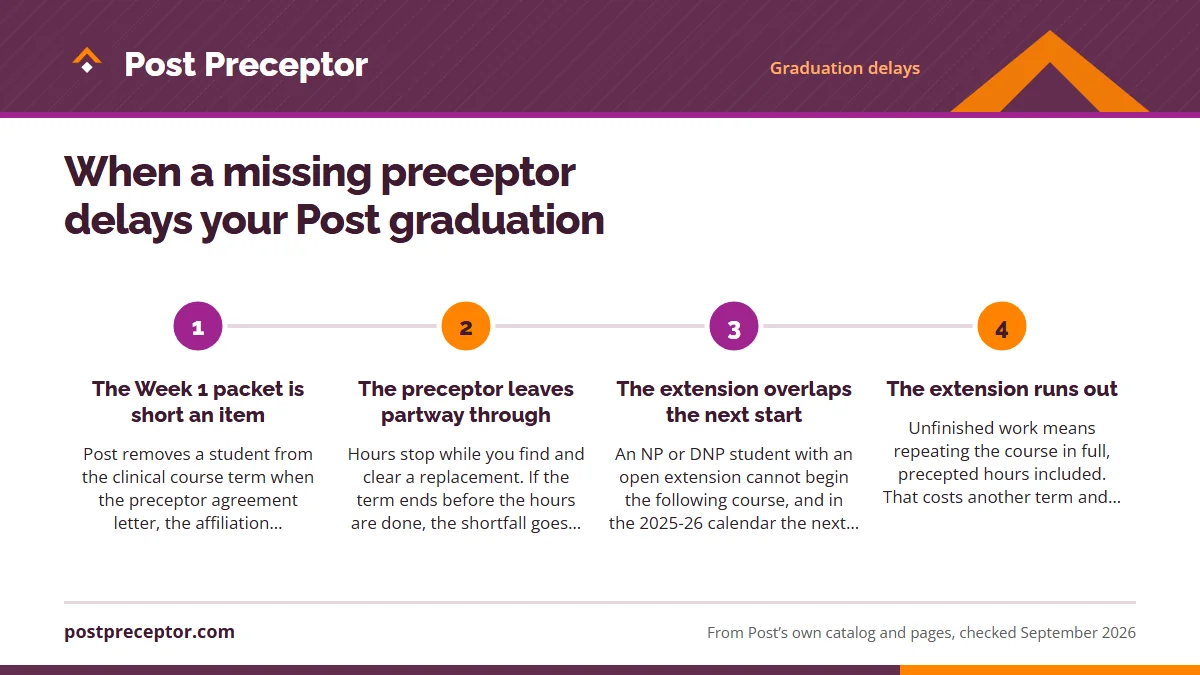
- The Week 1 packet is short an itemPost removes a student from the clinical course term when the preceptor agreement letter, the affiliation agreement or another required item is missing at the end of Week 1. That course moves to a later start, and every course behind it moves too.
- The preceptor leaves partway throughHours stop while you find and clear a replacement. If the term ends before the hours are done, the shortfall goes to the Clinical Coordinator as an extension request.
- The extension overlaps the next startAn NP or DNP student with an open extension cannot begin the following course, and in the 2025-26 calendar the next term in sequence opened within about a week of the previous one closing. Two extra weeks therefore tend to cost one start.
- The extension runs outUnfinished work means repeating the course in full, precepted hours included. That costs another term and spends the single NP-specific repeat Post allows after the APEA 3P exam.
What a delay can look like on the calendar
Here is an illustration, not a prediction, for an FNP student on the alternate-month pattern from Post's 2024 schedule.
N 581is due right afterN 580, but the site's affiliation agreement is still unsigned when Week 1 ends. The course moves to its next offering: about two months.- Later, the
N 589preceptor cuts back to one clinic day a week in Week 5. A replacement is approved in time to finish most of the hours but not all, and a two-week clinical extension follows. The next course waits for the start after that: about two more months. - Net effect: roughly half of the eight-month cushion is gone, with
N 599still ahead.
Neither event looked large on its own. Together they turned a comfortable plan into one where a single further slip, or a repeat, would press against the 36-month limit. The NP progression rules set out the repeat and time limits in full.
Checkpoints worth putting in your own calendar
- The day you pass the 3P exam. Begin planning every preceptorship left in your track, not only the next one; the 3P exam page explains the gate.
- Up to 60 days before a clinical term. Some state boards want notice of a clinical plan that far ahead, so the preceptor and site need to be known by then.
- Seven business days after an affiliation agreement request. That is the window Post gives its Academic Affairs staff just to make first contact with a new site.
- Four weeks or more before the start at some health systems. Systems with their own student onboarding set their own lead times; one Connecticut system publishes a four-week deadline for learner health forms.
- The end of Week 1. Every item in the Week 1 packet complete and accepted.
- Before the term ends. The last moment to request an extension, and the time to ask what it will do to your next start.
If the delay has already begun
Start by collecting facts. Ask your Student Success Advisor for the date your time limit falls, the next offering of each remaining course, and whether any petition for more time exists for NP students, since the available catalog text says nothing on that last point. Ask the Clinical Coordinator what is still outstanding for your next clinical course.
Then work two courses ahead instead of one. Settle the preceptor for the course you are about to take and line up the one after it, so a slow approval in one place does not ripple through the rest of the track. If your current preceptor is wavering, treat it as a preceptor dropout now rather than in Week 5.
Finally, check the calendar before filing for an extension. Knowing it will likely push your next course back by a term start may change whether an extension, an incomplete or another plan is the better choice.
How Post Preceptor keeps your finish date in view
Post students choose us because we plan clinical courses as a sequence, the way Post's term calendar makes you live them.
- One placement plan covering every preceptorship left in your track, each matched to its course's patients and setting.
- Preceptors checked against Post's rules, with the signed preceptor agreement letter and the preceptor's license report, certification and CV ready well before Week 1.
- Affiliation agreement requests started early, so the seven-business-day contact window and any health-system onboarding fall comfortably before the term.
- A replacement search the same day a preceptor steps back, so your hours keep moving inside the term.
Send your program, your next clinical course and your time-limit date through the contact page, and your placement advisor will map the remaining terms with you.
Questions Post students ask
Does a term I sit out count toward Post's time limit?
The limits are expressed in months, so a term spent waiting for a preceptor or a course offering still passes on the calendar. Post's 2025-26 catalog text describes no pause in the count for a missed clinical term. Confirm how your own record is measured with your Student Success Advisor, particularly if you have already had a gap.
Can I take a different course while I wait for a preceptor?
Possibly, but the NP sequence runs on prerequisites: each preceptorship follows its paired didactic course, and you can hold only one course in any 8-week term. Whether another course can fill a waiting term depends on what remains in your plan. Your Student Success Advisor can check your remaining sequence against the current offerings.
Is the final graduation meeting held in person?
Post's NP specializations list a final graduation meeting among their mandatory synchronous online sessions, set by the course syllabus, so plan to attend it live online. In-person commencement in Waterbury, Connecticut is optional; Post invites graduates to join their class there, but you can finish the program without traveling.
How early should I plan my last preceptorship?
Earlier than feels necessary. Integration courses such as N 599 for the FNP and AGPCNP and N 569 for the PMHNP sit at the end of the track, when the cushion is thinnest, so a slip there presses hardest on the time limit. Planning them alongside your first clinical courses leaves options open if an early placement falls through.
Does an incomplete hold up my next course the way an extension does?
The 2025-26 catalog applies the next-course block to NP and DNP students with an open extension, and its incomplete policy, as available, does not repeat that language. An incomplete still leaves work due up to four weeks after the term, which overlaps the next start. Ask your Student Success Advisor how registration treats it before you choose.
Related pages
Last checked 2026-09-27
We check these pages against Post University's own catalog, program pages and published nursing documents. Your course faculty and the Clinical Coordinator have the final word.
- Post University 2025-26 Catalog: Academic Policies and Procedures
- Post University 2025-26 Catalog: Additional Nursing Information
- Post University MSN Family Nurse Practitioner program
- Post University MSN Psychiatric Mental Health Nurse Practitioner program
- Post University 2024 American Sentinel College course schedules
Post asks you to select your own preceptor. We make the search the easy part.
Tell us your Post track, your city and your next preceptorship course. We line up preceptors who fit the course, collect the license report, certification and CV the Clinical Coordinator reviews, and start the affiliation agreement early so your Week 1 packet is complete before the term opens.
- Preceptors matched to the course: primary care for FNP and AGPCNP, mental and behavioral health for PMHNP, doctoral nurse leaders for DNP hours
- Preceptor agreement letter, license report, certification and CV ready for Post's approval
- Every preceptorship planned together, close to home in a state where you hold your license and Post's disclosure says yes
Start your placement plan
Track, city and next preceptorship course is all we need to begin.