N 567: 90 hours with adolescents and substance misuse
N 567 Psych Specialty for Advanced Practice Preceptorship Experience is the shortest PMHNP preceptorship at Post University, 90 precepted hours in its 2021-22 course description, and the narrowest. The patients are adolescents experiencing substance misuse, seen in a variety of settings. The weekly load is lighter than in the other four courses; finding the right caseload is the real work.
Get your placement plan
Tell us your Post program and where you live. A placement advisor replies with the preceptor and site options that fit your course.
What N 567 asks of you
Post's 2021-22 catalog description gives N 567 90 precepted clinical hours with adolescents experiencing substance misuse, in a variety of settings. Its prerequisite is N 566 Psych Specialty for Advanced Practice, the didactic course you take the term before. In the PMHNP sequence it is the fourth of five preceptorships, after N 565 and ahead of the integration course, N 569.
Those descriptions are dated. Nothing newer could be checked, since the 2025-26 course pages would not load and the 2026-27 nursing pages were unavailable, so confirm the hours and the population in your syllabus. The 90 also squares with the program total in Post's 2025-26 catalog: 630 minus 90 leaves 540, or 135 for each of the other four preceptorships, and N 565 is printed at exactly 135.
It is also the only PMHNP pairing whose title names a specialty rather than a numbered level. N 560 to N 568 run from Advanced Practice Psych Nursing I to IV, while N 566 and N 567 carry the Psych Specialty name, which fits a course built around one population.
Fitting 90 hours into eight weeks
90 hours over an 8-week term is about 11 precepted hours a week (our computation), against roughly 17 in the 135-hour PMHNP courses. That widens the field. A specialist who could never give you three days a week may manage one long day plus a half day, which can be enough at 11 hours a week.
Fewer hours do not mean fewer documents. Post's end-of-Week-1 check applies to N 567 exactly as it does to every other clinical course, and a new site needs its own fully executed affiliation agreement. The Week 1 deadline page lists every item.
Timing matters with teenagers. Programs for adolescents may schedule around the school day, so ask when their patients are actually seen before you promise a preceptor your weekday mornings.
Where adolescents with substance misuse are treated
Settings to put on your list
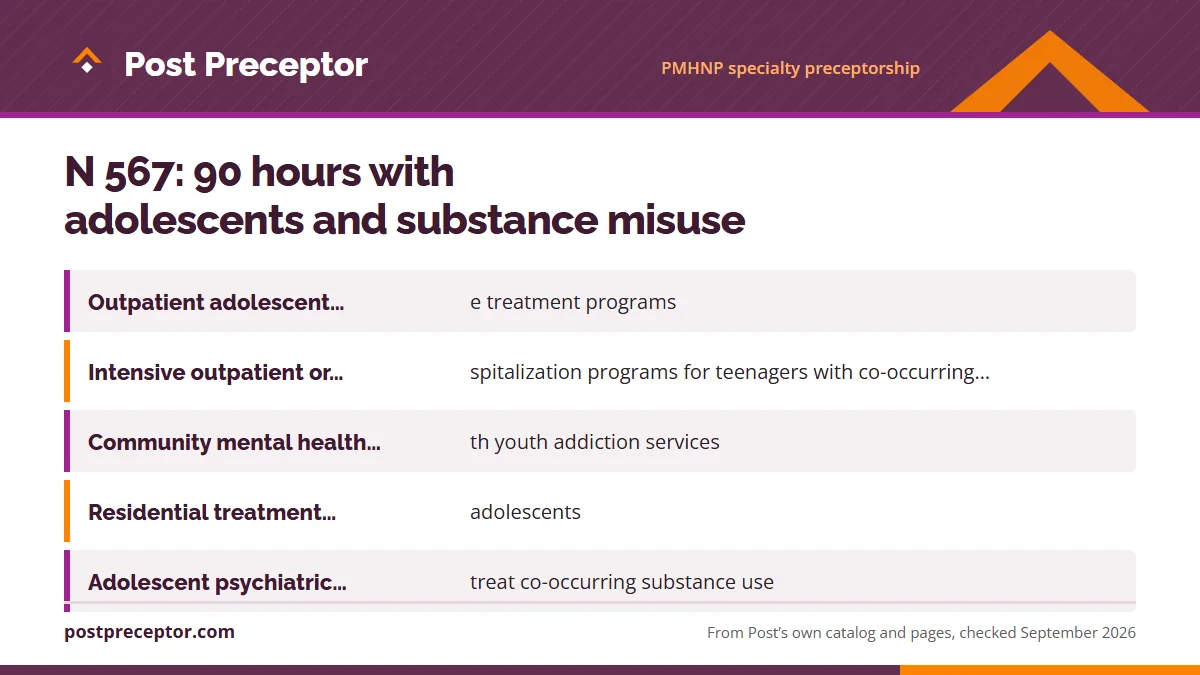
- Outpatient adolescent substance use treatment programs
- Intensive outpatient or partial-hospitalization programs for teenagers with co-occurring disorders
- Community mental health centers with youth addiction services
- Residential treatment programs for adolescents
- Adolescent psychiatric units that treat co-occurring substance use
- Child and adolescent psychiatry practices with a substance use caseload
Post's description allows "a variety of settings", so the patients matter more than the building. The Clinical Coordinator approves the specific site. The first test to apply yourself is whether a qualified preceptor there treats adolescents whose substance misuse is part of their care, often enough to fill about 11 hours a week.
Settings that treat minors may ask trainees for extra orientation or confidentiality steps before the first patient contact. Ask what the program needs from a student and how long it takes, then build that time into your plan ahead of Week 1.
Who can precept a specialty course
Post's NP preceptor rules apply without change, and they are on preceptor requirements. For N 567 the practical question is whose caseload fits. A psychiatric NP who treats adolescents with co-occurring disorders, a child and adolescent psychiatrist, or an addiction psychiatrist can each be a strong candidate, since Post accepts an MD or DO, subject to the Coordinator's review.
Count your nurse practitioner preceptors before choosing. Post recommends at least two clinical courses with an NP and prefers all. If NPs precepted two of N 561, N 563 and N 565, a physician here leaves that recommendation intact; if not, lean toward an NP now or plan one for N 569.
If you work at an addiction program as an RN, clinicals at your workplace are possible, provided the preceptor is not your direct supervisor or a relative.
Questions that shorten an N 567 search
- How many of your patients are adolescents, and for how many is substance misuse part of the treatment plan?
- When do those adolescents come in: daytime clinic, after-school groups, evenings?
- What does your program require of trainees before they sit in on assessments and medication visits with minors?
- Has your organization signed affiliation agreements with nursing schools before, and who handles them?
- Could you give about 11 hours a week for eight weeks, on dates you can name now?
Your N 563 contacts are the best place to start. If that preceptor treats teenagers, ask who in the area provides adolescent substance use care; some youth programs offer both. Reusing a site may mean its affiliation agreement is already executed when N 567 arrives, but each course is approved separately, so check with the Clinical Coordinator. Aim to name the N 567 preceptor as N 565 begins, two terms ahead.
Why Post PMHNP students use us for N 567
A narrow population calls for a targeted search, and that is how we run it. We go straight to programs and preceptors who treat adolescent substance misuse, confirm each candidate meets Post's credential rules, and check the volume of adolescent patients before you are introduced.
We collect the license report, certification and CV, get the preceptor agreement letter signed, start the affiliation agreement request early and set a schedule of about 11 hours a week that fits around your job. Because we plan N 563 and N 567 together, one search can serve both, and if a preceptor's plans shift mid-term we stay on call and move quickly to someone who treats the same population. Tell us your N 565 term through the contact form and we will build N 567 from there.
Questions Post students ask
How many hours is N 567 at Post?
90 precepted clinical hours, according to the 2021-22 course description, the newest one retrievable. It is the only PMHNP preceptorship below 135. Add 90 to 135 for each of the other four courses, the split the totals imply and the figure printed for N 565, and you reach the 630-hour PMHNP total in Post's 2025-26 catalog. Check your syllabus for the current figure before fixing dates with a preceptor.
Can N 567 be done at an adult addiction program?
The course description names adolescents, so an adult-only program is a poor fit even if its preceptor is excellent. If the program also sees patients under 18, ask how many and how often. The Clinical Coordinator makes the final call, and an adult addiction preceptor may suit N 565 or N 569 instead.
Can an addiction medicine physician precept N 567?
Post's catalog allows an MD or DO to precept NP students, so a physician who treats adolescent substance misuse is worth proposing. The Clinical Coordinator decides whether that physician's certification and practice fit the course. Weigh it against Post's recommendation of at least two clinical courses with a nurse practitioner across the program.
Why is N 567 shorter than the other PMHNP preceptorships?
Post's public sources give the number, 90 hours, without explaining it. The course is framed as a specialty experience with one population, adolescents experiencing substance misuse, while the other four preceptorships cover broader groups. For planning, the shorter course means about 11 hours a week instead of about 17 across an 8-week term.
What is N 566?
N 566 Psych Specialty for Advanced Practice is the didactic course paired with N 567, and the 2021-22 description lists it as the prerequisite. With one course allowed per 8-week term, N 566 is the term before your preceptorship, and the last full term in which to finish the N 567 paperwork.
Related pages
Last checked 2026-09-27
We check these pages against Post University's own catalog, program pages and published nursing documents. Your course faculty and the Clinical Coordinator have the final word.
Post asks you to select your own preceptor. We make the search the easy part.
Tell us your Post track, your city and your next preceptorship course. We line up preceptors who fit the course, collect the license report, certification and CV the Clinical Coordinator reviews, and start the affiliation agreement early so your Week 1 packet is complete before the term opens.
- Preceptors matched to the course: primary care for FNP and AGPCNP, mental and behavioral health for PMHNP, doctoral nurse leaders for DNP hours
- Preceptor agreement letter, license report, certification and CV ready for Post's approval
- Every preceptorship planned together, close to home in a state where you hold your license and Post's disclosure says yes
Start your placement plan
Track, city and next preceptorship course is all we need to begin.