N 563: Post's second PMHNP preceptorship, planned around young patients
N 563 Advanced Practice Psych Nursing II Preceptorship Experience is the second of five PMHNP preceptorships at Post University. Post's 2024 course schedule titles it "Child and Adolescent", so the sound plan is a psychiatric preceptor with a real caseload of children and teenagers, checked against your syllabus before you commit. Post has not printed its hours; the PMHNP total points to 135.
Get your placement plan
Tell us your Post program and where you live. A placement advisor replies with the preceptor and site options that fit your course.
What Post has published about N 563
The catalog calls the course Advanced Practice Psych Nursing II Preceptorship Experience and places it among the NP courses that need a preceptor. The title itself says nothing about patients. Two other Post sources fill the gap: Post's 2024 nursing course schedule lists N 563 as "Child and Adolescent", and Post's PMHNP program page says the specialization prepares you to "care for children with psychiatric mental health needs".
Read together, those point to a child and adolescent focus, and that is the likely emphasis. It remains an inference: N 563's own course description was not among those retrieved, and the 2025-26 descriptions were unreadable. Before a preceptor signs anything, confirm the expected population with the Clinical Coordinator or in the course syllabus.
The companion course is N 562 Advanced Practice Psych Nursing II. Since NP students register for a single course at a time and Post makes each didactic partner a prerequisite (N 564 before N 565, for instance), N 562 should sit between N 561 and N 563 in your plan.
Hours: what the PMHNP arithmetic suggests
No public Post source splits the PMHNP's 630 precepted hours by course. The pieces available are the 2025-26 catalog total and two 2021-22 course descriptions, which give N 567 90 hours and N 565 135. Once N 567's 90 is taken out, four preceptorships share 540, an even 135 apiece.
That makes 135 the implied load for N 563, good for planning and nothing more; Post has not stated it. American Sentinel University did state it before the merger: its 2020 PMHNP page listed N 563 at 135 hours. Your syllabus names the real figure.
At 135 hours an 8-week term asks for about 17 hours a week at the site (our computation). With young patients, that number meets the school calendar: a clinic whose child and teen visits bunch into late afternoons may not supply 17 hours a week unless you can be there most weekdays. Ask about volume and timing before you agree on dates, and write the answers into the NP Clinical Schedule.
Settings that see children and teenagers
Post's PMHNP site rule is broad: mental and behavioral health settings whose patients span the lifespan. For a course centered on young patients, the test is simple. Would children and adolescents fill most of your hours there?
Settings worth asking about
- Outpatient child and adolescent psychiatry practices, private or owned by a health system
- Community mental health centers that run a children's or family program
- Behavioral health services embedded in pediatric practices, if the Clinical Coordinator accepts the setting as mental health care
- Partial-hospitalization or intensive outpatient programs for youth
- Child and adolescent inpatient psychiatric units
An adult-only practice is a weak match for this course even when its preceptor is excellent. Keep that contact for N 565, whose description names adults and older adults. The PMHNP clinical sites page compares site types across all five preceptorships.
Questions to put to an N 563 preceptor
- Roughly what share of your patients are under 18, and which age bands do you see most?
- When are young patients booked? If most visits fall after the school day, can our hours line up with my RN shifts for eight straight weeks?
- Will you let me sit in on evaluations and medication visits, then take a growing share of each visit?
- Does your organization have its own onboarding for students who work with minors, and how long does it run?
- Will your organization sign an affiliation agreement with Post, and who signs it?
On credentials, the Post rule is the one on preceptor requirements: licensed without encumbrance, nationally certified in the population focus, prepared at the master's or doctoral level if an APRN, and a year or more in practice. A child and adolescent psychiatrist qualifies, because Post accepts an MD or DO. Just keep at least two of your five preceptorships with nurse practitioners, which is Post's recommendation.
Plan N 563 and N 567 in one search
Youth contacts do double duty in Post's PMHNP. Two courses after N 563 comes N 567, a 90-hour preceptorship with adolescents experiencing substance misuse. A program that treats teenagers may run adolescent substance use services itself or refer to them, so every N 563 conversation is also a lead for N 567.
Each course is still approved on its own. The Clinical Coordinator reviews preceptor and site again, each site must have its own executed affiliation agreement, and your file is checked at the end of Week 1 of each clinical course (see the Week 1 deadline). If one site can serve both terms, its agreement may already be executed when N 567 arrives, which shortens that term's list.
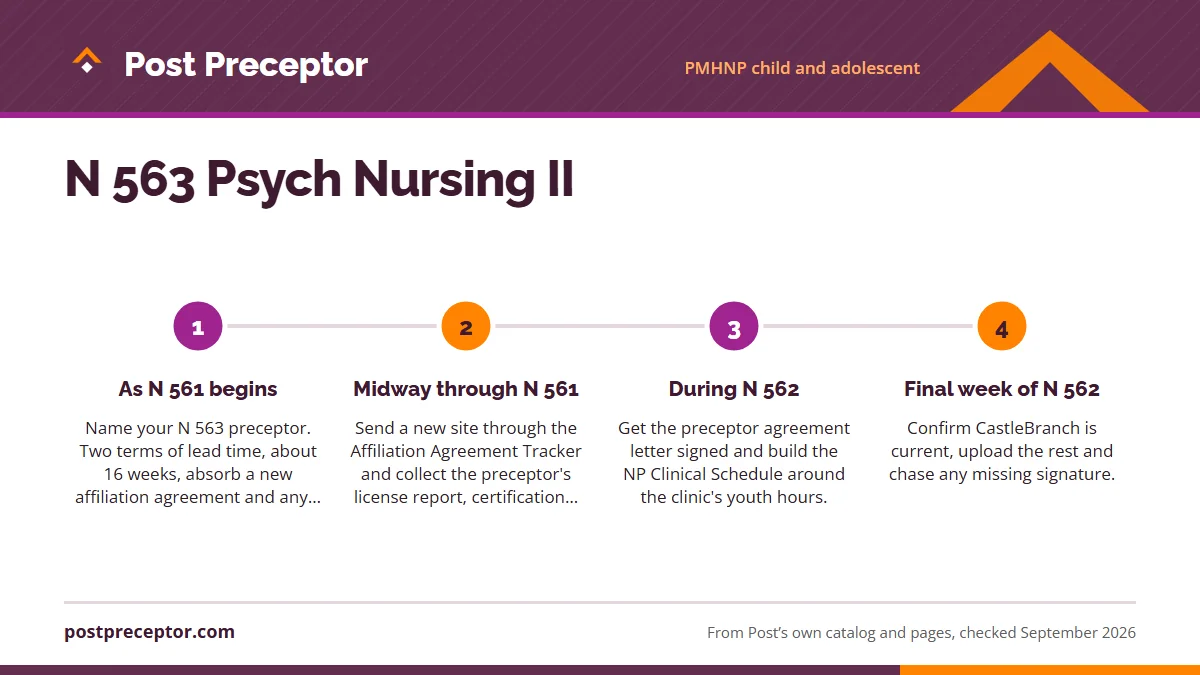
- As N 561 beginsName your
N 563preceptor. Two terms of lead time, about 16 weeks, absorb a new affiliation agreement and any board that wants a clinical plan up to 60 days out. - Midway through N 561Send a new site through the Affiliation Agreement Tracker and collect the preceptor's license report, certification and CV.
- During N 562Get the preceptor agreement letter signed and build the NP Clinical Schedule around the clinic's youth hours.
- Final week of N 562Confirm CastleBranch is current, upload the rest and chase any missing signature.
How we find N 563 preceptors for Post students
A child and adolescent term depends on the caseload, so that is where our search begins. We look for psychiatric nurse practitioners and child and adolescent psychiatrists whose patients are mostly young, close to where you live, in a state your license covers. We ask the questions above before your name ever reaches them, then check the license and certification, gather the CV and secure the preceptor's signature on the agreement letter.
We start the affiliation agreement request early, keep your file in the order the Clinical Coordinator reviews it, and plan N 567 in the same search, so both youth-focused terms are covered at once. Read how it works or use the contact form to tell us when N 561 starts.
Questions Post students ask
Is N 563 the child and adolescent course in Post's PMHNP?
Very likely, though its catalog title never says so. The 2024 course schedule Post published labels N 563 "Child and Adolescent", and the PMHNP program page mentions children with psychiatric needs. The current course description could not be checked. Ask the Clinical Coordinator, or read the syllabus, before choosing a site built around young patients.
How many clinical hours is N 563?
Post has not published a per-course number. The program requires 630 precepted hours in five preceptorships, and the only course-level figures in print belong to N 565 (135) and N 567 (90). Removing the 90 leaves 135 for each of the other four, so plan around 135 until your syllabus confirms the requirement.
Does my N 563 preceptor need pediatric certification?
Post's catalog asks for national certification in the population focus and leaves the fit to the Clinical Coordinator. For a PMHNP student that focus is psychiatric-mental health, so a certified psychiatric NP who treats children is the natural choice. Post also accepts an MD or DO, which covers a child and adolescent psychiatrist. Confirm any other credential with the Coordinator first.
Can I use an adult psychiatric practice for N 563?
Only the Clinical Coordinator can say yes, and the likely child and adolescent focus makes an adult-only practice a hard case. If the practice also treats teenagers, ask what share of the caseload they are. Otherwise save that preceptor for N 565, whose 2021-22 description centers on adults and older adults.
What is N 562, and why does it matter for my preceptor search?
N 562 Advanced Practice Psych Nursing II is the didactic course paired with N 563, and it should fall in the term just before. Treat those eight weeks as your deadline: the preceptor agreement letter, the affiliation agreement and the schedule all need to be finished by the end of the first week of N 563.
Related pages
Last checked 2026-09-27
We check these pages against Post University's own catalog, program pages and published nursing documents. Your course faculty and the Clinical Coordinator have the final word.
Post asks you to select your own preceptor. We make the search the easy part.
Tell us your Post track, your city and your next preceptorship course. We line up preceptors who fit the course, collect the license report, certification and CV the Clinical Coordinator reviews, and start the affiliation agreement early so your Week 1 packet is complete before the term opens.
- Preceptors matched to the course: primary care for FNP and AGPCNP, mental and behavioral health for PMHNP, doctoral nurse leaders for DNP hours
- Preceptor agreement letter, license report, certification and CV ready for Post's approval
- Every preceptorship planned together, close to home in a state where you hold your license and Post's disclosure says yes
Start your placement plan
Track, city and next preceptorship course is all we need to begin.