N 569: the final PMHNP preceptorship at Post University
N 569 Advanced Practice Psych Nursing Integration IV Preceptorship Experience closes the clinical side of Post University's PMHNP. It follows N 568, draws the four earlier preceptorships together, and lands close to the 42-month completion limit. Post prints no hour figure for it; the program total implies 135.
Get your placement plan
Tell us your Post program and where you live. A placement advisor replies with the preceptor and site options that fit your course.
Where N 569 sits
N 569 is the highest-numbered PMHNP course in Post's catalog and the last of the five PMHNP preceptorships. Its didactic partner is N 568 Advanced Practice Psych Nursing IV. Because NP students may carry only one course in an 8-week term, and the paired didactic course comes first elsewhere in the track, plan on N 568 in the term right before. The catalog and Post's 2024 course schedule use the same title for N 569.
Its key word is integration. Post's public sources say nothing about the course beyond that title, because its description was not among those retrieved, so read the syllabus as soon as it opens. A fair reading of an integration course is a caseload that pulls together the ages and conditions you met in N 561 through N 567; treat that as an expectation to confirm, not a rule.
The hour count, by subtraction
Post's catalog sets the PMHNP at 630 precepted hours over five courses and never publishes the per-course split. Two 2021-22 descriptions come close: N 567 at 90 and N 565 at 135. Take away the 90, divide what is left by four, and each remaining course comes to 135, the same as N 565.
For N 569, then, 135 is an implication of the totals, not a figure Post has stated. The pre-merger American Sentinel PMHNP page from 2020 printed 135 for N 569, which matches the arithmetic. The syllabus and the Clinical Coordinator decide. If 135 holds, the term needs about 17 precepted hours a week (our computation), the same pace as N 561. What changes in the final course is the price of slipping, covered below.
One practical check: compare the hours you logged in earlier preceptorships with each course's requirement before N 569 starts. If an earlier term closed on an extension, confirm it is closed, because an open extension keeps an NP student from moving on to the next course.
A preceptor for the integration course
Look for breadth. A preceptor whose week mixes new evaluations and follow-ups, adults and younger patients, medication management and referrals for therapy gives an integration course something to integrate. General outpatient psychiatry, or a community mental health center with a mixed caseload, often suits this course better than a narrow specialty clinic.
Ask whether the preceptor will let you run more of each visit as the weeks pass, with review afterward. The credential rules on preceptor requirements are the same as in every earlier course, MD or DO included. If nurse practitioners precepted fewer than two of your first four preceptorships, use N 569 to close that gap, since Post recommends at least two.
Going back to a preceptor from an earlier term can be the fastest route. Post's public rules neither describe nor bar it, so ask the Clinical Coordinator, and remember that each clinical course still needs its own complete Week 1 file.
What rides on the final term
- Time: Post advertises the PMHNP at 34 months and requires completion within 42.
- Grades: nursing courses need a B (83%) or better; a B- counts as failing.
- Repeats: past the 3P exam, the program allows a repeat of just one NP-specific course, and repeating means redoing the clinical work too.
- Extensions: the two-week extension offered by the American Sentinel College of Nursing & Health Sciences at Post University needs half the coursework done, clinical-hour extensions go through the Clinical Coordinator, and work left unfinished means repeating the course, clinicals included.
- Live sessions: NP courses carry mandatory synchronous online activities, and Post names the final graduation meeting among them.
A preceptor who withdraws in the fifth week of N 569 is the costliest dropout in the program, because there is no later term to absorb the delay. Keep a second candidate warm, and read preceptor dropped out and delayed graduation before the term, not during it. The full grade and repeat rules are on NP progression rules.
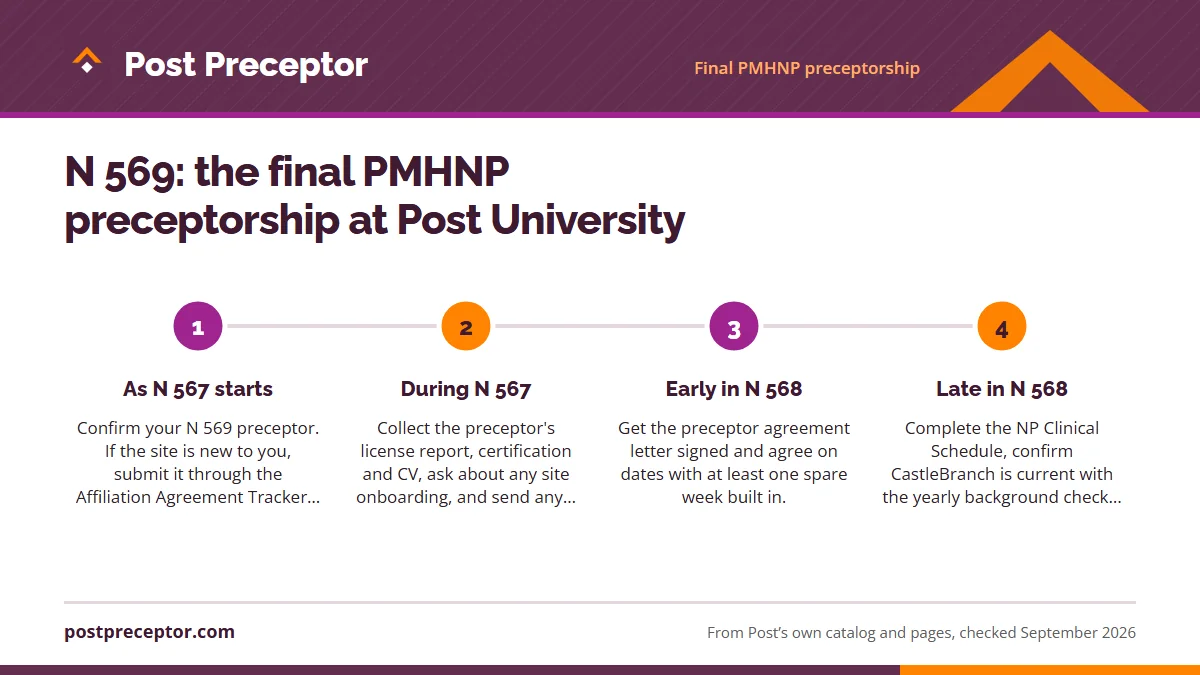
Setting up N 569 two terms ahead
- As N 567 startsConfirm your
N 569preceptor. If the site is new to you, submit it through the Affiliation Agreement Tracker now, since Academic Affairs needs up to seven business days just to make first contact. - During N 567Collect the preceptor's license report, certification and CV, ask about any site onboarding, and send any clinical plan your state board wants; some boards ask up to 60 days before the start.
- Early in N 568Get the preceptor agreement letter signed and agree on dates with at least one spare week built in.
- Late in N 568Complete the NP Clinical Schedule, confirm CastleBranch is current with the yearly background check and drug screen, and upload the remaining documents listed on the Week 1 deadline page.
The last preceptorship is not the one to leave until last. Line up N 569 while you are still in N 567, so a late problem has two terms of room instead of none.
How we see Post PMHNP students through N 569
We plan the fifth preceptorship at the same time as the first, so N 569 never becomes a scramble at the end of a 34-month program. For this course we look for a psychiatric preceptor with a broad caseload near your home, confirm the license and certification, collect the CV and secure the signed preceptor agreement letter during N 567.
We start any new affiliation agreement early and keep a second vetted preceptor in reserve through the term. If your preceptor's plans change, we are on call and move fast to a replacement, protecting both your hours and your graduation timeline. Students who come to us partway through the program get the same plan from wherever they stand. Tell us where you are in the sequence through the contact form.
Questions Post students ask
Is N 569 the last clinical course in Post's PMHNP?
By the catalog it is: N 569 is the highest-numbered of the five PMHNP preceptorships, and its title marks it as the integration course, numbered IV. Your own sequence can shift if you repeat a course or change terms, so confirm with your Student Success Advisor that N 569 is your final clinical term.
How many clinical hours does N 569 require?
Post has not published a figure for N 569 alone. The PMHNP's 630 hours, less the 90 printed for N 567, divide into 135 for each of the four other preceptorships, and N 565's printed 135 fits that pattern. Plan for about 135 and take the exact requirement from your syllabus or the Clinical Coordinator.
What happens if I cannot finish my N 569 hours by the end of the term?
Talk to the Clinical Coordinator before the term ends, since extensions involving clinical hours run through that office. The college's two-week extension also needs half the coursework complete. If the work is still unfinished afterward, Post requires repeating the course, clinical hours included, and once the 3P exam is passed, just one NP course can be retaken.
Does N 569 include a project like the FNP integration course?
Post's public sources do not say. The FNP and AGPCNP integration didactic course, N 598, has students design an evidence-based quality improvement project in primary care, but the descriptions for N 568 and N 569 were not retrieved. Check the N 568 syllabus early and ask your preceptor whether the site could support a project if one is required.
Is anything in person at the end of Post's PMHNP?
No campus visit is required. The final graduation meeting is one of the mandatory synchronous online activities Post lists for NP courses, so keep that date clear of clinical shifts. In-person commencement is optional: Post invites graduates to join their class, but the degree does not depend on attending.
Related pages
Last checked 2026-09-27
We check these pages against Post University's own catalog, program pages and published nursing documents. Your course faculty and the Clinical Coordinator have the final word.
Post asks you to select your own preceptor. We make the search the easy part.
Tell us your Post track, your city and your next preceptorship course. We line up preceptors who fit the course, collect the license report, certification and CV the Clinical Coordinator reviews, and start the affiliation agreement early so your Week 1 packet is complete before the term opens.
- Preceptors matched to the course: primary care for FNP and AGPCNP, mental and behavioral health for PMHNP, doctoral nurse leaders for DNP hours
- Preceptor agreement letter, license report, certification and CV ready for Post's approval
- Every preceptorship planned together, close to home in a state where you hold your license and Post's disclosure says yes
Start your placement plan
Track, city and next preceptorship course is all we need to begin.