South Dakota: Post NP clinicals rest on the school-to-site agreement
South Dakota sits among the states where Post University's current NP disclosure says Yes to the FNP, AGPCNP and PMHNP alike; residents licensed here can enroll and train at home. State approval of Post is not part of the picture; what makes a placement work is the agreement Post signs with the clinic where your preceptor practices.
Get your placement plan
Tell us your Post program and where you live. A placement advisor replies with the preceptor and site options that fit your course.
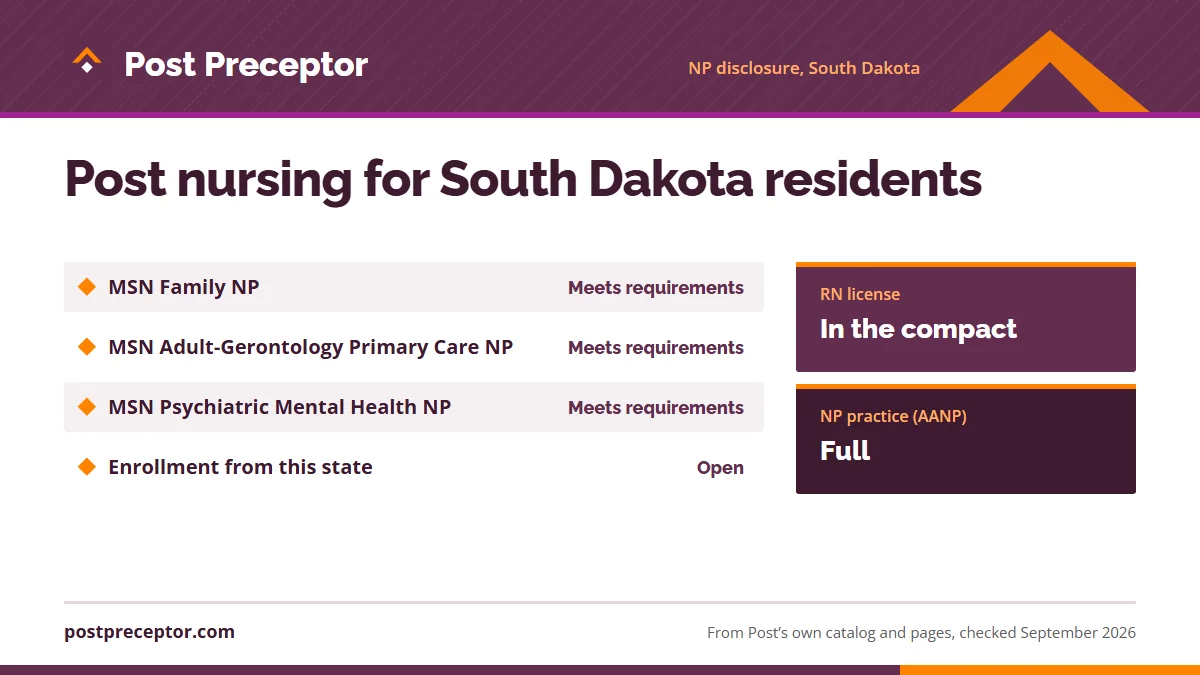
What Post's table says for South Dakota
Post answers Yes to both of its questions for South Dakota, covering the educational side of the NP license and of prescriptive authority, and all three specializations appear in the row.
| Post specialization or item | Post's answer for South Dakota |
|---|---|
| Family Nurse Practitioner | Yes |
| Adult Gerontology Primary Care NP | Yes |
| Psychiatric Mental Health NP | Yes |
| License title | Certified Nurse Practitioner |
| Other requirements, license | Unencumbered, active South Dakota or multistate RN license; certification through national nurse practitioner organization; collaborative agreement with a physician or CNP |
| Other requirements, prescribing | PDMP registration; DEA number (optional) |
| Governing body | South Dakota Board of Nursing (SDBON) |
Two cells belong to life after graduation: the collaborative agreement and the prescription drug monitoring registration. Post's row sets no end point for the agreement; the practice section adds one.
The board steps back; the school and the site sign
South Dakota's board, in a guidance sheet written for schools based elsewhere and last revised in 2020, states that approving those schools is not its role. When a clinic in the state hosts one of their students, the school settles the terms with the preceptor, the clinic, or both. At Post that means the affiliation agreement every site needs, as the affiliation agreement guide explains.
One expectation does fall on the school. The board looks for at least one faculty member authorized to practice in South Dakota at the student's level, by license or compact privilege, which for NP students means APRN-level authority. A separate distance-education rule repeats it for faculty whose APRN students sit in South Dakota. Post's public pages are silent on this, so raise it with the Clinical Coordinator and compliance officer before you commit to a clinic.
Practice rules and the South Dakota map
AANP rates South Dakota full practice, reached once an NP has logged 1,040 hours collaborating, in writing, with a physician, a CNP or a certified nurse midwife; Post's row names only the first two. For programs it approves, the board sets a preceptor floor: a license no lower than the one the student is pursuing and, for APRN students, a similar role and specialty. Post's own bar is on the preceptor requirements page.
Sioux Falls, about 315,000 people with a slice in Minnesota, is the biggest market. Rapid City's metro follows with some 157,000 residents; Aberdeen, a micropolitan area of 42,000 or so, is third. Research Monument Health, then Avera Health and Sanford Health, alongside independent practices. FNP and AGPCNP students need primary care; PMHNP students need behavioral health, including services for young patients in the adolescent-focused courses. None of these organizations is named here as a Post partner.
Licenses for training in and around South Dakota
A multistate RN license from South Dakota, which the state has issued since January 19, 2018, is honored in North Dakota, Nebraska, Montana, Wyoming and Iowa. Post still wants to approve out-of-state hours in advance, and North Dakota adds a board recognition step with a long lead time.
The Minnesota slice of the Sioux Falls metro is another matter. Minnesota is not a compact member, so a clinic there takes a Minnesota RN license in your name. South Dakota's APRN Compact bill was signed on February 5, 2024, yet the compact stays dormant until a seventh state enacts it, and it concerns NP licensure rather than the RN license that Post's clinical-state rule turns on.
What we handle for South Dakota students
In South Dakota the placement comes down to Post and the clinic agreeing, so we confirm a site is ready to sign Post's affiliation agreement before we bring you its preceptor. We match the preceptor's certification to your track and gather the license report, certification and CV along with a signed agreement letter, so the Clinical Coordinator's review begins with nothing missing.
Our search reaches from Sioux Falls to Rapid City, Aberdeen and the small-town clinics between, and we map every preceptorship with you, from N 581 or N 561 to your last. If a preceptor steps away partway through a course, we run the search for a replacement. Tell us your town through the form below.
Questions Post students ask
Does South Dakota's board have to approve Post before I start clinicals?
No. Its guidance leaves out-of-state schools outside its approval process and treats the placement as an arrangement between Post and your preceptor or clinic. The board does look for a program faculty member with APRN-level authority in South Dakota, so ask the Clinical Coordinator how Post covers that.
Will Post's hours count toward South Dakota's NP licensure requirements?
The board's licensure checklist calls for a minimum of 500 clinical hours tied to your role and population focus, alongside graduate coursework covering pharmacology, physical assessment and pathophysiology. Post's precepted totals are 540 (FNP, AGPCNP) and 630 (PMHNP), and its table answers Yes on the educational requirements.
Can a South Dakota student log hours in Nebraska or North Dakota?
Yes, with Post's prior approval. Each is a compact state and a Yes in Post's table, so your South Dakota multistate license travels with you. North Dakota's board also wants its distance-recognition paperwork from the program two months ahead, which pushes that plan earlier.
Can I train at the Sioux Falls clinic where I work?
Post allows a clinical at your workplace, provided your preceptor is not your direct supervisor or a family member and the site fits your track. The clinic still signs Post's affiliation agreement, which in South Dakota is the arrangement that matters most. The workplace clinicals page has the details.
Related pages
Last checked 2026-09-27
We check these pages against Post University's own catalog, program pages and published nursing documents. Your course faculty and the Clinical Coordinator have the final word.
Post asks you to select your own preceptor. We make the search the easy part.
Tell us your Post track, your city and your next preceptorship course. We line up preceptors who fit the course, collect the license report, certification and CV the Clinical Coordinator reviews, and start the affiliation agreement early so your Week 1 packet is complete before the term opens.
- Preceptors matched to the course: primary care for FNP and AGPCNP, mental and behavioral health for PMHNP, doctoral nurse leaders for DNP hours
- Preceptor agreement letter, license report, certification and CV ready for Post's approval
- Every preceptorship planned together, close to home in a state where you hold your license and Post's disclosure says yes
Start your placement plan
Track, city and next preceptorship course is all we need to begin.