South Carolina RNs in Post University's nurse practitioner programs
South Carolina is open for every one of Post University's MSN nurse practitioner tracks; its row in Post's current NP disclosure reads Yes for family, adult-gerontology primary care and psychiatric mental health alike. South Carolina screens outside schools whose students are working toward a first nursing license, not RNs in graduate study, so your clinicals hinge on Post's approvals and a preceptor near Greenville, Columbia, Charleston or wherever you live.
Get your placement plan
Tell us your Post program and where you live. A placement advisor replies with the preceptor and site options that fit your course.
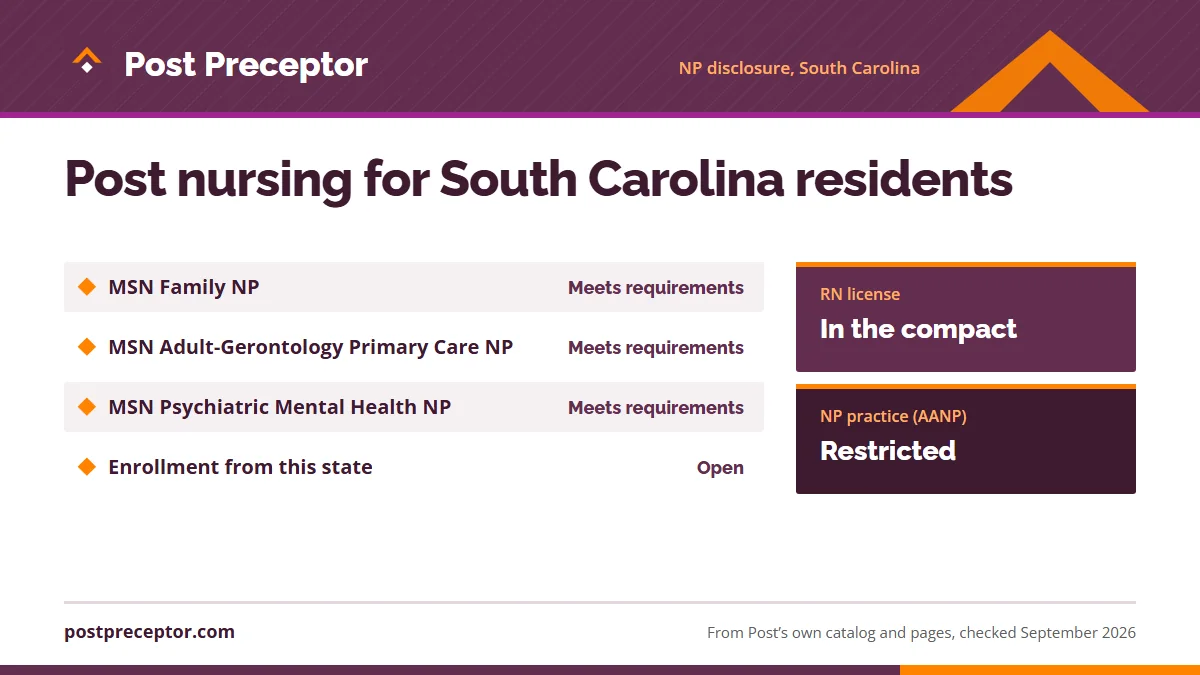
What Post lists for South Carolina
Three details set this row apart. Certification carries a within-one-year note; the physician document is a practice agreement, where Post's North Carolina and Georgia rows say collaborative agreement; and prescribing adds a DHEC number beside the DEA number. The state's public health agency now goes by the South Carolina Department of Public Health, so check the current registration with the Board of Nursing when you apply.
All coursework is online, with no visit to Waterbury, and the hands-on piece takes place in South Carolina: 540 precepted hours in primary care offices for family or adult-gerontology students, or 630 in psychiatric settings for the PMHNP.
| Post specialization or column | Post's answer for South Carolina |
|---|---|
| MSN Family Nurse Practitioner (FNP) | Yes |
| MSN Adult Gerontology Primary Care NP (AGPCNP) | Yes |
| MSN Psychiatric Mental Health NP (PMHNP) | Yes |
| License title | Nurse Practitioner |
| Education met for NP license / prescriptive authority | Yes / Yes |
| Other requirements Post lists | Unencumbered, active RN license; national NP certification (within 1 year); practice agreement with a physician; for prescribing, a practice agreement, a DEA number and a DHEC number |
Regulation 91-6 and why it passes you by
South Carolina does screen some outside nursing schools. Under Regulation 91-6, a school from another state running clinicals toward a first nursing license must win Board approval beforehand, stay fully approved at home, post a faculty member on site for each shift (licensed in South Carolina or a compact state), sign a written affiliation agreement, and follow South Carolina's preceptor rules.
RN-to-BSN and APRN programs go unmentioned in 91-6, and no separate Board step for graduate NP students appears in the rules. What governs a Post student is Post's own process, in which the practice and preceptor you choose go to the Clinical Coordinator for approval and each practice signs an affiliation agreement with Post. For Post's own note about boards that like early notice, see state board notice.
Practice agreements, preceptors and the state tax credit
AANP rates South Carolina restricted: delegated acts run under a practice agreement with a physician, and controlled-substance prescriptions come with supply limits. Every NP you approach therefore has a physician partner, and that physician may precept you as well, since Post's catalog lists MDs and DOs while favoring NPs; who can precept you has the details.
The state's preceptor tax credit, in section 12-6-3800 of the tax code, helps physician, APRN and PA preceptors who meet its Medicaid and rotation-length tests, but only when the student attends a South Carolina public or independent college. A Post student's preceptor is outside it. A 2024 act pushed its repeal to January 1, 2030; the Department of Revenue's ruling #20-2 still lists the older 2026 date.
Where South Carolina students look, and how far a license reaches
Greenville-Anderson-Greer tops a million residents; Charleston-North Charleston and Columbia each hold just under 900,000; and roughly 450,000 South Carolinians live in the Charlotte metro. Among the employers you will notice: Roper St. Francis Healthcare, then Prisma Health, McLeod Health, Lexington Health and MUSC Health. They are landmarks for finding outpatient practices rather than places with any tie to Post. Family and adult-gerontology hours stay in primary care.
South Carolina's compact membership began January 19, 2018, and the APRN Compact has no South Carolina statute. A multistate license from here reaches North Carolina and Georgia, both Yes states in Post's table, but training across either line still needs Post's approval in advance; the license page sets out that rule.
Why South Carolina's Post students choose us
We search around Greenville, Columbia, Charleston and the towns between for preceptors who match your Post course, including the North Carolina side of Charlotte when that is the shorter drive and Post agrees. Each preceptor receives a tidy, complete request, the preceptor agreement letter comes back signed early, and the affiliation request starts in time for Week 1. Send us your track and town.
Questions Post students ask
Must South Carolina's Board approve Post before I train in the state?
Not as far as the published rules show. Regulation 91-6 covers outside schools whose clinicals lead to a first nursing license and leaves APRN programs unmentioned. Post's approvals are what you need: the Clinical Coordinator reviews the practice and the preceptor, and the practice signs Post's affiliation agreement. Ask the Clinical Coordinator whether any state notice is due.
What does 'within 1 year' mean in Post's South Carolina row?
Post's cell pairs national NP certification with the note "within 1 year" and does not explain it further. It concerns licensure after you graduate, not your clinicals. The South Carolina Board of Nursing's licensure pages are the place to confirm what that window covers before you plan your certification exam date.
Can my preceptor use South Carolina's preceptor tax credit?
Not for a Post rotation. The credit only counts students at South Carolina public or independent colleges, and Post's home is Waterbury, Connecticut. Knowing that before your first call lets you lead with what matters to a busy clinician: your course, your weekly hours and Post's short approval steps.
Can I do Post clinicals in Charlotte or Augusta while living in South Carolina?
Both metros cross the state line, and North Carolina and Georgia are Yes states in Post's table and compact members. A practice across either line can work once Post approves a clinical outside South Carolina and the practice has signed its affiliation agreement with Post.
Related pages
Last checked 2026-09-27
We check these pages against Post University's own catalog, program pages and published nursing documents. Your course faculty and the Clinical Coordinator have the final word.
Post asks you to select your own preceptor. We make the search the easy part.
Tell us your Post track, your city and your next preceptorship course. We line up preceptors who fit the course, collect the license report, certification and CV the Clinical Coordinator reviews, and start the affiliation agreement early so your Week 1 packet is complete before the term opens.
- Preceptors matched to the course: primary care for FNP and AGPCNP, mental and behavioral health for PMHNP, doctoral nurse leaders for DNP hours
- Preceptor agreement letter, license report, certification and CV ready for Post's approval
- Every preceptorship planned together, close to home in a state where you hold your license and Post's disclosure says yes
Start your placement plan
Track, city and next preceptorship course is all we need to begin.