Pennsylvania and Post University's NP tracks: the CRNP route from an online program
Pennsylvania gets a Yes in every track, FNP, AGPCNP and PMHNP, from Post University's current NP disclosure, so a Pennsylvania RN can enroll online and keep every precepted hour in the state. The Pennsylvania-specific pieces are the CRNP title, physician collaboration that lasts a whole career, and a compact license that only arrived in July 2025.
Get your placement plan
Tell us your Post program and where you live. A placement advisor replies with the preceptor and site options that fit your course.
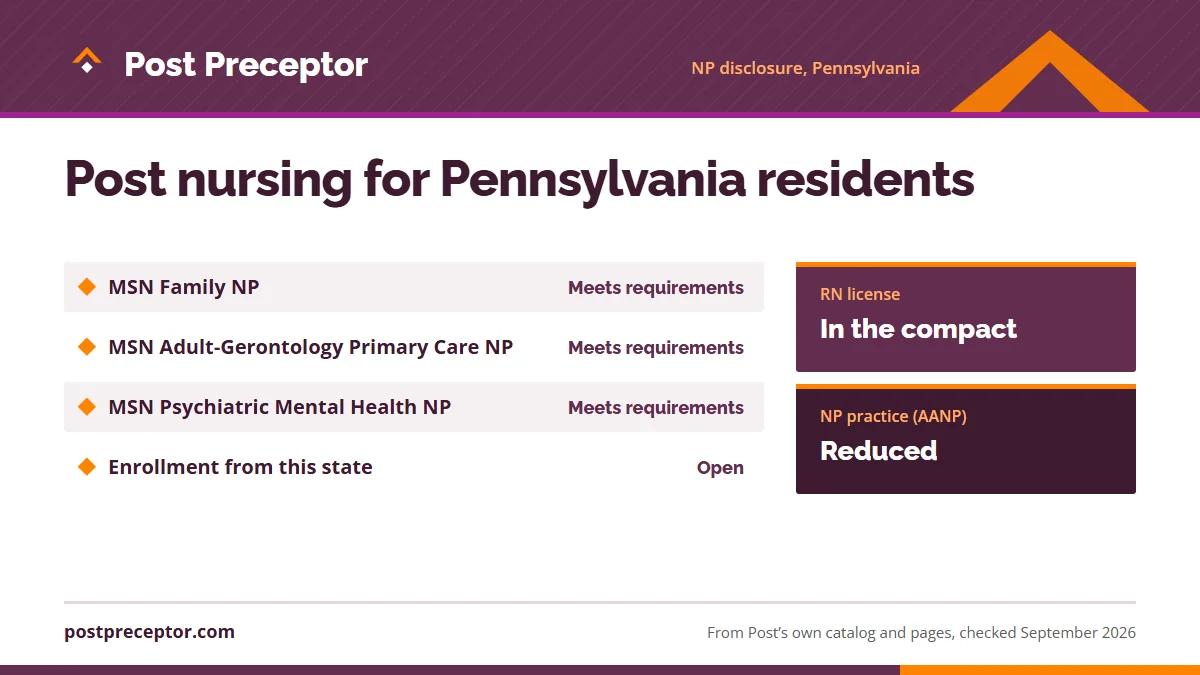
Pennsylvania in Post's disclosure table
Post lists the credential as Certified Registered Nurse Practitioner (CRNP) and gives Pennsylvania a Yes in both columns, licensing and prescribing. The governing body appears simply as the State Board of Nursing.
| Post specialization | Post's answer for Pennsylvania |
|---|---|
| MSN, Family Nurse Practitioner (FNP) | Yes |
| MSN, Adult Gerontology Primary Care NP (AGPCNP) | Yes |
| MSN, Psychiatric Mental Health NP (PMHNP) | Yes |
| License title | Certified Registered Nurse Practitioner |
| Other requirements Post lists | An unencumbered, active Pennsylvania RN license; certification through a national NP organization; a collaborative agreement with a physician; for prescribing, an optional DEA number |
One detail stands out. The New Jersey and Delaware rows accept a state or multistate RN license, but Pennsylvania's names only a Pennsylvania license, even though Pennsylvania put the compact fully into effect on July 7, 2025. If you hold a multistate license from elsewhere, ask the Clinical Coordinator how Post reads that line today.
Collaboration for the life of the license
AANP rates Pennsylvania reduced practice, and the reason is permanence: a CRNP's written collaboration with physicians never expires, however long they practice. Prescribing adds a second layer, with agreements required with at least two physicians. Post's row mentions a single physician; the board's rules are the ones you will license under.
For your search, every CRNP preceptor already practices inside a physician collaboration. Post counts physicians, MD or DO, as eligible preceptors as well, while steering at least two of your clinical courses toward NP preceptors, and the preceptor requirements list the credentials.
Section 21.118 and out-of-state graduate students
Pennsylvania spells out what a visiting graduate student may do. The rule is 49 Pa. Code § 21.118, and it turns on three facts: your RN license was issued by another U.S. jurisdiction or by Canada, your graduate nursing program is accredited, and you take no pay for the clinical time. When all three hold, your required clinicals need no Pennsylvania license. Holding an RN job in the state at the same time is a separate matter, handled through endorsement plus a temporary permit.
Post's admissions rule is tighter: you train only in a Post-approved state where your own license is active and clean. Plan around Post's rule, which is the one the Clinical Coordinator applies. No Pennsylvania rule located in research asks a school from another state for permission before its students start clinicals. A Distance Education Application exists, but only for programs already carrying the board's approval. The board's overhaul of its education chapter is in its final stage: the final-form version went to regulators on September 8, 2026, the review commission takes it up in public on October 15, 2026, and § 21.118 survives it substantially intact.
Philadelphia, Pittsburgh and the regions between
Pennsylvania's share of the Philadelphia-Camden-Wilmington metro tops four million residents, the Pittsburgh metro holds roughly 2.4 million, and Harrisburg-Carlisle and Allentown-Bethlehem-Easton follow. Large systems include UPMC and Geisinger in addition to Jefferson Health, Penn State Health and the University of Pennsylvania's system, Penn Medicine.
These names signal where NP care happens; none is offered here as a site that takes Post students, and Post needs a signed affiliation agreement with whichever practice you land. Every FNP and AGPCNP hour belongs in primary care; PMHNP hours go to psychiatric practices, clinics and behavioral health programs serving all ages.
RN licensing for Pennsylvania clinicals
According to the board's compact page, a nurse with a multistate license in good standing can work in Pennsylvania on it. If Pennsylvania is your home, your license will be issued here. For hours across the line in New Jersey, Delaware, Maryland or another Yes state, Post needs prior specialization approval and a license the Clinical Coordinator accepts for that state. New York, on the northern border, is closed in Post's table. The APRN Compact has no Pennsylvania enactment. For Post's rule in full, read the RN license guide.
Why Pennsylvania Post students choose us
Pennsylvania is big enough that a good search starts with your own region, whether that is greater Philadelphia, the Allentown-Bethlehem-Easton area, the Harrisburg-Carlisle area or greater Pittsburgh. We confirm each preceptor's Pennsylvania license and national certification, match the setting to your track, and bring back the preceptor agreement letter, signed, alongside the preceptor's license report and CV.
Before we present a practice, we confirm it is ready to host a student, and Post gets the affiliation agreement request well before the term, which keeps your Week 1 packet on schedule. PMHNP students get all five psychiatric preceptorships mapped at the start. Map your Pennsylvania search with us.
Questions Post students ask
Will Post accept my multistate license for Pennsylvania clinicals?
Pennsylvania has honored multistate licenses for RN practice since July 7, 2025, but Post's Pennsylvania row names only a Pennsylvania RN license. Residents will hold a Pennsylvania license anyway. Residents of neighboring compact states who want Pennsylvania hours should ask the Clinical Coordinator whether the multistate privilege is enough, and need Post's prior specialization approval first.
How many collaborating physicians does a Pennsylvania CRNP need?
AANP's summary says the written collaborative agreement with physicians lasts a CRNP's whole career, and prescribing requires agreements with at least two physicians. Post's table lists a collaborative agreement with a physician. For the license you apply for after graduation, the State Board of Nursing's current rules decide.
Does § 21.118 mean I need no license where I train?
It lets an RN licensed outside Pennsylvania complete an accredited graduate program's unpaid clinical requirements in the state without a Pennsylvania license. Post's rule is narrower still: your hours count only in approved states where your own license is active and carries no restrictions, so plan around Post's rule and confirm your case with the Clinical Coordinator.
Is Pennsylvania open for Post's PMHNP?
Yes. Pennsylvania appears in Post's current NP disclosure for all three tracks, the PMHNP among them. The PMHNP asks 630 precepted hours of you, spread over five psychiatric courses; the FNP and AGPCNP each run 540 hours in primary care. The PMHNP guide lists the courses.
Related pages
Last checked 2026-09-27
We check these pages against Post University's own catalog, program pages and published nursing documents. Your course faculty and the Clinical Coordinator have the final word.
Post asks you to select your own preceptor. We make the search the easy part.
Tell us your Post track, your city and your next preceptorship course. We line up preceptors who fit the course, collect the license report, certification and CV the Clinical Coordinator reviews, and start the affiliation agreement early so your Week 1 packet is complete before the term opens.
- Preceptors matched to the course: primary care for FNP and AGPCNP, mental and behavioral health for PMHNP, doctoral nurse leaders for DNP hours
- Preceptor agreement letter, license report, certification and CV ready for Post's approval
- Every preceptorship planned together, close to home in a state where you hold your license and Post's disclosure says yes
Start your placement plan
Track, city and next preceptorship course is all we need to begin.