Post University NP clinicals for Ohio nurses
Yes, on all three counts. Post University's current NP disclosure marks Ohio Yes for each of its three NP specializations, so an Ohio RN can enroll in whichever track fits and log every precepted hour near home. Ohio's statute gives the board no gatekeeping role over schools headquartered elsewhere, though its wording pictures an APRN overseeing the student.
Get your placement plan
Tell us your Post program and where you live. A placement advisor replies with the preceptor and site options that fit your course.
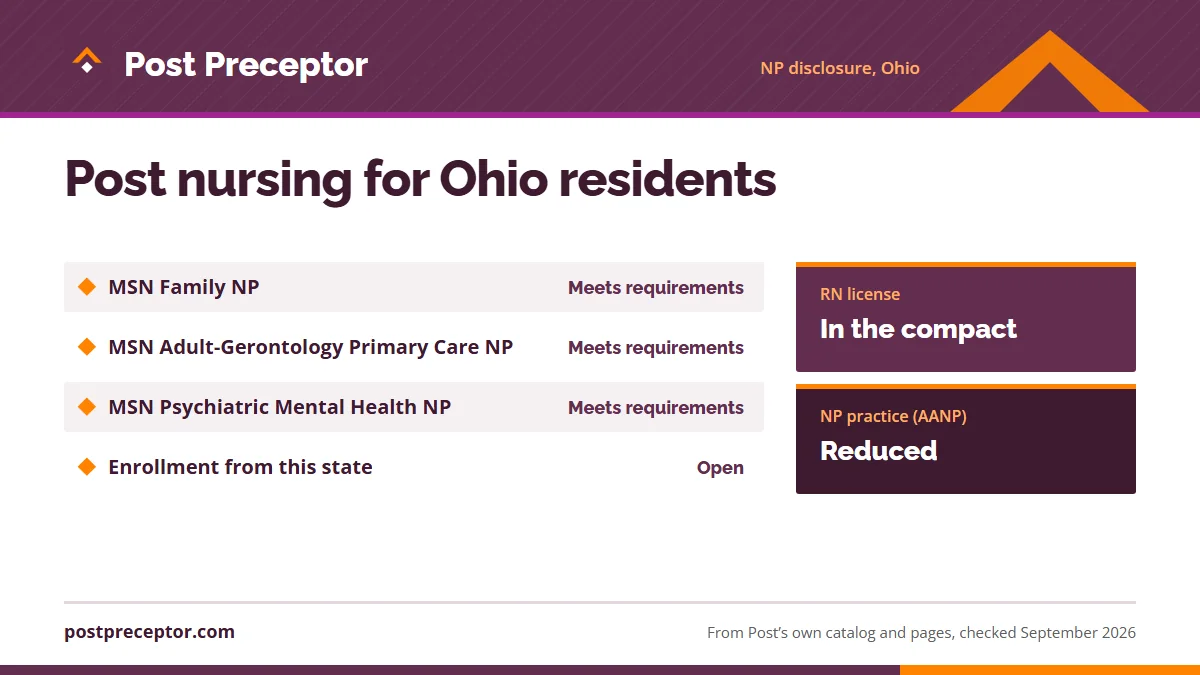
Ohio's row in Post's disclosure
Post's table gives the Ohio license title as Certified Nurse Practitioner and answers Yes twice, once for licensure as an NP and once for prescribing. The specialization cell names all three MSN tracks.
| Post specialization | Post's answer for Ohio |
|---|---|
| MSN, Family Nurse Practitioner (FNP) | Yes |
| MSN, Adult Gerontology Primary Care Nurse Practitioner (AGPCNP) | Yes |
| MSN, Psychiatric Mental Health Nurse Practitioner (PMHNP) | Yes |
| License title in Post's table | Certified Nurse Practitioner |
| Other requirements Post lists | Unencumbered, active Ohio or multistate RN license; national NP certification; collaborative agreement with a physician; DEA number optional for prescribing |
The last row describes practice after graduation, and in Ohio the collaboration piece never expires. AANP files Ohio under reduced practice: the standard care arrangement an Ohio CNP signs, with a physician or a podiatrist on the other side, stays in force for the whole career, and Schedule II drugs come with restrictions on the settings where they may be prescribed. None of this changes how your clinical courses run.
What Ohio law says about NP students at a clinical site
Ohio writes its student exemption straight into the Nurse Practice Act. Revised Code section 4723.32(F) is the clause for graduate NP students: it covers you when your program prepares its graduates for a national certification exam, the work happens under that program's umbrella, and an APRN oversees it in the role of faculty, teaching assistant or preceptor. The Code gives an out-of-state school no board filing to make before its students arrive.
The APRN wording matters because Post's catalog is broader: a physician (MD or DO) may precept an NP student, though Post would rather see an NP in charge of half your clinical courses or more; see who can precept a Post NP student. If an Ohio physician volunteers, ask the Clinical Coordinator how the statute reads for your rotation before you plan a term around that offer.
Most Ohio students search inside one of four metros: Columbus, Cleveland, Cincinnati or Dayton. The big names include Cleveland Clinic and University Hospitals up by the lake; in the capital, the Ohio State University Wexner Medical Center and OhioHealth; and Bon Secours Mercy Health, headquartered on the Cincinnati side of the state. Each runs its own student onboarding. Whichever door you knock on, an FNP or AGPCNP rotation has to be primary care, and a PMHNP rotation needs a psychiatric or behavioral setting open to children and adults alike.
Licensing for Ohio clinicals, and for hours across the line
Ohio RNs have been able to hold a multistate license since January 1, 2023, and Post's Ohio row accepts either that or a single-state Ohio license. The APRN Compact is not law in Ohio, so the CNP license you apply for after graduation will be Ohio's own.
Metro lines ignore state lines, and Post's rules follow you across them. Greater Cincinnati reaches into Kentucky and Indiana, both Yes states in Post's table and both compact members, yet hours there still need Post's prior specialization approval, and Post's catalog never says whether practicing on a compact privilege satisfies its license wording. Raise it early; our guide to RN licenses for clinicals explains how. Michigan, to the north, is not a compact state, so a practice there calls for a Michigan license. Pennsylvania came into the compact on July 7, 2025.
Why Ohio's Post NP students choose us
We start in your own metro and work outward, looking first for Ohio CNPs, which suits both the 4723.32(F) wording and Post's preference for NP preceptors. Once one agrees, we pull together the documents Post asks for about the preceptor, see the preceptor agreement letter through to signature, and send the affiliation request in time for a finished Week 1 packet.
We plan every preceptorship course together, and if an Ohio preceptor drops out mid-course, we start the search for a replacement at once. Tell us your Ohio county and track.
Questions Post students ask
Can I take Post's PMHNP track while living in Ohio?
Yes. Post lists Ohio as Yes for the Psychiatric Mental Health NP as well as the two primary care tracks. The PMHNP means 630 precepted hours split over five preceptorships in psychiatric and behavioral care for children through older adults, so expect more sites to line up than an FNP classmate. All coursework is online, with no trip to Waterbury.
Must Post get the Ohio board's approval before my first clinical day?
Ohio's Revised Code sets out no board filing for a school outside Ohio; the exemption in section 4723.32 carries the load. Even so, confirm with the Clinical Coordinator: Post's catalog notes that certain boards expect roughly two months' warning of a clinical plan, and Post's compliance officer tracks which ones.
Can a physician precept me for an Ohio rotation?
Post's catalog would allow it, but the Ohio clause covering NP students pictures an APRN in the supervising role. Ask the Clinical Coordinator to confirm before a physician signs the agreement letter. The simplest plan in Ohio is an NP preceptor, which Post already prefers for half your clinical courses or more.
Will I need a collaborating physician once I am licensed in Ohio?
Yes. Post's Ohio row names physician collaboration as one of the state's requirements beyond education, and AANP describes Ohio's standard care arrangement as lasting for an NP's entire career. A DEA number is optional in Post's row. Check the Ohio Board of Nursing for the current prescribing rules before you graduate.
Related pages
Last checked 2026-09-27
We check these pages against Post University's own catalog, program pages and published nursing documents. Your course faculty and the Clinical Coordinator have the final word.
Post asks you to select your own preceptor. We make the search the easy part.
Tell us your Post track, your city and your next preceptorship course. We line up preceptors who fit the course, collect the license report, certification and CV the Clinical Coordinator reviews, and start the affiliation agreement early so your Week 1 packet is complete before the term opens.
- Preceptors matched to the course: primary care for FNP and AGPCNP, mental and behavioral health for PMHNP, doctoral nurse leaders for DNP hours
- Preceptor agreement letter, license report, certification and CV ready for Post's approval
- Every preceptorship planned together, close to home in a state where you hold your license and Post's disclosure says yes
Start your placement plan
Track, city and next preceptorship course is all we need to begin.