Kentucky guide for Post University NP students: preceptors, licenses and borders
Living in Kentucky puts every Post University NP specialization within reach, since Post's current disclosure marks the FNP, AGPCNP and PMHNP Yes for the state. Kentucky's board requires no sign-off for a program based elsewhere, yet it has firm expectations about the licenses held by whoever supervises your hours on Kentucky soil, and that is where planning starts.
Get your placement plan
Tell us your Post program and where you live. A placement advisor replies with the preceptor and site options that fit your course.
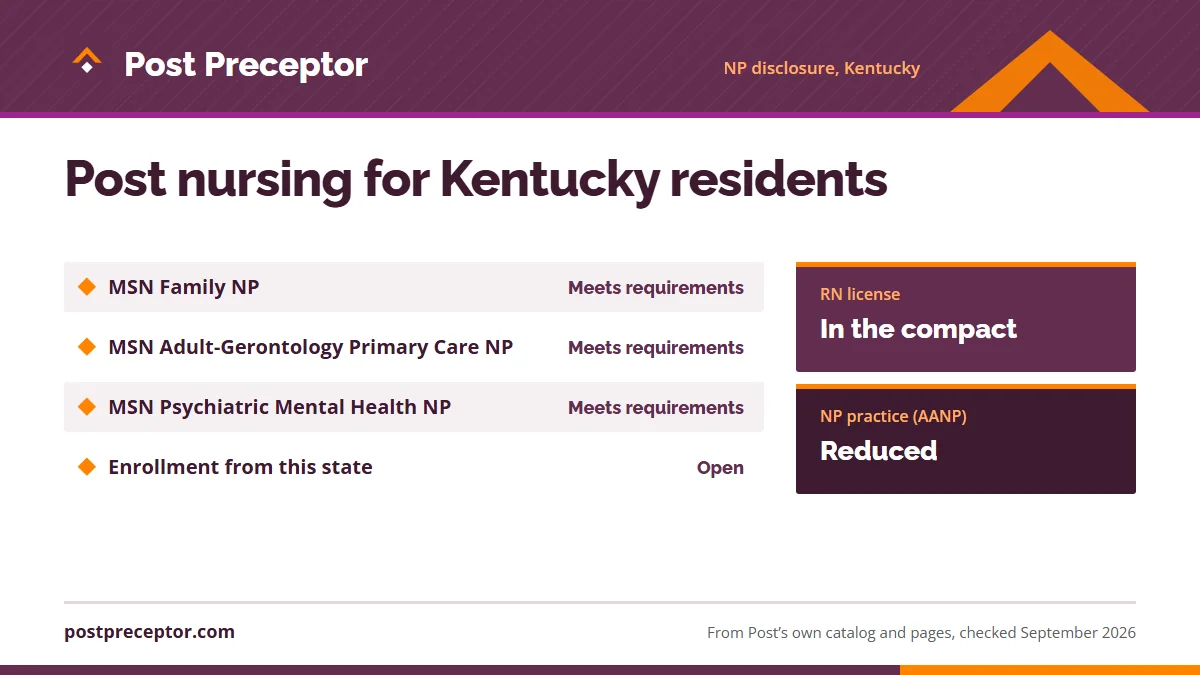
Post's Kentucky answer
Every column of Post's Kentucky row comes back Yes, so each of the three tracks satisfies Kentucky's educational bar for licensure and for prescribing.
| Post specialization or item | Post's answer for Kentucky |
|---|---|
| FNP | Yes |
| AGPCNP | Yes |
| PMHNP | Yes |
| License title | Certified Nurse Practitioner |
| Other requirements, license | Unencumbered, active Kentucky or multistate RN license; national NP certification |
| Other requirements, prescriptive authority | Collaborative agreement with a physician; DEA number (optional) |
| Governing body | Kentucky Board of Nursing |
The physician agreement sits under prescriptive authority here, which squares with AANP's reduced-practice rating: prescribing in Kentucky depends on two separate written agreements with physicians, one for scheduled drugs and one for everything else. The board can exempt an NP from them, and a first-year licensee faces limits on employer setting.
No program approval, but a license rule for preceptors
KBN says plainly that it approves only prelicensure programs that originate in Kentucky. Programs from other states, including those with no Kentucky presence beyond a clinical component, need no KBN approval. For visiting nurses on a clinical rotation, KBN cites an exemption in state law (KRS 314.101) that depends on the school's standing: SARA membership, which Post has, or licensure by Kentucky's postsecondary council (CPE).
The rule that matters falls on the preceptor. When an online MSN or DNP APRN student trains in a Kentucky setting, KBN expects the nurse faculty and preceptors overseeing that student to carry unencumbered, active Kentucky licensure at both levels, RN and APRN. For a nurse residing in some other compact state, the Kentucky APRN license is enough, since the multistate RN license covers the rest. Any NP practicing in Kentucky already carries that APRN license, so the check is quick:
- APRN licenseLook up the preceptor's Kentucky APRN license and confirm it is active with nothing against it.
- RN license behind itConfirm a Kentucky RN license, or a multistate one if the preceptor lives in another compact state.
- Post's own standardNational certification matching your population, a master's or doctorate, and a year or more in practice, per the preceptor requirements page.
- Physician preceptorsKBN's guidance speaks to nurses; if an MD or DO will precept you, ask the Clinical Coordinator what Kentucky and Post expect.
Where Kentucky NP students look
Kentucky's biggest population centers are three: the Kentucky side of the Louisville metro, about 1.12 million people; Lexington-Fayette, about 535,000; and the Northern Kentucky share of greater Cincinnati, near 475,000. Bowling Green adds nearly 200,000 more. Systems that NP students weigh include St. Elizabeth Healthcare, UofL Health and Norton Healthcare. UK HealthCare belongs to the University of Kentucky, and Baptist Health also operates across the river in Southern Indiana. They illustrate the landscape only; each has its own student rules and none is connected to Post.
Independent family practices, internal medicine offices and community mental health centers matter as much as hospitals, and Post's primary care site guide shows what counts for FNP and AGPCNP hours. The research found no Kentucky incentive for preceptors.
Your compact license and the river borders
NCSBN counts Kentucky among the states whose multistate licenses began on January 19, 2018. No APRN Compact law exists in Kentucky yet.
Kentucky's borders cut both ways. Across the Ohio River, Ohio and Indiana answer Yes in Post's table, so a Cincinnati or Southern Indiana practice can work for a Northern Kentucky or Louisville student, provided Post approves the out-of-state site in advance; such a site answers to its own state's preceptor rules rather than KBN's. To the south, Tennessee answers No, which rules out practices just over that line for students around Bowling Green. Post's full license and residence rule explains the approval step.
Why Kentucky Post students choose us
We build Kentucky placements around the preceptor license rule from the first call: every Kentucky NP we approach for you has a verified Kentucky APRN license and a qualifying RN license before the Clinical Coordinator sees a thing. From Louisville and Lexington to Northern Kentucky, Bowling Green and the eastern counties, we find primary care or mental health preceptors near home and bring the preceptor's documents, signed letter and site agreement together early, so your Week 1 packet is settled before day one. If a preceptor drops out, we find the replacement. Ask for a Kentucky search.
Questions Post students ask
Is KBN approval needed for Post's NP program?
No. KBN's approval, by its own account, covers only prelicensure programs born in Kentucky; programs from elsewhere need none of it, even when a Kentucky clinical is their only presence here. KBN's interest lies with the licenses of the nurses who oversee or precept online APRN students in Kentucky.
Which licenses must a Kentucky preceptor hold for a Post student?
A nurse precepting you in Kentucky should hold an unencumbered, active Kentucky APRN license plus an RN license, either Kentucky's or, for a preceptor living in another compact state, a multistate one. That is KBN's expectation for online APRN programs. Post then layers on its own standard for certification, education and experience, and the Clinical Coordinator approves the match.
Can a Northern Kentucky student do clinicals in Cincinnati?
Yes, if the pieces line up. Ohio answers Yes in Post's NP disclosure, but the site lies outside your state of residence, so Post's prior specialization approval comes first, and you must hold a license Post accepts for Ohio clinicals. The Ohio practice would also sign an affiliation agreement with Post's nursing college, like any Kentucky site.
I live near Bowling Green. Can my hours be in Tennessee?
No. Tennessee sits on Post's closed list: the disclosure answers No on licensure and on prescribing, and Post does not enroll NP students who live there. Since Post limits hours to approved states, a practice over the Tennessee line is out of bounds. Bowling Green and the rest of south-central Kentucky are where to look.
Related pages
Last checked 2026-09-27
We check these pages against Post University's own catalog, program pages and published nursing documents. Your course faculty and the Clinical Coordinator have the final word.
Post asks you to select your own preceptor. We make the search the easy part.
Tell us your Post track, your city and your next preceptorship course. We line up preceptors who fit the course, collect the license report, certification and CV the Clinical Coordinator reviews, and start the affiliation agreement early so your Week 1 packet is complete before the term opens.
- Preceptors matched to the course: primary care for FNP and AGPCNP, mental and behavioral health for PMHNP, doctoral nurse leaders for DNP hours
- Preceptor agreement letter, license report, certification and CV ready for Post's approval
- Every preceptorship planned together, close to home in a state where you hold your license and Post's disclosure says yes
Start your placement plan
Track, city and next preceptorship course is all we need to begin.