Texas and Post University's online NP programs: clinicals, preceptors and licenses
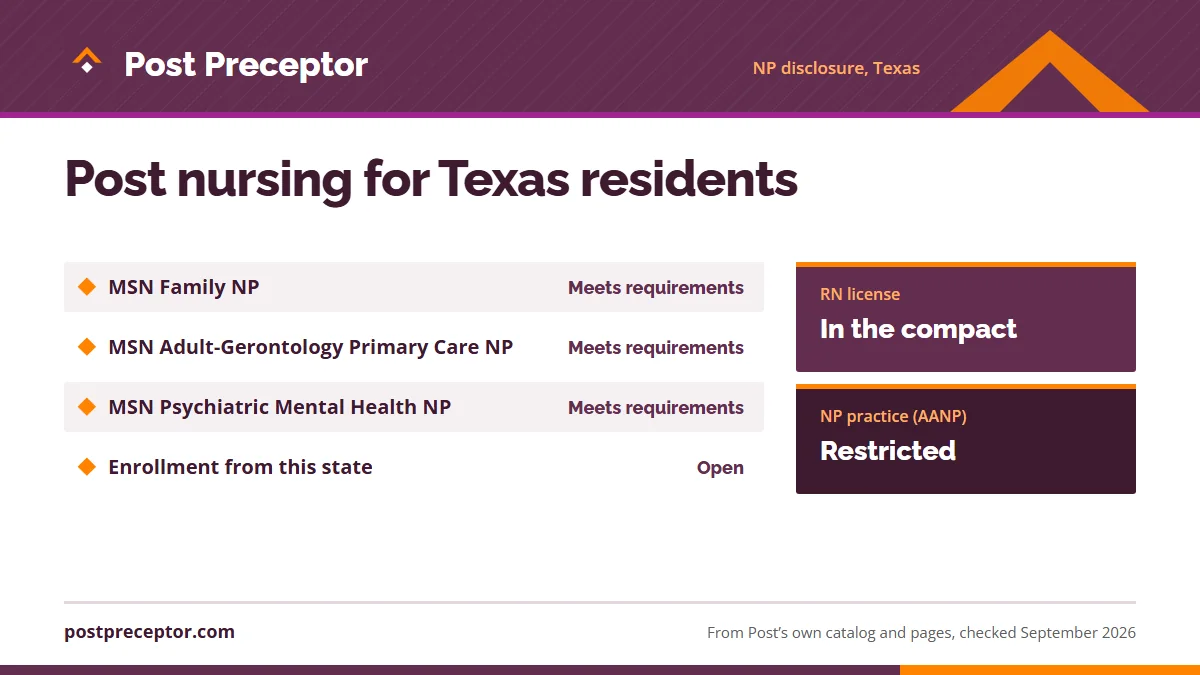
Texans can study any of Post University's three nurse practitioner specializations: the current NP disclosure marks the FNP, AGPCNP and PMHNP Yes for Texas. Texas scrutinizes outside nursing schools, but mainly pre-licensure ones, so for a Post NP student the working rules are Post's own, inside a restricted-practice state with four huge metros.
Get your placement plan
Tell us your Post program and where you live. A placement advisor replies with the preceptor and site options that fit your course.
Texas in Post's disclosure table
For Texas, Post's two questions, whether the coursework meets the license requirements and the prescribing ones, both come back Yes for all three MSN specializations.
| Post specialization or item | Post's answer for Texas |
|---|---|
| Family Nurse Practitioner | Yes |
| Adult Gerontology Primary Care Nurse Practitioner | Yes |
| Psychiatric Mental Health Nurse Practitioner | Yes |
| License title in Post's table | Certified Nurse Practitioner |
| Other requirements, license | Unencumbered, active Texas or multistate RN license; national NP certification; collaborative agreement with a physician |
| Other requirements, prescriptive authority | DEA number (optional) |
| Governing body | Texas Board of Nursing |
Post calls the DEA number optional for Texas and places the physician agreement under the license itself. Both belong to your first NP job rather than your clinicals; the rest of the table is decoded on the disclosure guide.
Which Texas board rules touch a Post NP student
The strictest ones do not: the research shows them aimed at schools that prepare a student for the NCLEX and a first license, while Post's NP tracks are post-licensure graduate programs.
| Texas source | Who it is written for | What it means for you |
|---|---|---|
| Education Guideline 3.1.3 (rev. May 1, 2026); 22 TAC 214.3(e) and 215.3(e) | Out-of-state vocational and professional RN programs (diploma, ADN, BSN, entry-level master's), which need board approval about four months before Texas clinicals, SARA or not | Not Post's MSN: graduate and post-licensure programs are outside this approval process |
| 22 TAC 219.10, APRN program standards | APRN programs seeking Texas approval; nationally accredited programs sit outside it | A useful picture: preceptors who are licensed APRNs or other licensed clinicians able to teach, and written program-preceptor-agency agreements |
| Nursing Practice Act, Sec. 301.004(a)(6) | Students of out-of-state programs the board has approved | You train under your own RN license in any case |
Post's MSN holds CCNE accreditation, and Post's own preceptor standard, preceptor agreement letter and affiliation agreement cover the ground those Texas standards describe. One Post caution still applies: its catalog mentions boards wanting a clinical plan up to 60 days early, and the Clinical Coordinator is the one to say whether Texas asks anything of you.
Finding a preceptor in a restricted-practice state
Texas NPs need a physician's delegation and supervision throughout their careers, spelled out in written protocols, and Schedule II prescribing depends on the practice setting; that is why AANP rates Texas restricted. Your future preceptors work inside that structure, and a physician (MD or DO) can precept a Post student too.
| Metro | Residents |
|---|---|
| Dallas-Fort Worth-Arlington | 8.48 million |
| Houston-Pasadena-The Woodlands | 7.90 million |
| San Antonio-New Braunfels | 2.81 million |
| Austin-Round Rock-San Marcos | 2.62 million |
Across those metros, systems NP students tend to size up include UT Southwestern Medical Center and Baylor Scott & White Health, while Houston Methodist, Texas Health Resources and University Health, San Antonio's system, fill out the usual list. They are reference points only, with separate student procedures and no Post tie. For FNP and AGPCNP hours, the primary care guide explains which clinics fit.
Texas preceptor incentives miss Post NP preceptors. A tuition exemption at public colleges exists for RN preceptors, but only those guiding undergraduates toward a first RN license, and the Nursing Shortage Reduction Program funds Texas schools' own programs rather than individual clinicians.
Your RN license and the Louisiana border
NCSBN lists Texas's compact start as January 19, 2018, so a Texas multistate license travels to other member states for RN work. The APRN Compact has not passed in Texas; your NP license, when it comes, will cover Texas alone.
East Texans should know that Louisiana is a No state for Post, closed to its clinicals whatever your multistate license allows you to do as an RN there. Oklahoma, Arkansas and New Mexico answer Yes, and hours there need Post's prior approval as out-of-state training. The full rule sits on the RN license page.
Why Texas Post students choose us
Whether you live in the Dallas-Fort Worth suburbs, greater Houston, around Austin and San Antonio, or in a rural county far from all four, we search family, internal medicine and adolescent primary care offices for FNP and AGPCNP students and mental health settings for PMHNP students, confirm each against Post's rules, and hand the Clinical Coordinator a complete package, with the preceptor's credentials, the signed letter and the affiliation request all accounted for. Your Week 1 packet is ready on time, and if a preceptor drops, we replace them. Start here.
Questions Post students ask
Must Post get Texas board approval before I start clinicals there?
Based on the research, no board approval step applies to Post's NP clinicals. Texas's four-month approval process for outside schools targets schools whose graduates sit for a first RN license, and graduate APRN programs fall outside it. Post's own rules still apply in full, and the Clinical Coordinator can confirm whether any Texas notice applies to your term.
Will precepting me earn my Texas preceptor the state tuition exemption?
No. The exemption, set in the Texas Education Code, rewards Texas-resident RNs who guide undergraduates in public programs toward first RN licensure. Precepting a graduate NP student from a program based in another state, such as Post's, does not qualify. Preceptors for Post volunteer their time, which is why a well-prepared, easy request matters.
Is Post's AGPCNP a good fit for Texas students?
It is open to Texas residents, with 540 precepted hours, all in primary care with adolescents through older adults, including the aging-focused N 585. Internal medicine and geriatric primary care practices in any of the big metros are natural places to look, and every class runs online with no trip to Waterbury.
Can I do clinicals in Louisiana if I live in East Texas?
No. Louisiana is among the seven states where Post's table answers No twice and where Post does not recruit NP students, which also takes it off the list of places you may train. Keep your search in Texas, or try Oklahoma or Arkansas, both Yes states, after Post grants prior specialization approval.
Related pages
Last checked 2026-09-27
We check these pages against Post University's own catalog, program pages and published nursing documents. Your course faculty and the Clinical Coordinator have the final word.
Post asks you to select your own preceptor. We make the search the easy part.
Tell us your Post track, your city and your next preceptorship course. We line up preceptors who fit the course, collect the license report, certification and CV the Clinical Coordinator reviews, and start the affiliation agreement early so your Week 1 packet is complete before the term opens.
- Preceptors matched to the course: primary care for FNP and AGPCNP, mental and behavioral health for PMHNP, doctoral nurse leaders for DNP hours
- Preceptor agreement letter, license report, certification and CV ready for Post's approval
- Every preceptorship planned together, close to home in a state where you hold your license and Post's disclosure says yes
Start your placement plan
Track, city and next preceptorship course is all we need to begin.