Post University NP clinicals in Hawaii: island searches, a Hawaii license and the preceptor tax credit
Every Post University NP track is open from Hawaii. The FNP, AGPCNP and PMHNP all carry a Yes in Post's current NP disclosure, so a Hawaii RN can finish any of them online and complete every precepted hour on the islands. Two local facts shape the plan. Your RN license has to come from Hawaii's own board, with no compact option, and Hawaii's tax credit for preceptors is tied to local programs, so it stays behind when the student is from Post.
Get your placement plan
Tell us your Post program and where you live. A placement advisor replies with the preceptor and site options that fit your course.
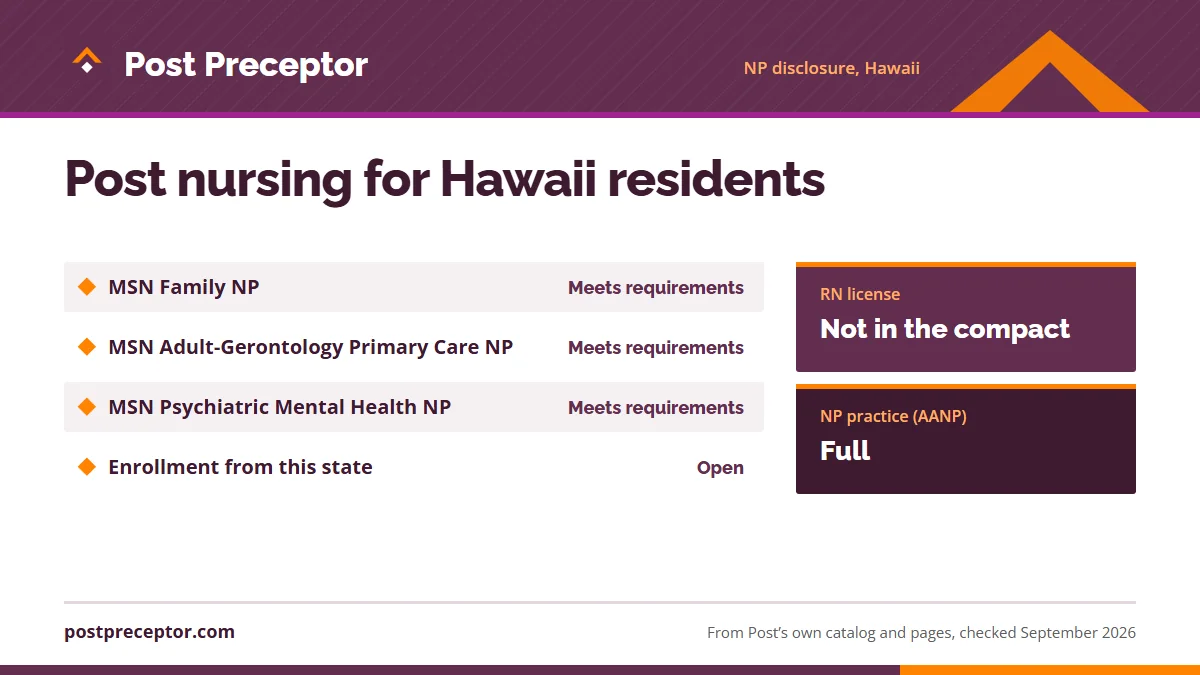
Hawaii's row in Post's disclosure
| Post specialization or column | Post's answer for Hawaii |
|---|---|
| MSN, Family Nurse Practitioner | Yes |
| MSN, Adult Gerontology Primary Care Nurse Practitioner | Yes |
| MSN, Psychiatric Mental Health Nurse Practitioner | Yes |
| License title | Nurse Practitioner |
| Other requirements Post lists | Unencumbered, active Hawaii RN license or a submitted Hawaii RN application; national NP certification; a DEA number, marked optional, for prescribing |
Post calls the governing body simply the Board of Nursing; in Hawaii it sits within DCCA's Professional and Vocational Licensing Division. The row carries no collaborative agreement, and AANP places Hawaii among the full practice states, so the NP role you are training for is an independent one.
How Hawaii's board treats schools based elsewhere
Hawaii's nursing law exempts student practice only for those in programs its own board has accredited (HRS 457-13(2)). The board's Education Committee took up a North Dakota BSN program's request in 2016 and decided that program could not bring a pre-licensure student to Hawaii for clinical work.
Already-licensed nurses studying at a distance are treated differently. A board FAQ covers post-licensure programs based on the mainland or online, naming LPN bridge study and the RN to BSN as its examples. For those, the board has no approval step and no application and expects no notice; faculty need a Hawaii license only for in-person teaching or precepting in the state. Graduate NP programs are never named, so have the Clinical Coordinator confirm Hawaii's position before your first clinical term. Post's catalog also cautions that certain boards expect a clinical plan as much as 60 days out (board notice guide).
The preceptor tax credit, and why it does not reach Post
The Healthcare Preceptor Income Tax Credit dates to 2018 (Act 43; HRS 235-110.25). It belongs to preceptors who reside in Hawaii and practice primary care there as a physician, pharmacist or APRN, taken against Hawaii income tax: one nonrefundable credit per qualifying volunteer rotation, up to a yearly limit. Rotations need certification from the state health department, and the statewide total is capped each year.
The limit that matters for you sits on the student side. According to the program's FAQ, an APRN student's rotation counts only if the student's program is accredited in Hawaii or physically there, and more than half of its students are Hawaii residents. Post, a Connecticut school, falls outside both tests, so the rotation with you earns your preceptor no credit. We say so at the first conversation, which keeps every request straightforward.
Searching Oahu, Maui and Hawaii Island
Urban Honolulu, with nearly a million residents, is the biggest search area by far; the Kahului-Wailuku area on Maui and Hawaii Island's Hilo-Kailua area come next. Systems students usually research include Hawaii Pacific Health (Straub is one of its hospitals), The Queen's Health Systems, Kaiser Permanente Hawaii, plus HHSC, the Hawaii Health Systems Corporation. They are reference points in a search that also runs through private primary care offices and community mental health programs.
Whoever precepts you still has to meet Post's standard, laid out in the preceptor requirements guide.
Licensing on the islands
NCSBN's list of compact jurisdictions leaves Hawaii off. A mainland multistate license does nothing for clinical work there; the RN license must come from Hawaii's own board. Post's rule, set out in the license rules for clinicals, also limits your hours to approved states that have licensed you. Hawaii has not enacted the APRN Compact.
Why Hawaii students choose us
At about 17 clinical hours a week for each 135-hour preceptorship, commuting between islands is rarely realistic, so we keep your search on the island where you live. FNP and AGPCNP students get primary care offices; PMHNP students get psychiatric and behavioral health placements for every age group, including the child and adolescent work N 563 covers.
Once a preceptor agrees, their credentials reach you in one bundle with the agreement letter already signed, and the affiliation agreement request is filed well before the term's first week. Start your Hawaii search.
Questions Post students ask
Can the person precepting me claim Hawaii's preceptor tax credit?
Not for your rotation, based on the program's FAQ. For APRN students the credit follows programs accredited or based in Hawaii where most students are residents. Post is based in Connecticut, so the rotation falls outside it, even if your preceptor also claims the credit for students from local programs.
Can I use my multistate RN license from another state for clinicals in Hawaii?
No. Compact licenses only work in member jurisdictions, and Hawaii is not one, so the RN license you train under must be issued by Hawaii. Post likewise keeps clinical hours inside states where you personally hold a license.
Does the Hawaii Board of Nursing have to approve Post's NP program?
For distance programs serving licensed nurses with no campus in the state, the board describes no approval process at all, but its examples are LPN bridge and RN to BSN programs rather than graduate NP study. Ask Post's Clinical Coordinator to confirm Hawaii's status for your clinical courses early, while you still have time to adjust.
Can I take Post's PMHNP from Hawaii?
Yes, the PMHNP appears on Hawaii's row with the other two tracks. Its five preceptorships add up to 630 hours in psychiatric and behavioral health settings, so on a smaller island it pays to line up candidates for every course before the first one begins.
Related pages
Last checked 2026-09-27
We check these pages against Post University's own catalog, program pages and published nursing documents. Your course faculty and the Clinical Coordinator have the final word.
Post asks you to select your own preceptor. We make the search the easy part.
Tell us your Post track, your city and your next preceptorship course. We line up preceptors who fit the course, collect the license report, certification and CV the Clinical Coordinator reviews, and start the affiliation agreement early so your Week 1 packet is complete before the term opens.
- Preceptors matched to the course: primary care for FNP and AGPCNP, mental and behavioral health for PMHNP, doctoral nurse leaders for DNP hours
- Preceptor agreement letter, license report, certification and CV ready for Post's approval
- Every preceptorship planned together, close to home in a state where you hold your license and Post's disclosure says yes
Start your placement plan
Track, city and next preceptorship course is all we need to begin.