Post University NP students in Wisconsin
Wisconsin gets a Yes for all three specializations in Post University's current NP disclosure. Two recent changes make Wisconsin worth a closer read: an APRN statute that went live in September 2026, and a board form, updated in April, for nursing schools based elsewhere. Both deserve a question to Post's Clinical Coordinator well before your first preceptorship.
Get your placement plan
Tell us your Post program and where you live. A placement advisor replies with the preceptor and site options that fit your course.
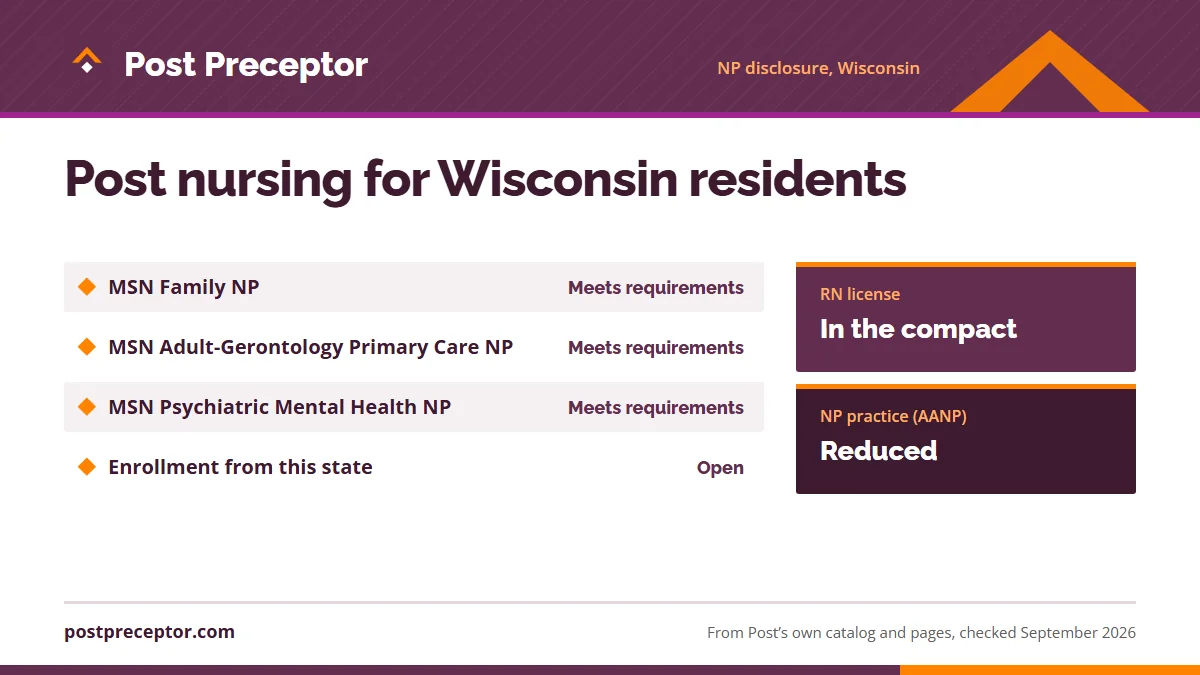
Wisconsin's row in Post's disclosure
Post lists the Wisconsin license as Nurse Practitioner, answers Yes on licensure and prescribing alike, and names every MSN track in the specialization cell.
| Post specialization | Post's answer for Wisconsin |
|---|---|
| MSN, Family Nurse Practitioner (FNP) | Yes |
| MSN, Adult Gerontology Primary Care Nurse Practitioner (AGPCNP) | Yes |
| MSN, Psychiatric Mental Health Nurse Practitioner (PMHNP) | Yes |
| License title in Post's table | Nurse Practitioner |
| Other requirements Post lists | Unencumbered, active Wisconsin or multistate RN license; national NP certification; the Wisconsin jurisprudence examination; collaborative agreement with a physician; DEA number optional for prescribing |
The jurisprudence examination is the Wisconsin extra most rows lack, and Post's disclosure says plainly that its programs do not prepare students for state law or ethics exams, so budget study time for it after graduation.
What the 2026 APRN law changes, and what it leaves alone
Under 2025 Wisconsin Act 17, in force since that September date, the state's licensing department (DSPS) issues APRN licenses by role, NP being one of four, and old APNP licenses have been converted. Independent practice, with no collaborating physician, is open to NPs who apply for it separately and win the board's sign-off. AANP's reduced-practice rating for the state now carries a note about the act.
Post's table reads as if written before the act: it calls the license Nurse Practitioner and lists a physician collaboration without the new independent route. Treat DSPS as the authority on the title and on collaboration, and confirm your own path with the board as graduation nears. The law changes what you apply for after you finish; your clinical courses, the 540 hours of the FNP or AGPCNP and the 630 of the PMHNP, run as before.
Board approval of out-of-state schools, and who may precept here
Wisconsin expects visiting schools to earn its approval. Its out-of-state program form, 3067-OEE (the version revised April 13, 2026), cites N 1.06, a rule in the state's nursing code, and applies it to graduate programs too, not only to associate and bachelor's ones; an approved school then files a self-evaluation (form 3069OEE) to stay approved. Our research could not show whether Post holds Wisconsin approval, so ask the Clinical Coordinator or Post's compliance officer before a Wisconsin site goes into your term plan.
Any faculty member or preceptor on a Wisconsin clinical, the form adds, must be licensed by Wisconsin or practicing on a compact privilege. Check that line in your preceptor's license report along with Post's own preceptor standard.
Students cluster around Milwaukee and Waukesha first, then Madison, with Green Bay and Appleton in the northeast. Among systems, you will hear about UW Health and Froedtert ThedaCare Health constantly. Aurora Health Care, today an Advocate Health system, is large too, and so are Aspirus Health and Ascension Wisconsin, and each sets its own terms for students.
A compact state with non-compact neighbors
Multistate licenses have been issued in Wisconsin since January 19, 2018; either a Wisconsin or a multistate license satisfies Post's row. The APRN Compact is not law here.
Now look at the map. Iowa is the only neighbor inside the compact; Minnesota, Illinois and Michigan are not. Some western Wisconsin counties belong to the Twin Cities and Duluth metros, and the southeast corner looks toward Chicago, yet a practice across any of those lines needs that state's own RN license, plus Post's prior approval for hours outside your home state. The Minnesota guide explains why a Minnesota site such as Mayo Clinic may ask for a Minnesota license.
Why Wisconsin students in Post's NP tracks choose us
Wisconsin adds questions to the plan, and we raise them at the start rather than in Week 1. We search near you, in Milwaukee, Madison, the Fox Valley or up north, confirm each preceptor's Wisconsin license or compact privilege, and get the agreement letter signed with the Week 1 packet in view. Send us your county and track.
Questions Post students ask
Does Wisconsin's new APRN law affect my Post clinical courses?
Not directly. Act 17 changes the license you apply for after graduation: DSPS now issues APRN licenses by role and offers independent practice through a separate, board-approved application. Your Post preceptorships still follow Post's rules on hours, settings and approvals. Because Post's table predates the change in places, check DSPS for the current title and collaboration terms.
Does Post need Wisconsin Board of Nursing approval before I train in Wisconsin?
Wisconsin's out-of-state program form calls for board approval, and graduate programs are included. Whether Post holds that approval did not appear in our research, so the Clinical Coordinator and Post's compliance officer are the ones to ask, ideally a full term before your first Wisconsin preceptorship.
What is the Wisconsin jurisprudence examination?
It is a state law exam that Post lists among Wisconsin's requirements outside education for NP licensure. Post's disclosure is clear that prep for jurisprudence, law and ethics exams sits outside its programs, so you study for it on your own. DSPS publishes the details and the current rules for taking it.
Can a western Wisconsin student train across the river in Minnesota?
Minnesota is a Yes state in Post's table, but it is outside the compact, and a multistate license issued by Wisconsin stops at the border. Post wants you licensed in every state where you train, and some Minnesota sites, Mayo Clinic among them, require a Minnesota license outright. Add Post's prior approval for hours outside your home state.
Related pages
Last checked 2026-09-27
We check these pages against Post University's own catalog, program pages and published nursing documents. Your course faculty and the Clinical Coordinator have the final word.
Post asks you to select your own preceptor. We make the search the easy part.
Tell us your Post track, your city and your next preceptorship course. We line up preceptors who fit the course, collect the license report, certification and CV the Clinical Coordinator reviews, and start the affiliation agreement early so your Week 1 packet is complete before the term opens.
- Preceptors matched to the course: primary care for FNP and AGPCNP, mental and behavioral health for PMHNP, doctoral nurse leaders for DNP hours
- Preceptor agreement letter, license report, certification and CV ready for Post's approval
- Every preceptorship planned together, close to home in a state where you hold your license and Post's disclosure says yes
Start your placement plan
Track, city and next preceptorship course is all we need to begin.