Post's RN to BSN has no preceptor to find; the RN to BSN/MSN does later
Post University's RN to BSN needs no preceptor and no CastleBranch account: its 90 to 100 practice hours come from practice learning experiences and simulation, with no precepted time at all. The RN to BSN/MSN opens the same way but requires a CastleBranch account, and its master's courses bring precepted practice experiences and sometimes an affiliation agreement. That later stretch is where our placement desk comes in.
Plan the MSN half early
Tell us your specialization and when your MSN courses begin.
RN to BSN: practice hours with nothing to arrange
Post's 2025-26 catalog is direct on this point: the RN to BSN requires neither a preceptor nor a CastleBranch account. Those 90 to 100 hours consist of practice learning experiences and simulations, and the post.edu page presents them as "Individualized Practice Experiences". That leaves your energy for the coursework itself.
Three BSN courses carry those hours. BSN 421PE Leadership and Strategic Planning carried 30 hours in its 2021-22 description and follows BSN 405, BSN 410 and BSN 415. BSN 432PE and BSN 437PE hold the rest; their descriptions were not among the sources we could read, so check your course pages for their hours and focus.
Simulation at the American Sentinel College of Nursing & Health Sciences at Post University runs on Sentinel U. For how practice learning, precepted practice and simulation differ, see the practice experiences guide.
Credits, formats and pace
The RN to BSN is 30 nursing credits inside a 120-credit degree, and up to 90 credits can transfer in. To enroll you need an active RN license and at least a 2.0 GPA from your prelicensure nursing program. Undergraduate nursing courses need a C+ (77%), and the BSN, like the MSN, is CCNE-accredited.
Two formats share the program: 8-week terms with monthly starts, and "RN to BSN Powered by SIMPath", Post's competency-based option. SIMPath semesters run 16 weeks, start monthly, allow courses to be added through week 12, and require you to join weekly faculty sessions to stay active.
Post advertises 12 to 24 months, or as little as 14 with a full 90 transfer credits, while the 2021-22 catalog put the term-based format at two years and the competency-based one at one. The spread comes from format and transfer credit, and undergraduates face no program time limit.
Still waiting to sit the NCLEX? Post's Early Admission lets associate-degree and diploma students within six months of graduation take BSN 405 and BSN 410, up to 6 credits, as non-degree students.
RN to BSN/MSN: the same start, a different finish
The dual degree runs 57 credits and 490 to 500 practice hours. Post advertises 24 to 42 months, and the 2024-25 catalog gave three years and six months for the term-based format and two years for competency-based. To move from the BSN courses into the MSN ones, you need a 3.0 GPA across the 21 BSN credits.
| Stage | Courses with practice hours | Preceptor |
|---|---|---|
| BSN courses | BSN 421PE, BSN 432PE, BSN 437PE | None |
| MSN core | N 501PE, N 522PE | Not on Post's preceptor list |
| MSN specialization | The specialization's practice courses | Yes, for courses on the preceptor list |
| Capstone | N 555PE | Yes |
N 522PE Advanced Physical Assessment lost its practice hours as of August 2024. The 490 to 500 total equals the RN to BSN's 90 to 100 plus the 400 that each non-NP MSN specialization counts, by our arithmetic, which suggests the dual degree finishes in one of those tracks; confirm your specialization options with admissions.
What changes when the master's courses begin
Three things matter once the MSN half begins. The first is CastleBranch, which Post requires of every RN to BSN/MSN student; have it in order before any precepted work, and see our CastleBranch guide for what it tracks. The second is preceptors: each course on Post's preceptor list needs a master's-prepared RN, or one with a doctorate, who works at the site. The third is an affiliation agreement, whenever the site asks for one.
Which courses need a preceptor depends on the specialization you choose, so read the guide for Nursing Education, for Leadership and Case Management, or for Informatics and Infection Prevention. Every one of those tracks finishes with N 555PE, a 130-hour capstone in the 2021-22 description.
The usual limits hold for every one of those courses: no preceptor who supervises you directly, is related to you or is studying in your program.
A dual-degree timeline, stage by stage
The RN to BSN/MSN rewards thinking one stage ahead. Here is a workable order, drawn from Post's program rules; your Student Success Advisor confirms the course sequence for your start date.
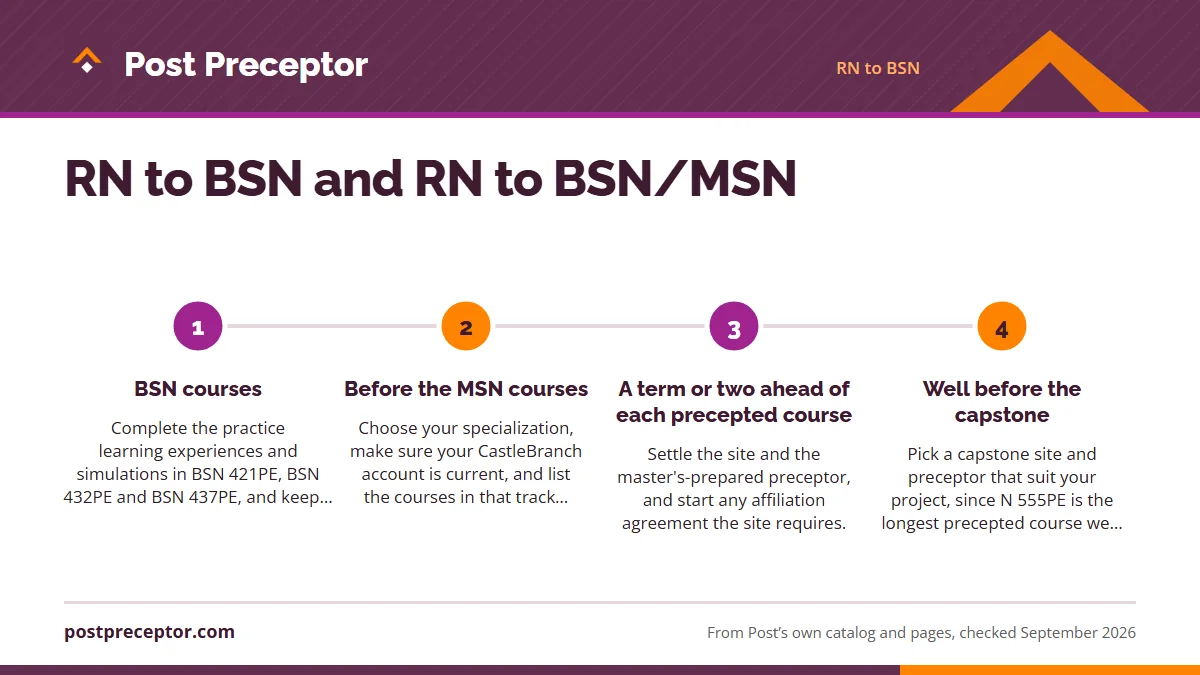
- BSN coursesComplete the practice learning experiences and simulations in
BSN 421PE,BSN 432PEandBSN 437PE, and keep your GPA at 3.0 or higher across the 21 BSN credits. - Before the MSN coursesChoose your specialization, make sure your CastleBranch account is current, and list the courses in that track that sit on Post's preceptor list.
- A term or two ahead of each precepted courseSettle the site and the master's-prepared preceptor, and start any affiliation agreement the site requires.
- Well before the capstonePick a capstone site and preceptor that suit your project, since
N 555PEis the longest precepted course we could verify.
Where our placement desk comes in
For the RN to BSN on its own, there is no preceptor to find, and your time goes to coursework and the practice hours Post builds into it. The RN to BSN/MSN changes partway through, and planning that change early makes the master's years far smoother.
Our desk starts the planning while you are still in the BSN courses. We map the precepted courses in your chosen specialization, find master's-prepared nurses employed at sites near you who suit each course, confirm degree and license against Post's rule, and request any affiliation agreement the site requires as soon as it agrees. We line up the capstone preceptor well before N 555PE, and if a preceptor drops out partway through a course, we go straight to finding the next one.
Every approval belongs to Post's coordinators, and we make sure they receive a finished, rule-ready file on the first pass. Start with how it works, then fill in the form below.
If a nurse practitioner track comes next
Some RN to BSN graduates move on to Post's MSN nurse practitioner specializations, which run very differently. To be admitted you need a 3.0 GPA in your BSN or MSN, a year of full-time clinical nursing as an RN within the past three years, residence and an RN license in a state Post approves for NP study, and passing results in the 3P courses and on the APEA 3P exam.
From there, each preceptorship course needs a site and preceptor you select and the Clinical Coordinator approves, and a document packet must be complete by the close of Week 1. Start with our NP tracks comparison and the 3P exam guide.
Questions Post students ask
Does Post's RN to BSN include clinicals?
It includes practice hours, not clinical rotations. The 90 to 100 hours are practice learning experiences and simulation with nothing precepted, so there is no preceptor or clinical site to arrange. Post's catalog describes practice experiences as different from the clinical rotations of pre-licensure RN programs.
Do RN to BSN students need CastleBranch at Post?
No. Post's catalog says RN to BSN students need neither a preceptor nor a CastleBranch account. Dual-degree students do need it, as do Post's MSN and DNP students, so choosing the RN to BSN/MSN brings a CastleBranch account with it.
How long does Post's RN to BSN take?
Post advertises 12 to 24 months, and as little as 14 months if you transfer in the full 90 credits. The 2021-22 catalog gave two years for the term-based format and one year for the competency-based SIMPath format. Undergraduate students have no program time limit.
Can I start Post's RN to BSN before passing the NCLEX?
Partly. Early Admission lets associate-degree or diploma students within six months of graduation who have not yet taken the NCLEX enroll in BSN 405 and BSN 410 as non-degree students, up to 6 credits. Full admission to the RN to BSN requires an RN license.
What GPA do I need to move into the MSN courses?
A 3.0 GPA across the 21 BSN credits that come before the master's courses in the RN to BSN/MSN. Admission to the dual degree itself asks for a 2.0 GPA from your prelicensure program. After that, the bar in each master's-level nursing course rises to a B (83%).
Related pages
Last checked 2026-09-27
We check these pages against Post University's own catalog, program pages and published nursing documents. Your course faculty and the Clinical Coordinator have the final word.
Post asks you to select your own preceptor. We make the search the easy part.
Tell us your Post track, your city and your next preceptorship course. We line up preceptors who fit the course, collect the license report, certification and CV the Clinical Coordinator reviews, and start the affiliation agreement early so your Week 1 packet is complete before the term opens.
- Preceptors matched to the course: primary care for FNP and AGPCNP, mental and behavioral health for PMHNP, doctoral nurse leaders for DNP hours
- Preceptor agreement letter, license report, certification and CV ready for Post's approval
- Every preceptorship planned together, close to home in a state where you hold your license and Post's disclosure says yes
Start your placement plan
Track, city and next preceptorship course is all we need to begin.