A placement desk built for Post University nursing students
Post Preceptor finds preceptors and clinical sites for students in the American Sentinel College of Nursing & Health Sciences at Post University, and nobody else. We built every step around the way Post runs clinicals: the site and preceptor you select, the Clinical Coordinator's approval, the affiliation agreement, and a Week 1 packet that has to be complete before the term gets going.
Get your placement plan
Tell us your Post program and where you live. A placement advisor replies with the preceptor and site options that fit your course.
Why a service for one university
Post's catalog places the choice of clinical site and preceptor with each MSN nurse practitioner student, for every clinical experience, and the Clinical Coordinator approves both. Post's online tuition page says students who are struggling to find a preceptor may hire a company whose specialty is locating nearby clinical preceptors. That is the job we do, and we do it for Post students only.
Focusing on one school pays off in the details. Post names its documents and roles its own way, runs NP courses one at a time in 8-week terms, removes students from a clinical course when the Week 1 packet is short, and limits clinicals to states its NP disclosure approves. A search that ignores any of that produces a preceptor Post cannot use. Ours starts from those rules.
What we do for you
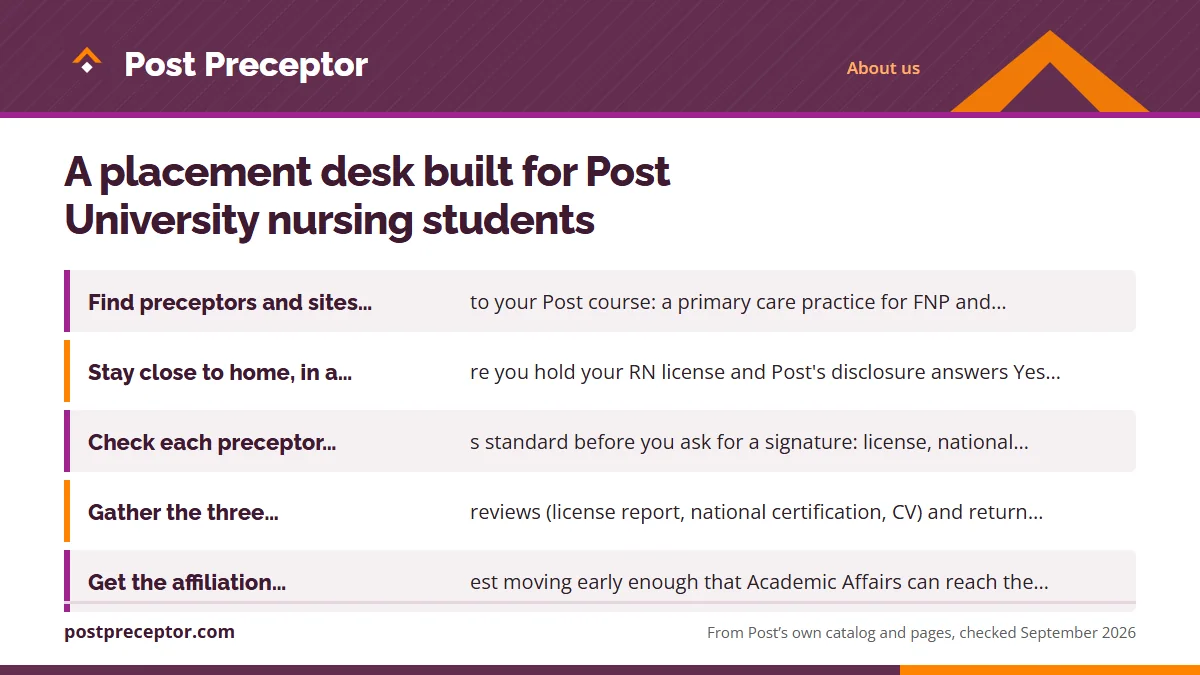
- Find preceptors and sites matched to your Post course: a primary care practice for FNP and AGPCNP, a psychiatric or behavioral health setting for PMHNP, a nurse leader with a doctorate for DNP practice hours, and a master's-prepared nurse employed at the site for non-NP MSN practice experiences.
- Stay close to home, in a state where you hold your RN license and Post's disclosure answers Yes for your specialization.
- Check each preceptor against Post's standard before you ask for a signature: license, national certification, degree, experience, and the relationships Post rules out.
- Gather the three credentials Post reviews (license report, national certification, CV) and return a signed preceptor agreement letter.
- Get the affiliation agreement request moving early enough that Academic Affairs can reach the site long before Week 1.
- Plan every preceptorship in your track together, not one term at a time.
- Stay on call through each term, ready with a new preceptor if yours cannot continue.
For the order of steps, see how it works.
How we work with Post's process
Post's Clinical Coordinator approves every preceptor and every site, and that approval stays exactly where Post puts it. Our part is everything that comes before it: finding the right clinician, confirming the fit, and assembling the documents so that what reaches the Coordinator is complete and matches Post's rules the first time. You submit your packet through Post's channels, and the tracking system, CastleBranch and your course faculty work as they always do.
We speak about Post's staff and systems with respect, because the process works. The catalog's clinical rules are clear, the Affiliation Agreement Tracker is simple, and Academic Affairs contacts a site within seven business days of a request. What students lack is time to cold-call practices while working as RNs and studying. That is the gap we fill. The placement process guide lays out Post's full route.
Who we help
The bulk of our work is with students in Post's three MSN nurse practitioner specializations, including nurses who already hold an MSN and are earning a second one to become NPs, since Post's catalog lists no post-master's NP certificate. FNP and AGPCNP students complete 540 precepted clinical hours in primary care across four preceptorship courses; PMHNP students complete 630 hours across five, in psychiatric and behavioral health settings with patients of every age. Each preceptorship falls in its own 8-week term, so a single missing preceptor can hold up a whole plan.
We also help DNP students find doctoral-prepared nurse preceptors for their practice hours, and students in the Nursing Education, Case Management, Informatics, Infection Prevention and Control, and Management and Organizational Leadership specializations who need a preceptor for a precepted practice experience. The RN to BSN has no precepted hours; RN to BSN/MSN students come to us once their MSN precepted courses are near. Clinicians who want to teach a Post student can start on the preceptor page.
Our standards for accuracy
Each guide here is built from Post's own sources: the University Catalog, program and admissions pages on post.edu, the NP disclosure by state and other Post documents, with state boards and statutes covering licensing law. Each page names its sources at the bottom and shows when it was last reviewed. Post's rules are quoted exactly where we quote them.
Where Post's sources disagree, as with the two total-hour figures in the catalog or the monthly versus every-other-month NP course starts, we show both and name the office that can confirm. Where Post has not published an answer, we flag the gap and direct you to the Clinical Coordinator or the Student Success Advisor assigned to you. Health systems appear only through their own published student processes. The result is a site you can trust when a term is on the line.
Your information
A search needs only a few facts to begin: your Post track, the code of your next preceptorship course, your town and the start month. Documents come later, once a preceptor has agreed. We use what you share to reply to you, arrange your placement and keep you updated on it. The privacy policy sets out the details, including how to have your details removed, and the terms describe the service.
Start with a conversation
The earlier we start, the more choice you have. A preceptor who is asked two terms ahead can plan a schedule around you; one asked in Week 1 often cannot. Tell us your track, your next course and where you live, and a placement advisor answers with a plan covering that course and the ones after it. Use the contact form, or see what shapes a quote first.
Questions Post students ask
Are you part of Post University?
We're an independent placement desk working on your side, the student's. Post's tuition page notes that students may contract with a company specializing in finding clinical preceptors, and that is the role we fill. Every preceptor and site we help you bring still goes through Post's Clinical Coordinator for approval.
Do you only work with nurse practitioner students?
NP students are most of our work, but we also help DNP students find doctoral-prepared nurse preceptors and non-NP MSN students find master's-prepared preceptors employed at the site. The RN to BSN itself calls for no preceptor, and RN to BSN/MSN students usually contact us as their MSN practice experiences approach.
Which states do you cover?
Every state where Post's NP disclosure answers Yes for your specialization and you hold an active RN license. That is all three tracks in 42 states, plus the FNP and AGPCNP in California. The DNP and non-NP MSN tracks have no state table, so we search wherever you live and work.
Who handles my placement?
Your placement advisor, backed by our placement desk. Your advisor learns your track, schedule and location, runs the search for each preceptorship, checks each preceptor against Post's standard, and stays in touch through the term so a problem is handled before it costs you hours.
Where do your guides get their facts?
From Post University's own catalog, program pages, admissions pages and NP disclosure, and from state boards, statutes and health systems' published student pages. Each guide shows its sources and its review date, and flags any place where Post's own documents disagree.
Related pages
Last checked 2026-09-27
We check these pages against Post University's own catalog, program pages and published nursing documents. Your course faculty and the Clinical Coordinator have the final word.
Post asks you to select your own preceptor. We make the search the easy part.
Tell us your Post track, your city and your next preceptorship course. We line up preceptors who fit the course, collect the license report, certification and CV the Clinical Coordinator reviews, and start the affiliation agreement early so your Week 1 packet is complete before the term opens.
- Preceptors matched to the course: primary care for FNP and AGPCNP, mental and behavioral health for PMHNP, doctoral nurse leaders for DNP hours
- Preceptor agreement letter, license report, certification and CV ready for Post's approval
- Every preceptorship planned together, close to home in a state where you hold your license and Post's disclosure says yes
Start your placement plan
Track, city and next preceptorship course is all we need to begin.